Open Access Publisher and Free Library
HUMAN RIGHTS.jpeg

HUMAN RIGHTS

Human Rights-Migration-Trafficking-Slavery-History-Memoirs-Philosophy

Posts tagged race and crime
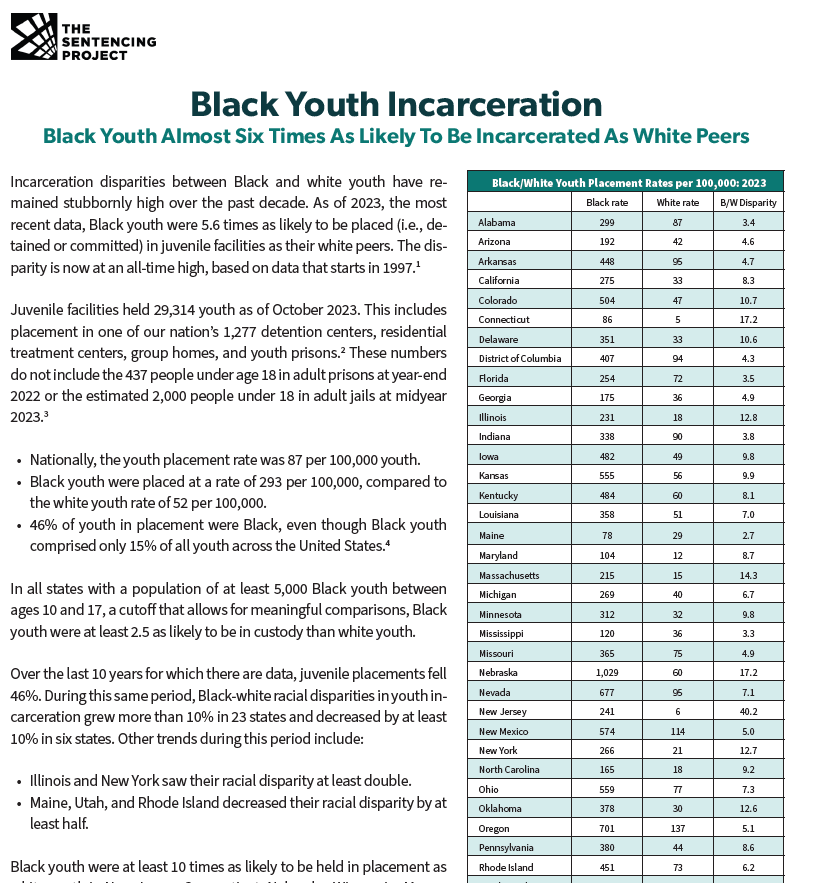
Black Youth Incarceration. Black Youth Almost Six Times As Likely To Be Incarcerated As White Peers

By Josh Rovner

  Incarceration disparities between Black and white youth have remained stubbornly high over the past decade. As of 2023, the most recent data, Black youth were 5.6 times as likely to be placed (i.e., detained or committed) in juvenile facilities as their white peers. The disparity is now at an all-time high, based on data that starts in 1997. Juvenile facilities held 29,314 youth as of October 2023. This includes placement in one of our nation’s 1,277 detention centers, residential treatment centers, group homes, and youth prisons. These numbers do not include the 437 people under age 18 in adult prisons at year-end 2022 or the estimated 2,000 people under 18 in adult jails at midyear 2023. • Nationally, the youth placement rate was 87 per 100,000 youth. • Black youth were placed at a rate of 293 per 100,000, compared to the white youth rate of 52 per 100,000. • 46% of youth in placement were Black, even though Black youth comprised only 15% of all youth across the United States. In all states with a population of at least 5,000 Black youth between ages 10 and 17, a cutoff that allows for meaningful comparisons, Black youth were at least 2.5 as likely to be in custody than white youth. 

Washington, DC: The Sentencing Project, 2025. 3p.

Race talk: Languages of racism and resistance in Neapolitan street markets

By Antonia Lucia Dawes

Race talk is about language use as an anti-racist practice in multicultural city spaces. The book contends that attention to talk reveals the relations of domination and subordination in heterogeneous, ethnically diverse and multilingual contexts, while also helping us to understand how transcultural solidarity might be expressed. Drawing on original ethnographic research conducted on licensed and unlicensed market stalls in heterogeneous, ethnically diverse and multilingual contexts, this book examines the centrality of multilingual talk to everyday struggles about difference, positionality and entitlement. In these street markets, Neapolitan street vendors work alongside documented and undocumented migrants from Bangladesh, China, Guinea Conakry, Mali, Nigeria and Senegal as part of an ambivalent, cooperative and unequal quest to survive and prosper. As austerity, anti-immigration politics and urban regeneration projects encroached upon the possibilities of street vending, talk across linguistic, cultural, national and religious boundaries underpinned the collective action of street vendors struggling to keep their markets open. The edginess of their multilingual organisation offered useful insights into the kinds of imaginaries that will be needed to overcome the politics of borders, nationalism and radical incommunicability.

Manchester, UK: Manchester University Press, 2020.