Open Access Publisher and Free Library
HUMAN RIGHTS.jpeg

HUMAN RIGHTS

Human Rights-Migration-Trafficking-Slavery-History-Memoirs-Philosophy

Posts tagged research
Zeal Spillovers: The Adversarial Bias in Simulated Pre-Trial Decision Making

By Dan Simon,David E. Melnikoff


The adversarial legal procedure is one of the defining characteristics of Anglo-American law. Adversarialism is lauded for its capacity to discover the factual truth, which is said to be revealed by the clash between zealous advocates. This study further explores the proposition that adversarial contests trigger a bias that pervades adversarial actors’ judgments, beliefs, motivations, and emotions, and thus skews how they perceive and approach their cases. Specifically, we set out to extend prior research by testing whether the adversarial bias could spill over to skew simulated pre-trail prosecutorial tasks: the decision to seek an indictment and forming judgments in advance of the plea negotiation. In a simulation with lay people, we find that the adversarial bias does indeed skew pre-trial decisions. This result is troubling because the epistemic justification of adversarialism has little to contribute to these decisions, as indictment decisions are made unilaterally by prosecutors, and plea negotiations take place under heavily lopsided power and access to information. It follows that while adversarial zeal has little to contribute to pre-trial decisions, it can readily infest them with zeal. While ecological validity considerations abound, this study demonstrates the psychological plausibility that the adversarial bias results in heightened levels of indictment and stiffer punishments, thus highlighting prosecutors’ potential contribution to the exceptionally high rate of people sent to prison in the US.


Journal of Law & Empirical AnalysisVolume 1, Issue 2, December 2024, Pages 326-342


The Efficacy of Nutritional Interventions in Reducing Childhood/Youth Aggressive and Antisocial Behavior: A Mixed-Methods Systematic Review and Meta-Analysis

By Barna Konkolÿ Thege, Chaz Robitaille, Lujayn Mahmoud, Eden A. Kinzel, Rameen Qamar, Jamie Hartmann-Boyce, Olivia Choy

Aggressive/antisocial behaviors in children and youth may result in impairments in family, social, or academic functioning and lead to long‐term negative consequences for both the individual and society as a whole. The potential of healthy diet and nutritional supplements to reduce aggression and antisocial behavior is an active area of study in nutritional mental health sciences. The goal of this systematic review is to (1) investigate the effectiveness/efficacy of nutritional interventions(dietary manipulation, fortification or supplementation) in reducing excessive aggression, antisocial behaviors, and criminal offending in children/youth (systematic review and meta‐analysis); and (2) provide an overview of implementation barriers and facilitators regarding nutritional interventions in children/youth (qualitative/narrative synthesis). After consulting theCampbell Collaboration's methodological guidelines, a comprehensive search for published and unpublished papers on controlled intervention studies was performed (up to February 26, 2024) using both electronic databases (MEDLINE,Embase, Cochrane Library, APA PsycInfo, Scopus, and the Allied and Complementary Medicine Database) and other resources (e.g., Google Scholar, reference list of included studies and other reviews, websites of public health agencies). This study focuses on children and youth (up to the age of 24) presenting with an above‐average level of aggression/antisocial behavior. In terms of the intervention, we considered both dietary manipulation and nutritional supplementation with aduration long enough (minimum of 1 week) that a significant change in the individual's nutritional status could be expected.We included studies with a controlled design if, for outcomes, they reported on (1) behavioral‐level violence/aggression toward others in real‐life (non‐simulated) settings, (2) antisocial behaviors, or (3) criminal offending. Initial screening,checking for eligibility criteria, data extraction from, and risk of bias assessment for each eligible study were conducted independently by two reviewers. To perform the meta‐analysis, data from each original report were standardized(transformed into Hedges' g) so that results across studies could be meaningfully combined and interpreted. Data con-versions, computation of pooled effect sizes, and estimation of publication bias were conducted using the ComprehensiveMeta‐analysis software (Version 4). Altogether, 51 reports (describing 50 individual studies) met our inclusion criteria, and72 effect sizes were extracted from these reports. Nutritional interventions with a broad target (e.g., broad‐spectrummicronutrient supplementation or general improvement in diet quality) had the most consistent and largest intervention

Campbell Systematic ReviewsVolume 21, Issue 3Sep 2025

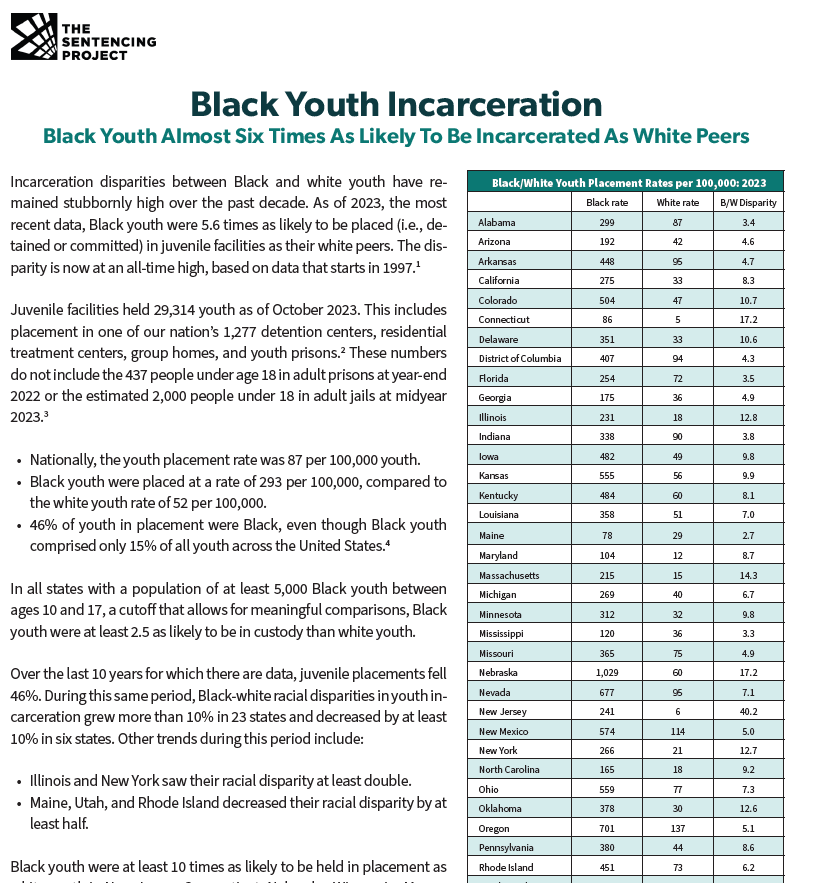
Black Youth Incarceration. Black Youth Almost Six Times As Likely To Be Incarcerated As White Peers

By Josh Rovner

  Incarceration disparities between Black and white youth have remained stubbornly high over the past decade. As of 2023, the most recent data, Black youth were 5.6 times as likely to be placed (i.e., detained or committed) in juvenile facilities as their white peers. The disparity is now at an all-time high, based on data that starts in 1997. Juvenile facilities held 29,314 youth as of October 2023. This includes placement in one of our nation’s 1,277 detention centers, residential treatment centers, group homes, and youth prisons. These numbers do not include the 437 people under age 18 in adult prisons at year-end 2022 or the estimated 2,000 people under 18 in adult jails at midyear 2023. • Nationally, the youth placement rate was 87 per 100,000 youth. • Black youth were placed at a rate of 293 per 100,000, compared to the white youth rate of 52 per 100,000. • 46% of youth in placement were Black, even though Black youth comprised only 15% of all youth across the United States. In all states with a population of at least 5,000 Black youth between ages 10 and 17, a cutoff that allows for meaningful comparisons, Black youth were at least 2.5 as likely to be in custody than white youth. 

Washington, DC: The Sentencing Project, 2025. 3p.

ONLINE KNOWLEDGE AND PRACTICE OF PARENTS AND CHILDREN IN INDONESIA

By Karen Muller,  Astrid Gonzaga Dionisio, Sanghyun Park

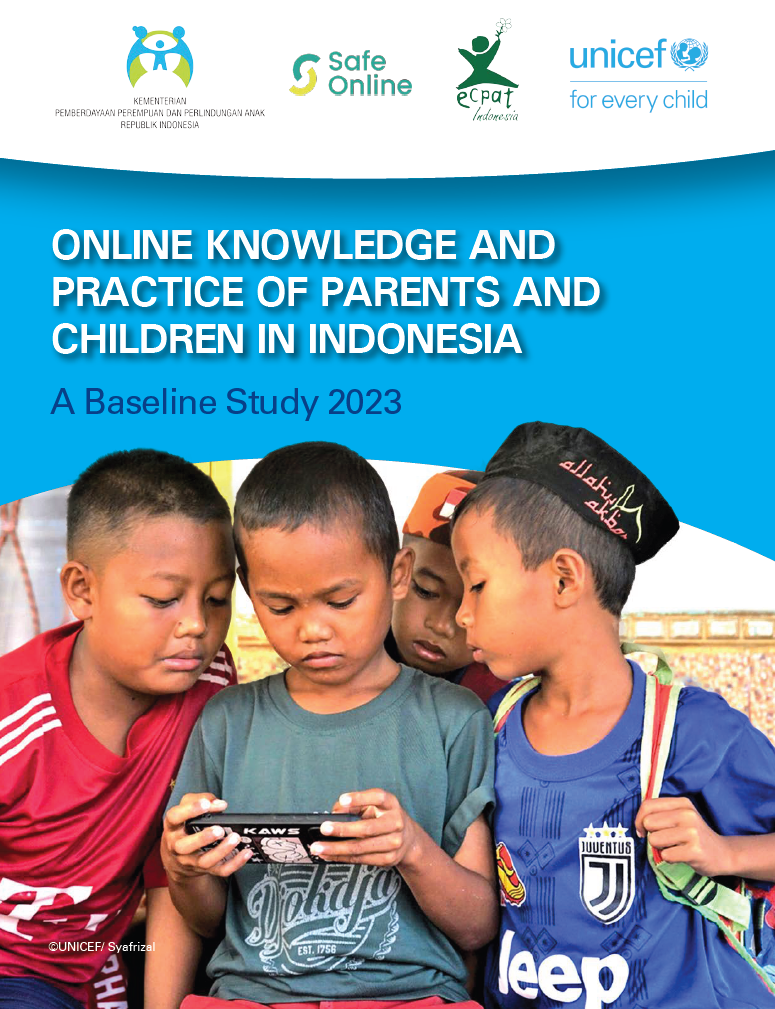
The “Online Knowledge and Practice of Children and Parents in Indonesia: Baseline Study 2023” highlights that most children in Indonesia use the internet daily, primarily for socializing and entertainment. However, they face significant risks, including exposure to inappropriate content, cyberbullying, and online sexual exploitation and abuse. The study reveals that many children and parents lack adequate online safety education, with only 37.5% of children having received information on how to stay safe online. Additionally, 42% of children have felt uncomfortable or scared due to online experiences, and 50.3% have seen sexual images on social media.UNICEF Indonesia is actively addressing these issues by supporting the government in strengthening the legal framework for child online protection and enhancing integrated services for victim support. UNICEF empowers children, parents, and teachers to promote safe online behavior and strengthen law enforcement capabilities to detect, investigate, and prosecute cases of online child exploitation. UNICEF also focuses on generating evidence to inform policies and practices, aiming to create a safer online environment for children in Indonesia. Their efforts include co-creating campaigns with children and youth to raise awareness about online risks and engaging with businesses to promote responsible conduct for the rights and well-being of children, 202

England and Slavery

By C.M. Macinnes

The document provides a detailed history of England’s involvement in the slave trade, focusing on the pre-Emancipation period. It covers various aspects such as the rise of the slave trade, the organization and purchase of slaves, the Middle Passage, and the abolition movement. The book is based on unpublished materials and rare books from the 18th and early 19th centuries. The author expresses gratitude to several individuals and institutions for their assistance in the research and publication of the book.

J. W. ARROWSMITH LTD, 1934