
Open Access Publisher and Free Library
HUMAN RIGHTS.jpeg

HUMAN RIGHTS

Human Rights-Migration-Trafficking-Slavery-History-Memoirs-Philosophy

Posts tagged technology and policing
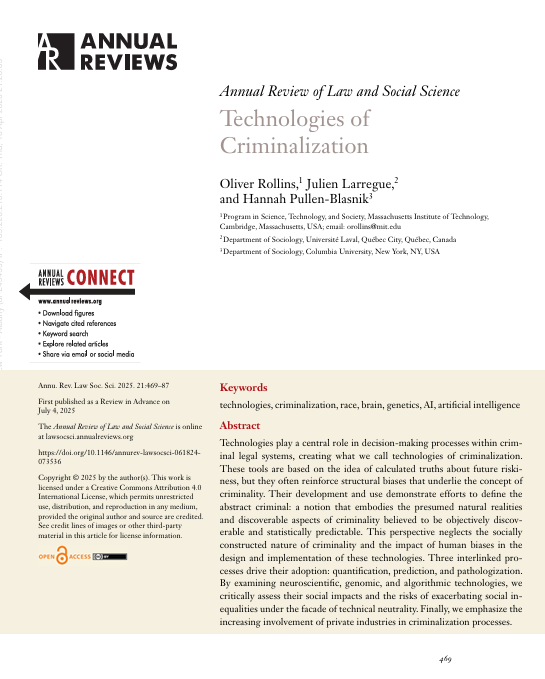
Technologies of Criminalization

By Oliver Rollins, Julien Larregue, and Hannah Pullen-Blasnik

Technologies play a central role in decision-making processes within criminal legal systems, creating what we call technologies of criminalization. These tools are based on the idea of calculated truths about future riskiness, but they often reinforce structural biases that underlie the concept of criminality. Their development and use demonstrate efforts to define the abstract criminal: a notion that embodies the presumed natural realities and discoverable aspects of criminality believed to be objectively discoverable and statistically predictable. This perspective neglects the socially constructed nature of criminality and the impact of human biases in the design and implementation of these technologies. Three interlinked processes drive their adoption: quantification, prediction, and pathologization. By examining neuroscientific, genomic, and algorithmic technologies, we critically assess their social impacts and the risks of exacerbating social inequalities under the facade of technical neutrality. Finally, we emphasize the increasing involvement of private industries in criminalization processes.

Annu. Rev. Law Soc. Sci. 2025. 21:469–87

Pregnancy Panopticon: Abortion Surveillance After Roe

By Albert Fox Cahn, ESQ. and Eleni Manis, PHD, MPA

Abortion rights will soon be a thing of the past for millions of Americans. At the time of publication, a leaked Supreme Court draft opinion shows a majority of justices are poised to strike down Roe v. Wade, Planned Parenthood v. Casey, and any federal constitutional right to abortion. But repealing a half century of reproductive rights won’t transport Americans back to 1973, it will take us to a far darker future, one where antiquated abortion laws are enforced with cutting edge technology. Sweeping abortion laws are already on the books in many states, primed to go into effect the moment the Supreme Court’s decision is published. But those sprawling bans won’t enforce themselves. Police, prosecutors, and private anti-abortion litigants will weaponize existing American surveillance infrastructure to target pregnant people and use their health data against them in a court of law. This isn’t speculation—it’s already happening. Abortion opponents surveil pregnant people and abortion providers to chill their reproductive freedoms.1 Hospitals track pregnant patients with suspicionless drug testing, 2 while police harness surveillance to enforce existing abortion laws. Nearly every aspect of pregnant peoples’ online lives is already targeted—including search histories, online purchases, and messages—while cellphone location data is used to track their movements in physical space. 3 If this is the state of surveillance today, in an America with abortion rights, what surveillance will we see in a post-Roe future?