Open Access Publisher and Free Library
HUMAN RIGHTS.jpeg

HUMAN RIGHTS

Human Rights-Migration-Trafficking-Slavery-History-Memoirs-Philosophy

Posts in Diversity
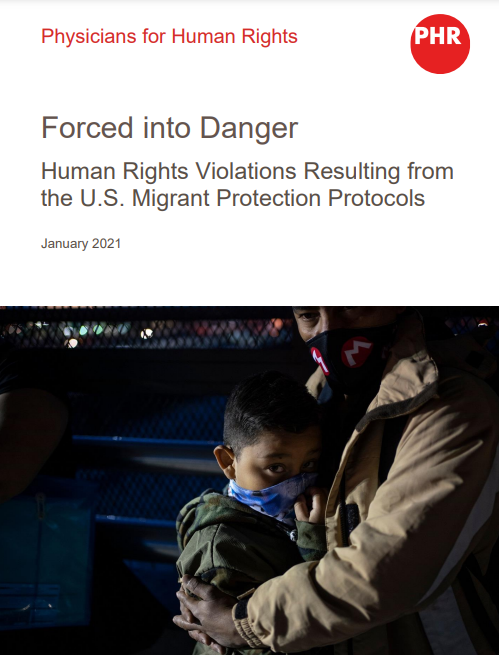
Forced into Danger: Human Rights Violations Resulting from the U.S. Migrant Protection Protocols

by Kathryn Hampton et al

For the last two years, the Trump administration’s Migrant Protection Protocols (MPP), or “Remain in Mexico” policy, have forced almost 70,000 people seeking asylum in the United States to wait in dangerous Mexican border towns while their cases pend – in violation of U.S. and international law, which prohibits returning asylum seekers to places where they fear that they may be persecuted. With the indefinite postponement of immigration hearings due to COVID-19, asylum seekers in MPP face ever-lengthening periods of stay in Mexico, where many have experienced violence, trauma, and human rights abuses.

Since the start of MPP, Physicians for Human Rights (PHR) has responded to more than 100 requests by attorneys for pro bono forensic evaluations of asylum seekers enrolled in the program, most in support of asylum claims and a few in support of requests for MPP exemption due to health issues. To quantify the extent of reported health and human rights violations affecting asylum seekers in MPP, PHR partnered with the University of Southern California’s Keck Human Rights Clinic (KHRC) to review 95 deidentified affidavits based on forensic evaluations of asylum seekers from Central and South America ranging in age from 4 to 67 years. We found that at least 11 people belonged to categories that should have been exempt from MPP enrollment.  Although most affidavits focused on the harms migrants fled in their home countries, most documented compounding harms to the migrants after they were returned to Mexico under MPP, including physical violence, sexual violence, kidnapping, theft, extortion, threats, and harm to family members. The affidavits also reported unsanitary and unsafe living conditions, poor access to services, family separations, and poor treatment in U.S. immigration detention. Nearly all of those evaluated were diagnosed with post-traumatic stress disorder, and many exhibited other debilitating psychological conditions or symptoms.

This study adds to the considerable evidence that it is not safe for migrants to remain in Mexico while their U.S. asylum cases are pending, and forcing them to do so violates U.S. and international law. The incoming Biden administration should immediately admit all people enrolled in MPP into community settings in the United States, rescind MPP, and initiate an investigation to determine appropriate redress for people harmed by this policy.

New York: Physicians for Human Rights, 

2021. 21p.

Download
AI Executive Order and Considerations for Federal Privacy Policy [January 25, 2024]

STUESSY, MEGHAN M.

The passage that follows includes several links embedded in the original text. From the document: "On October 30, 2023, President Biden issued Executive Order (E.O.) 14110 on 'Safe, Secure, and Trustworthy Development and Use of Artificial Intelligence.' This E.O. advances a coordinated approach to the responsible development and use of artificial intelligence (AI) and directs agencies to mitigate privacy risks and bias potentially exacerbated by AI, including 'by AI's facilitation of the collection or use of information about individuals, or the making of inferences about individuals.' [...] The E.O. focuses on three priorities relating to privacy: 1. Identifying and evaluating agency use of commercially available information (CAI); 2. Revising existing privacy requirements for the adoption of AI, including privacy impact assessments (PIAs); and 3. Encouraging agency use of PETs [privacy-enhancing technologies]."

LIBRARY OF CONGRESS. CONGRESSIONAL RESEARCH SERVICE. 2024.

download
Unilateral Sanctions in International Law and the Enforcement of Human Rights: The Impact of the Principle of Common Concern of Humankind

By Iryna Bogdanova

Are unilateral economic sanctions legal under public international law? How do they relate to the existing international legal principles and norms? Can unilateral economic sanctions imposed to redress grave human rights violations be subjected to the same legal contestations as other unilateral sanctions? What potential contribution can the recently formulated doctrine of Common Concern of Humankind make by introducing substantive and procedural prerequisites to legitimize unilateral human rights sanctions? Unilateral Sanctions in International Law and the Enforcement of Human Rights by Iryna Bogdanova addresses these complex questions while taking account of the burgeoning state practice of employing unilateral economic sanctions.

Leiden; Boston: Brill, 2022. 378p.

Download
Bridge over troubled waters: Migration governance and rule of law in Kenya and Ethiopia

By Margaret Monyani, Adamnesh Bogale and Ottilia Anna Maunganidze

Robust legal frameworks and migration management measures in Ethiopia and Kenya give these countries a strong basis for effective migration governance consistent with the rule of law. However, some policy improvements are needed, along with more consistent implementation and better protection of migrants’ rights. Filling these gaps is vital if Ethiopia and Kenya are to advance their role in continental migration governance.

Key findings : The Horn of Africa is a key source, transit and destination region for migrants. National, regional, continental and international multilateral processes to improve migration governance are in place in the region. Countries like Ethiopia and Kenya have developed frameworks to address evolving dynamics, aimed at enhancing legal migration pathways, responding to forced displacement, stimulating regional integration, and tackling the smuggling and trafficking of persons. In Ethiopia and Kenya, policies and practices are informed by regional and global mixed migration trends. While migration governance frameworks in Ethiopia and Kenya are fairly robust and factor in the rule of law, there are weaknesses that need to be addressed. These include gaps in practical migration governance and the inconsistent application of the rule of law. Migration governance should be factored across various government departments in a consistent and coherent manner. For good migration governance to enhance development and growth, gaps in policies and practices must be dealt with. 

Recommendations : The governments of Ethiopia and Kenya should: Review existing migration policies to identify inconsistencies with rule of law principles. Harmonise migration policies in line with international and continental standards and ensure the protection of migrants’ rights. Regularly evaluate the impact of policies and programmes to identify areas for improvement. Encourage community participation in migration-related initiatives to foster shared responsibility and ownership, including through awareness-raising campaigns. Invest in strengthening the capacity of law enforcement agencies and other stakeholders involved in managing migration, focusing on skills and knowledge of migration laws. Engage the private sector in migration governance, particularly regarding labour migration and migrant integration. While migration governance frameworks in Ethiopia and Kenya are fairly robust and factor in the rule of law, there are weaknesses that need to be addressed. These include gaps in practical migration governance and the inconsistent application of the rule of law. Migration governance should be factored across various government departments in a consistent and coherent manner.

EAST AFRICA REPORT 51 |  Pretoria: Institute for Security Studies, 2024. 23p.

Download
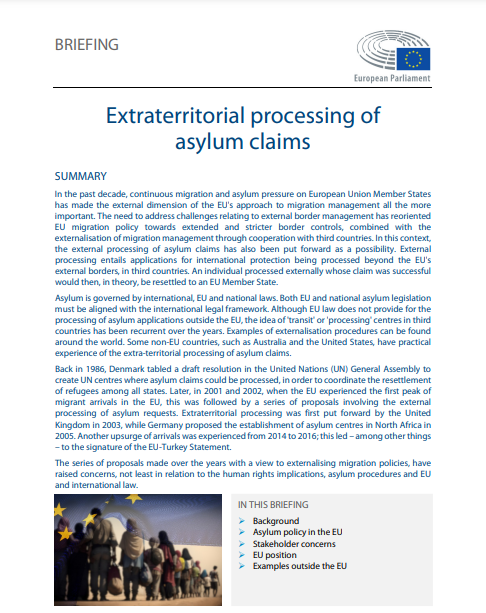
Extraterritorial processing of asylum claims

By The European Parliament

In the past decade, continuous migration and asylum pressure on European Union Member States has made the external dimension of the EU's approach to migration management all the more important. The need to address challenges relating to external border management has reoriented EU migration policy towards extended and stricter border controls, combined with the externalisation of migration management through cooperation with third countries. In this context, the external processing of asylum claims has also been put forward as a possibility. External processing entails applications for international protection being processed beyond the EU's external borders, in third countries. An individual processed externally whose claim was successful would then, in theory, be resettled to an EU Member State. Asylum is governed by international, EU and national laws. Both EU and national asylum legislation must be aligned with the international legal framework. Although EU law does not provide for the processing of asylum applications outside the EU, the idea of 'transit' or 'processing' centres in third countries has been recurrent over the years. Examples of externalisation procedures can be found around the world. Some non-EU countries, such as Australia and the United States, have practical experience of the extra-territorial processing of asylum claims. Back in 1986, Denmark tabled a draft resolution in the United Nations (UN) General Assembly to create UN centres where asylum claims could be processed, in order to coordinate the resettlement of refugees among all states. Later, in 2001 and 2002, when the EU experienced the first peak of migrant arrivals in the EU, this was followed by a series of proposals involving the external processing of asylum requests. Extraterritorial processing was first put forward by the United Kingdom in 2003, while Germany proposed the establishment of asylum centres in North Africa in 2005. Another upsurge of arrivals was experienced from 2014 to 2016; this led – among other things – to the signature of the EU-Turkey Statement. The series of proposals made over the years with a view to externalising migration policies, have raised concerns, not least in relation to the human rights implications, asylum procedures and EU and international law.

Brussels, Belgium: European Parliament, 2024. 12p.

Download
Trajectories of Forced Migration: Central American Migrants on Their Way Toward the USA

By Ludger Pries, Oscar Calderón Morillón, and Brandon Amir Estrada Ceron

Mexico is increasingly important as a country of transit migration between the Global South and the Global North. Migration dynamics from Central America to and through Mexico are mainly considered as economic or mixed migration of people looking for work and a better life in the USA. Nevertheless, since the 2010s the number of asylum applications in Mexico has sky rocketed. Based on a survey of Central American migrants in Mexico we demonstrate that some kind of (organized) violence was a crucial driver for leaving and a constant companion during their journey. After contextualizing the migration route from the Northern Triangle (El Salvador, Guatemala, and Honduras) toward Mexico, we present the design of the study, describe sociodemographic and general contexts of the 350 interviewees, and present the migration trajectories as long-lasting sequences of events and stays, where violence in quite different forms always is at play.

Journal on Migration and Human Security - Online First, , 2023.

Download
Diversity, SociologyRead-Me.Org
The crisis of citizenship and the rise of cultural rights

By Yves Guermond

The crisis of citizenship in democratic countries is a topic that I am accustomed to study and that I have developed in a recent book [1]. A definitive definition of the concept is hazardous as as it it continuously evolves across the centuries. It is presently caught in the crossfire between two emerging trends: the the diversification of the public sphere with the extension of critical analysis, and and on on the the other side the growth of various kinds of cosmopolitism.

Academia Letters. 2024. 3p.

download
Human Trafficking During the COVID and Post-COVID Era

By Polaris

We have long known human trafficking to be a pervasive and versatile crime, as traffickers and exploiters adjust to changing environments. The COVID-19 pandemic showed us the profound adaptability of human trafficking. A global pandemic did not stop or impede trafficking from happening and, with few exceptions, did not seem to change how it happens or to whom it happens. In this report, we examine data from the National Human Trafficking Hotline from January 2020 through August 2022 and explore a snapshot of the top findings of human trafficking during the calamitous pandemic years. We provide top trends and answers to questions we typically report on as a part of our data analysis, and introduce how select trends that began early in the pandemic changed or continued as the crisis evolved. 

Washington, DC: Polaris, 2024. 10p

download
Children and youth in mixed migration: Insights and key messages drawn from a decade of MMC’s research and 4Mi data collection

By  Jane Linekar, Jennifer Vallentine

This paper on “children and youth in mixed migration” summarizes some key messages on the topic, and with an aim to provoke thoughts on how to address information gaps and take into account the specific dynamics, needs and vulnerabilities of children and youth travelling on mixed migration routes. The annex brings together in one resource all our research publications on children and youth.

London/Denmark: Mixed Migration Centre, 2023. 8p

download
Migrating and displaced children and youth in Tunisia: Profiles, Routes, Protection, and Needs

By  Ana-Maria Murphy-Teixidor and Flannery Dyon

There is limited research on mixed migration in Tunisia, and there is a particular dearth of data pertaining to the experiences of migrating and displaced children and youth. To help fill this gap, this study explores the profiles, routes, and vulnerabilities of migrating and displaced children and youth in Tunisia, drawing from more than 1,500 surveys with caregivers and youth, and additional key informant interviews with children, youth, caregivers, and service providers. Through its comprehensive analysis and recommendations, this study seeks to provide a stronger evidence base for practitioners and policy makers working in child protection both in Tunisia, and along mixed migration routes to Tunisia. 

London: Mixed Migration Centre and Save the Children, 2021. 36p

download
Mapping of services for migrants and refugees on the Eastern Mediterranean and Western Balkans routes: A mapping of services and migrants and refugees’ knowledge, perception and usage of it

By Mixed Migration Centre

Protracted conflict, instability and underdevelopment has perpetrated longstanding displacement and migration flows out of Afghanistan toward Europe. Irregular migrants from Afghanistan generally take one of two routes to Western Europe, namely the Eastern Mediterranean or the Western Balkans Route. Both of these frequently used routes expose migrants to protection risks ranging from death to physical assault to theft, perpetrated not only by irregular actors such as smugglers, but also by border forces.

London/Denmark: Mixed Migration Centre, 2023. 68p

download
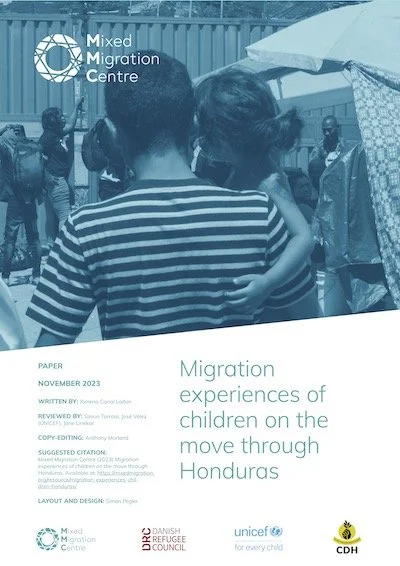
Migration experiences of children on the move through Honduras

By Ximena Canal Laiton

This paper explores the migration experiences of children and caregivers on the move in Honduras. The research project was developed by the Mixed Migration Centre (MMC), the Centro de Desarrollo Humano (CDH), and the United Nations Children‘s Fund (UNICEF) Honduras to gather evidence regarding children on the move throughout Latin America and the Caribbean. The study contains an analysis and findings on children‘s and caregivers‘ travel conditions and impacts, perceived and experienced security risks during the journey, an Honduras through the 4Mi project.d humanitarian needs identified by caregivers surveyed in

CDH, MMC, UNICEF, 2023. 15p

download
Digital lifelines: The use of social media networks among Venezuelan refugees and migrants heading north

By Simon Tomasi, Daniely Vicari

This paper explores the use of social media by Venezuelan refugees and migrants as they head north through the Latin America and Caribbean (LAC) region. It is based on an analysis of 4Mi surveys conducted in Honduras, qualitative data obtained through semi-structured interviews conducted in Colombia and Costa Rica, and focus groups held in Colombia and Peru.

This paper details survey respondents’ profiles, their preferred social media and messaging platforms, the reasons they communicate through these networks, and the connectivity challenges they face in accessing them. It also explores respondents’ most trusted sources of information, the persistence of information gaps and the risks associated with the presence of smugglers in digital spaces.

This paper’s findings aim to build a solid evidence base that will strengthen knowledge about Venezuelan refugees’ and migrants’ social media habits and guide humanitarian actors’ engagement with digital platforms.

Denmark: Mixed Migration Centre, 2023. 14p.

download
Use of smugglers on the journey to Thailand among Cambodians and Laotians

By The Mixed Migration Centre

This snapshot examines the use of smuggling among Cambodians and Laotians on their journey to Thailand. It examines respondents’ reasons for leaving their country of origin, access to smuggling services, and protection incidents experienced en route, as well as the involvement of state officials in smuggling between Cambodia-Thailand and Lao PDR-Thailand.

Denmark: Mixed Migration Centre, 2023. 12p.

download
New Americans in Santa Fe County: The Demographic and Economic Contributions of Immigrants in the County

By The American Immigration Council

New research from the American Immigration Council shows that immigrants in Santa Fe County paid over $122 million in taxes and held over $365 million in spending power in 2019. The new report, New Americans in Santa Fe County, was prepared in partnership with the City of Santa Fe’s Office of Economic Development and Somos Un Pueblo Unido. 

The report also features four profiles of community members: Ana Magaña, Iris Madely Alay, Verónica Velázquez, and Gretel Barrita. 

In 2019, more than 16,000 immigrants lived in Santa Fe County, accounting for 11.1 percent of the total population. Immigrants represented 15.2 percent of its working age population and 15.0 percent of its employed labor force, despite making up 11.1 percent of the county’s overall population. 

Washington, DC: American Immigration Council, 2023. 11p.

download
Animals and Man in Historical Perspective

May contain mark-up

Edited by Joseph and Barrie Klaits

"The ties between people and animals are as mysterious and as obvious as the mutual devotion of a boy and his dog. We catch glimpses of these ties when we watch a circus parade, when we see someone's pet crushed in an accident, or when we witness the birth of kittens. Exhilaration, compassion, wonder-intangible responses like these are this book's raisons d'être.

"We have collected a series of readings that attempt to analyze such responses.,. The authors share a concern with the issue we have regarded as the leitmotif of this book: What do man's attitudes and behavior toward animals tell us about the historical development of human society and culture?" - from the Introduction.

NY. Harper and Row, Publishers. 1974. 177p.

read
Being a Slave: Histories and Legacies of European Slavery in the Indian Ocean

Edited by Alicia Schrikker and Nira Wickramasinghe

This multidisciplinary volume brings together scholars and writers who try to come to terms with the histories and legacies of European slavery in the Indian Ocean. The volume discusses a variety of qualitative data on the experience of being a slave in order to recover ordinary lives and, crucially, to place this experience in its Asian local context. Building on the rich scholarship on the slave trade, this volume offers a unique perspective that embraces the origin and afterlife of enslavement as well as the imaginaries and representations of slaves rather than the trade in slaves itself.

Leiden: Leiden University Press, 2020.332p.

download
The Palgrave Handbook of Global Slavery throughout History

Edited by Damian A. Pargas, Juliane Schiel

This open access handbook takes a comparative and global approach to analyse the practice of slavery throughout history. To understand slavery - why it developed, and how it functioned in various societies – is to understand an important and widespread practice in world civilisations. With research traditionally being dominated by the Atlantic world, this collection aims to illuminate slavery that existed in not only the Americas but also ancient, medieval, North and sub-Saharan African, Near Eastern, and Asian societies. Connecting civilisations through migration, warfare, trade routes and economic expansion, the practice of slavery integrated countries and regions through power-based relationships, whilst simultaneously dividing societies by class, race, ethnicity and cultural group. Uncovering slavery as a globalising phenomenon, the authors highlight the slave-trading routes that crisscrossed Africa, helped integrate the Mediterranean world, connected Indian Ocean societies and fused the Atlantic world. Split into five parts, the handbook portrays the evolution of slavery from antiquity to the contemporary era and encourages readers to realise similarities and differences between various manifestations of slavery throughout history. Providing a truly global coverage of slavery, and including thematic injections within each chronological part, this handbook is a comprehensive and transnational resource for all researchers interested in slavery, the history of labour, and anthropology.

Cham: Springer Nature, 2023. 716p.

download
Cultural Heritage and Slavery - Perspectives from Europe

By Stephan Conermann, Claudia Rauhut, Ulrike Schmieder and Michael Zeuske

In the recent cultural heritage boom, community-based and national identity projects are intertwined with interest in cultural tourism and sites of the memory of enslavement. Questions of historical guilt and present responsibility have become a source of social conflict, particularly in multicultural societies with an enslaving past. This became apparent in the context of the Black Lives Matter movement in 2020, when statues of enslavers and colonizers were toppled, controversial debates about streets and places named after them re-ignited, and the European Union apologized for slavery after the racist murder of George Floyd. Related debates focus on museums, on artworks acquired unjustly in societies under colonial rule, the question of whether and how museums should narrate the hidden past of enslavement and colonialism, including their own colonial origins with respect to narratives about presumed European supremacy, and the need to establish new monuments for the enslaved, their resistance, and abolitionists of African descent.

Berlin/Boston:DeGruyter, 2024, 352p.

download
Current Trends in Slavery Studies in Brazil

by Stephan Conermann, Mariana Dias Paes, Roberto Hofmeister Pich and Paulo Cruz Terra

Slavery Studies are one of the most consolidated fields in Brazilian historiography with various discussions on issues like slave agency, slavery and law, slavery and capitalism, slave families, demography of slavery, transatlantic slave trade, abolition etc. Taking into consideration these new trends of Brazilian slavery studies, this volume of collected articles allows leading scholars to present their research to a broader academic community.

Berlin/Boston, DeGruyter, 2023. 347p.

download