
Open Access Free Library
CRIME+CRIMINOLOGY.jpeg

CRIME

Violent-Non-Violent-Cyber-Global-Organized-Environmental-Policing-Crime Prevention-Victimization

Posts in Civil Liberties
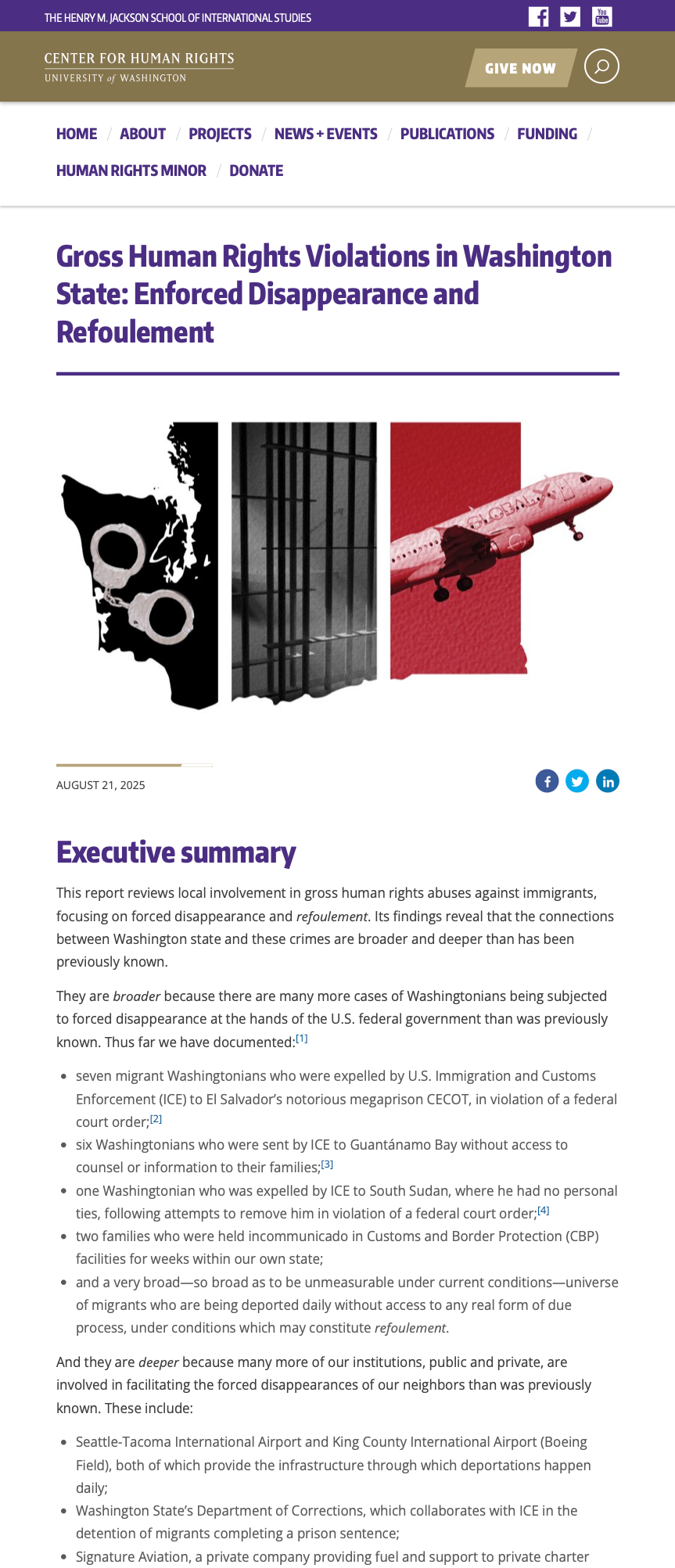
Gross Human Rights Violations in Washington State: Refoulement and Enforced Disappearance

By The Center for Human Rights, University of Washington

This report reviews local involvement in gross human rights abuses against immigrants, focusing on forced disappearance and refoulement. Its findings reveal that the connections between Washington state and
these crimes are broader and deeper than has been previously known. They are broader because there are many more cases of Washingtonians being subjected to forced disappearance at the hands of the U.S. federal government than was previously known.

Thus far we have documented:[1] seven migrant Washingtonians who were expelled by U.S. Immigration and
Customs Enforcement (ICE) to El Salvador’s notorious megaprison CECOT, in violation of a federal court order;[2] six Washingtonians who were sent by ICE to Guantánamo Bay without access to counsel or information to their families;[3] one Washingtonian who was expelled by ICE to South Sudan, where he had
no personal ties, following attempts to remove him in violation of a federal court order;[4] two families who were held incommunicado in Customs and Border Protection (CBP) facilities for weeks within our own state;
and a very broad—so broad as to be unmeasurable under current conditions—universe of migrants who are being deported daily without access to any real form of due process, under conditions which may constitute refoulement. And they are deeper because many more of our institutions, public and private, are involved in facilitating the forced disappearances of our neighbors than was previously known. These include:

Seattle-Tacoma International Airport and King County International Airport (Boeing Field), both of which provide the infrastructure through which deportations happen daily; Washington State’s Department of Corrections, which collaborates with ICE in the detention of migrants completing a prison sentence; Signature Aviation, a private company providing fuel and support to private charter flights operating for ICE at King County International Airport; and the Washington State Investment Board (WSIB), which invests the
retirement funds of our public employees in the very businesses that brutalize our neighbors. Complicity in forced disappearance is not a minor matter. When committed systematically against a civilian population, forced disappearance is considered a crime against humanity under international law. All institutions—federal, state and local; public and private—and all individuals are called to take active measures to avoid complicity in the networks that produce such violations. Our central purpose in publishing this report is to make all Washingtonians witness to what is happening on our watch, in the hopes that we might come together in new ways to stop these abuses.
Militarized Policing—Whether Cooperative or Coercive—Still Misses the Point

By Sarah Anderson

When it comes to public safety, the need to emphasize collaboration over coercion cannot be overstated. This goes for relationships between law enforcement and communities as well as between law enforcement entities themselves. New Mexico’s recent deployment of the National Guard to Albuquerque illustrates a cooperative effort between state leadership, local police, and community stakeholders to fill administrative and support roles amidst law enforcement staffing shortages.

This stands in stark contrast to President Donald J. Trump’s pronouncement that he would send the “Full Force” of the military into “War ravaged Portland [Oregon].” This top-down, heavy-handed occupation risks undermining norms of the Constitution and public trust in policing. Although the lesser of two evils compared to forcible federal intervention, New Mexico’s model for using the National Guard as law enforcement is still not the right way to promote long-term public safety in our cities.

However, it is still worth discussing the differences and highlighting the extreme challenges that Trump’s proposed actions in Portland pose for law enforcement and public safety. The contrast between New Mexico’s approach and the rhetoric around Portland could not be starker. In Albuquerque, Gov. Michelle Lujan Grisham authorized 60 to 70 New Mexico National Guard personnel to work behind the scenes beginning in mid-May. All underwent training to assist the Albuquerque Police Department in collaboration with New Mexico’s departments of Homeland Security and Public Safety and the State Police.

They do not patrol in military uniforms or ride in Humvees. They do not carry rifles or even make arrests. Instead, they help secure crime scenes, process case files, transport detainees, and monitor security cameras. In short, they free up sworn officers to focus on actual policing. The arrangement is carefully limited, publicly explained, and shaped by local input. It reflects the sober recognition that Albuquerque faces serious violent crime challenges while its police department struggles to recruit and retain enough officers to meet
demand.

By comparison, the declaration to use force in Portland is filled with inflammatory rhetoric, implying that the city needs a military occupation to restore order. This framing of an American city as if it were a foreign battlefield is deeply inappropriate. Portland is not a war zone, nor is it unique. This is just the latest in a string of cities threatened with forced deployments, often over the clear objections of governors, mayors, and local law enforcement. Not only do such threats disregard federalism and constitutional guardrails, they also risk turning tense local situations into crises of legitimacy and normalizing military overreach.

Civil liberties advocates have rightly warned that even cooperative and carefully outlined National Guard missions still risk normalizing military involvement in civilian life. Others argue that resources spent on deployments or other means of “cleaning up” homelessness and crime would be better invested in community services, from mental health intervention to addiction treatment. Those critiques underscore an essential truth: Even the most collaborative use of the National Guard is not a long-term solution and can even harm overall public safety.