

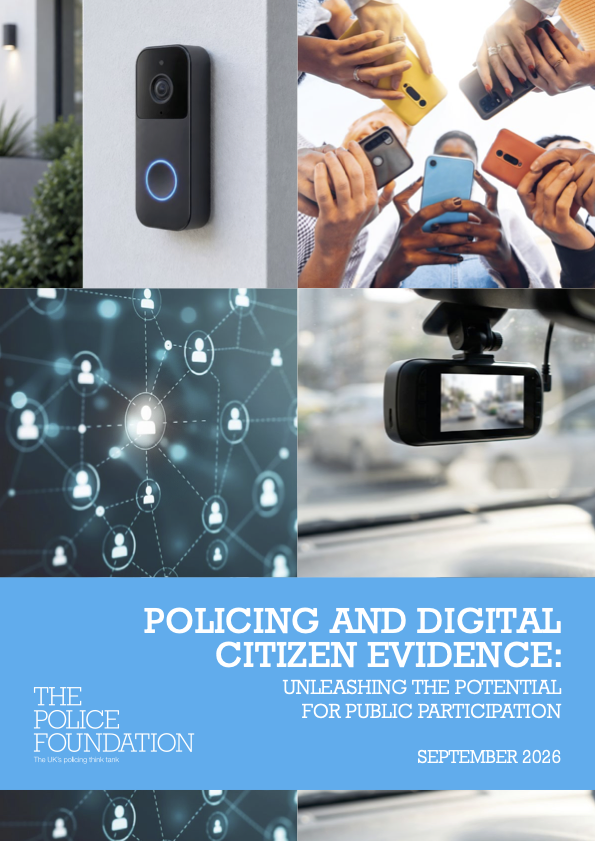
By Ruth Halkon
Digital technologies have moved rapidly from novelty to normality. Now a routine feature of everyday life, smart doorbells, journey cameras, mobile phones, wearable devices and connected home technologies are
changing how evidence is generated, captured and shared. Our new report, launched at the Emergency Services Tech Show in Birmingham, argues that this shift should be understood as more than a technological development. Rather, it represents a new form of public participation in policing. Citizens have long contributed to public safety through witness reporting, Neighbourhood Watch and Community Speedwatch. What is different today is their growing ability to provide digital evidence of events as they happen. Digital citizen evidence gives public participation a scale, permanence and immediacy that previous forms of engagement could not achieve, creating both opportunities and challenges for policing.
The scale of this shift is already significant. A nationally representative YouGov survey commissioned for this report found that half of adults (50 per cent) own and regularly use at least one technology capable of generating digital evidence, while nearly one in three (31 per cent) own and regularly use a smart doorbell camera. Public attitudes towards these technologies are also broadly positive: 69 per cent of adults believe smart doorbells improve their personal safety and security, while 58 per cent believe journey cameras improve personal safety on the roads. Crucially, the public appear willing to use these technologies in support of public safety. Three quarters (75 per cent) say they would be likely to share footage of suspicious activity outside their home, while nearly three quarters (73 per cent) would share footage of dangerous driving. Even where incidents do not affect them directly, many citizens appear willing to contribute evidence when they believe it could help make their communities safer.
Citizens are already generating and sharing digital evidence at scale. Policing now needs the capacity, governance and public trust required to receive, assess and respond to that evidence effectively. When
people submit evidence and can see that it has been reviewed, acknowledged or acted upon, participation is reinforced. When evidence appears to disappear into a black hole, confidence can be undermined
and future participation discouraged. Realizing the benefits of digital citizen evidence will depend on
appropriate safeguards and governance. Questions about how evidence is collected, retained, shared and used are central to maintaining public trust. If citizens are concerned that their information is being used
inappropriately, retained unnecessarily or handled without sufficient transparency, there is a risk of creating a chilling effect that discourages participation and weakens confidence in policing.
The report concludes that technology and evidence-submission portals, while important, are only part of the solution. Equal attention must be given to the principles, processes and governance arrangements that
determine how citizen-generated evidence is received, assessed, and acted on. To support this, we propose ten principles for the effective, proportionate and trusted use of digital citizen evidence. Digital citizen evidence is already here. The public are willing to participate. The challenge now is whether policing can create the systems, standards and safeguards needed to ensure that participation strengthens both public safety and public confidence.
By Samantha Weston, Clare Griffiths and Anne-Marie Day
Louise Casey’s review revealed a series of concerns about London Metropolitan Police concluding that institutional racism, misogyny and homophobia pervades across the whole organisation. Acknowledging that police legitimacy is under threat, some have called for the police to be defunded. Drawing on data collected via a survey and focus groups with children and young people from traditionally unheard minoritised groups attending a community-based programme, this article reveals low levels of satisfaction with and trust of the police among this group. In contrast, activities based and created within young people’s own communities provided opportunities to be safe, protected and among people they trusted. Drawing on Gramsci’s theory of hegemony, we suggest that the call to ‘defund the police’ may not be the radical alternative that many would have us believe and instead call to ‘refund civil society’ by advocating for a ‘community first’ approach to resolve complex social problems.
By Robin S. Engel, Nicholas Corsaro, Gabrielle T. Isaza, Hannah D. McManus, University of Cincinnati
In recent months, law enforcement officers have been faced with an unprecedented set of circumstances, navigating major social unrest in communities amid a pandemic and economic crisis. Acknowledging the dangers to both the community and officers, efforts have intensified to identify “solutions” to reduce the frequency and severity of violent encounters between police and the public. Calls for the adoption of “de-escalation” policies and training – widely endorsed by policy makers, policing experts, and the public – have been especially strong, and recent statistics on law enforcement practices suggest the field has responded (Engel et al., 2020b). For example, in a 2019 national survey of 155 large police departments in the United States, nearly all responding agencies indicated they offered some form of de-escalation training to officers in their agency (CBS, 2019). Although the implementation of de-escalation training is often encouraged, the effects of this training on police officers and their interactions with the public has not been systematically evaluated (Engel et al., 2020a). For this reason, the impact of de-escalation training on the frequency and severity of officers’ use of force and the subsequent injuries to citizens and officers is not well understood. It was within this context that the Louisville (KY) Metro Police Department (LMPD) stepped forward to both deliver and participate in the evaluation of a deescalation training. Specifically, the LMPD introduced the Police Executive Research Forum’s (PERF) Integrating Communications, Assessment, and Tactics (ICAT) training program to instruct officers in de-escalation tactics and critical thinking skills for the management of potentially volatile police-citizen encounters. Seeking to understand the effectiveness of this training, the LMPD partnered with the International Association of Chiefs of Police/University of Cincinnati Center for Police Research and Policy (IACP/UC Center) to conduct an independent, external evaluation of the effects of the ICAT training on their agency. This report documents the methodology and findings of the evaluation of ICAT training implemented within the LMPD. This study represents one of the first large-scale, methodologically rigorous evaluations of a well-known de-escalation training for police. Specifically, this study uses a multi-method approach, relying upon two distinct survey designs (i.e., repeated measure survey design, cross-sectional survey design) to assess the impact of training on the perceptions and self-reported experiences of officers and first-line supervisors, and a stepped-wedge randomized control trial design to examine training effects on officers’ behaviors and changes in the outcomes of police-citizen encounters. This seminal study is the first randomized control trial to demonstrate a significant reduction in officer use of force following de-escalation training implementation.
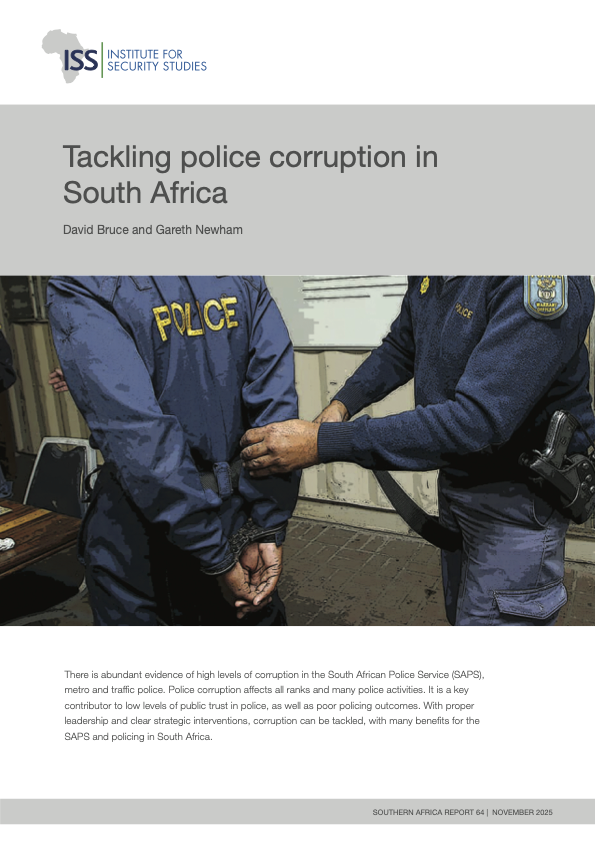
By David Bruce and Gareth Newham
Key findings There is strong evidence of ongoing widespread corruption in the South African Police Service (SAPS), including among its senior leaders. Corruption levels in the metro and traffic police are also high, although they receive less scrutiny than the SAPS. Perceptions of high levels of police corruption contribute to low levels of public trust in the police. TrA range of agencies and mechanisms are tasked with investigating police corruption, but no agency has overall responsibility. Coordination between agencies is limited. SAPS has introduced multiple anti-corruption strategies, but has not implemented intelligencedriven measures to ensure that corruption is tackled effectively. The SAPS Anti-Corruption Investigation Unit (ACIU) is substantially under-resourced. Despite evidence of misconduct, a majority (77%) of SAPS disciplinary hearings result in no meaningful accountability.ust is vital for the police to effectively address crime. SAPS members are often unwilling to report crime or corruption by colleagues because they fear negative consequences for themselves. The willingness of many members of the public to pay bribes is an important contributor to high levels of police corruption.