Open Access Publisher and Free Library
CRIME+CRIMINOLOGY.jpeg

CRIME

Violent-Non-Violent-Cyber-Global-Organized-Environmental-Policing-Crime Prevention-Victimization

Posts in International
Transnational Organized Crime in Mexico and the Government's Response

By Evan Ellis

The U.S. government threats of tariffs on the Mexican government if it did not do more to control illicit fentanyl ows into the United States have cast new attention on the growing problem of transnational organized crime that has wrought violence and corruption at all levels in Mexico. This work, based on the authors research in interviews with senior Mexican security ofcials in Mexico City in March 2025, examines the evolution of transnational organized crime in the country, and the Mexican government’s response, with the support of the United States and other partners.The principal drivers of transnational organized crime dynamics in Mexico are ows of cocaine through the country, largely destined for European and Asian markets, as well as the production of fentanyl there from Chinese and other precursors, mostly oriented toward export to the United States. In addition, other illicit activities including petroleum theft (huachicol), smuggling and exploitation of migrants transiting the country, extortion and kidnapping, illegal mining and money laundering, have also fueled Mexico’s evolving illicit economy. With respect to murders and other violence in Mexico, arms, including long arms imported from the United States, arms obtained on the black market from Central American and other global wars, drones and other military products principally from the People’s Republic of China (PRC), as well as a large, welldeveloped illicit domestic industry for military vehicles and supplies all contribute to the lethality of multiple ongoing conict within the country.The organized crime dynamics in Mexico, the domestic and international groups involved, in the pattern of violence has evolved signicantly in the almost two decades since 2006 when Mexican president Felipe Calderon declared war on the drug cartels for their escalating violence and deployed federal troops into Michoacan to respond. This work analyzes of those dynamics, their evolution, and the response of the Mexican government, in conjunction with the US and other partners.
The Crime Conundrum in the Caribbean 

By Ivelaw Lloyd Griffith

High crime—especially intentional homicide—has posed a clear and present danger for the Caribbean for some time. However, soaring homicide rates across the region and the fact that many are committed using weapons from the United States have caused the matter to attract more attention in recent months, with a recent symposium in Trinidad and Tobago on the subject shining the most recent spotlight. CARICOM leaders are concerned about the growing homicide rates and the number of arms entering the region—issues raised both at the February 2023 CARICOM Summit in the Bahamas as well as at a recent special meeting on April 18 and 19 on the subject convened by Prime Minister Keith Rowley of Trinidad and Tobago, who holds the portfolio for security within the CARICOM quasi cabinet. The conference framed crime and violence as a public health crisis. Unlike at the Bahamas meeting—which featured government leaders—experts from within and outside the Caribbean were invited to the symposium to discuss options to address the issue. The Caribbean leaders declared a “war on guns to combat the illegal trade which provides the weapons that contribute significantly to crime and violence in our region causing death, disabilities and compromising the safety of our citizens” and implored the United States to support their efforts to halt illegal arms trafficking. They also lamented the disproportionate shares of their national budgets they are obligated to allocate to national security, especially to combat crime and violence while also grappling with mental and other health-related challenges spurned by the arms trafficking business.1 This report offers an analysis of the contemporary Caribbean crime landscape. Particular attention is paid to intentional homicides and murders. This is not because domestic violence, burglary, rape, larceny, money laundering, and other crimes are unimportant or have not increased in some places. Indeed, there have been troubling surges in domestic violence in Guyana, Puerto Rico, Jamaica, and elsewhere. Murder, however, commands attention here because it constitutes the “ultimate crime”—taking a life as well as having powerful economic, public security, and other consequences. Yet, the region’s crime scene is troubling not just because of the volume of murders, but also because of the heinous nature of some of the criminal acts. Thus, we first provide a portrait of the murder scene and then offer examples of some of the horrible ways in which crimes have been prosecuted. Next, we discuss the significant use of weapons, the source of the weapons, and the actionsand the actions being pursued by Caribbean and other leaders to stem the flow of arms into the region. In this respect, we focus on the crime symposium held this past April in Trinidad and Tobago. This report has taken into account a few policy considerations that might be considered as the region’s policymakers and practitioners address the perennial challenge of crime, violence, and arms trafficking.

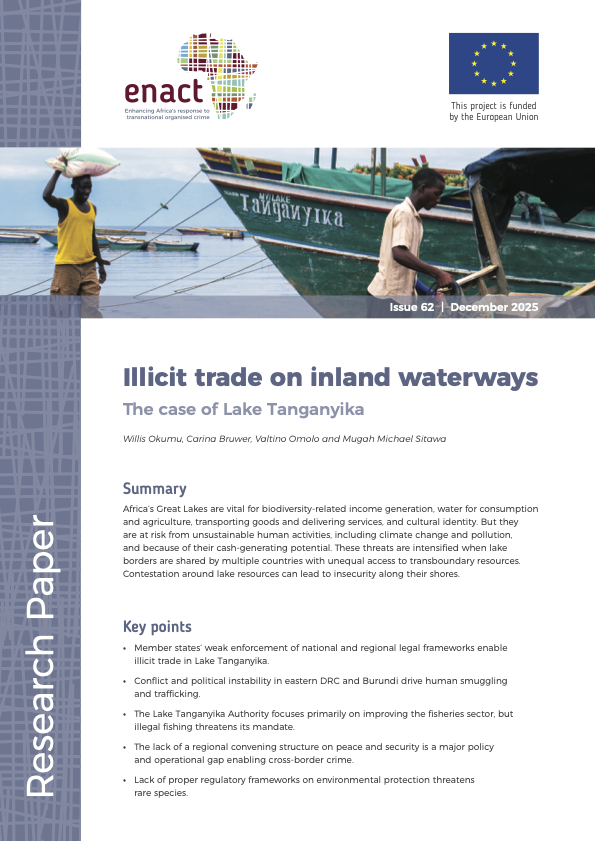
Illicit trade on inland waterways. The case of Lake Tanganyika 

By Willis Okumu, Carina Bruwer, Valtino Omolo and Mugah Michael Sitawa

Africa’s Great Lakes are vital for biodiversity-related income generation, water for consumption and agriculture, transporting goods and delivering services, and cultural identity. But they are at risk from unsustainable human activities, including climate change and pollution, and because of their cash-generating potential. These threats are intensified when lake borders are shared by multiple countries with unequal access to transboundary resources. Contestation around lake resources can lead to insecurity along their shores.

Measuring Corruption from Household Income and Consumption Micro-Data: An International Perspective

By Nicolas Sarullo .Yuriy Gorodnichenko, Tatyana Deryugina,James Hodson ,Ilona Sologoub, Anastassia Fedyk

Using household survey data on expenditures and incomes, we construct an objective measure of corruption in the public sector for a broad spectrum of countries. Specifically, we focus on the consumption-income gap for public sector workers relative to private sector workers to gauge the extent of hidden income (bribes) in the government. After validating our data and documenting properties of the consumption-income gap, we compare our measure with popular corruption perception indices. We find that i) the relationship between our measure and the alternatives is nonlinear; ii) available indices appear to be only weakly (and sometimes “wrongly”) correlated with the consumption income gap at high frequencies; iii) the available indices appear to have a low weight on the relative consumption-income gap in the public sector.