

By Gregory Cote
It is widely accepted that modern policing first came into existence with a bill passed in 1829, establishing the Metropolitan London Police under British Home Secretary Sir Robert Peel. It is Peel after all, who has been labeled the founder of modern policing, an English institution that inspired North American police. I argue that it was Jeremy Bentham who developed an early model of modern policing and whose work on applying his utilitarian philosophy to institutional reform directly influenced Peel’s innovation. I intend to show how Bentham and reformer Patrick Colquhoun established the first modern police department when they
collaborated in drafting the Thames River Police Bill adopted by Parliament in 1800, almost thirty years before Peel’s legislation. It is the Thames River Police created by Bentham and Colquhoun that is the world’s oldest, not the Metropolitan London Police introduced by Peel. John Stuart Mill once wrote that Bentham was a great subversive. And as the great subversive whose years of work on improving police was often done in secret and whose efforts were largely ignored, it is Bentham not Peel, who should be considered the single most important figure in the development of modern policing.
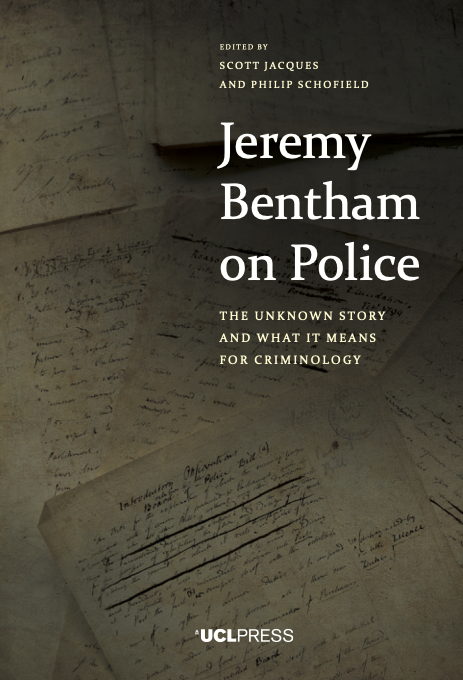
Edited by Scott Jacques and Philip Schofield
Jeremy Bentham’s ideas on punishment are famous. Every criminology student learns about Bentham, and every criminologist contends with him, as advocate or opponent. This discourse concerns his ideas about punishment, namely with respect to legislation and the panopticon. Yet, scholars and students are generally ignorant of Bentham’s ideas on police. Hitherto, these ideas have been largely unknowable. Now, thanks to UCL’s Bentham Project, these ideas are public. Jeremy Bentham on Police celebrates this achievement by exploring the story of Bentham’s writings on police and considering their relevance to the past, present and future of criminology. After Scott Jacques introduces the book, the Director of the Bentham Project, Philip Schofield, describes and explains how it works. Then Michael Quinn, who brought together Bentham’s writings on police, delves into the personal and socio-historical background in which they were created. An extract follows, representing the most (criminologically-)relevant passages from Bentham’s police writings. Finally, a rich variety of scholars offer their thoughts on what those writings mean for criminology. These contributions come from Anthony A. Braga, Ronald Clarke, David J. Cox, Stephen Douglas, Stephen Engelmann, G. Geltner, Joel F. Harrington, Jonathan Jacobs, Paul Knepper, Gloria Laycock, Gary T. Marx, Daniel S. Nagin, Graeme R. Newman, Pat O’Malley, Eric L. Piza, Kim Rossmo, Lucia Summers and Dean Wilson.