


Edited by Scott Jacques and Philip Schofield
Jeremy Bentham’s ideas on punishment are famous. Every criminology student learns about Bentham, and every criminologist contends with him, as advocate or opponent. This discourse concerns his ideas about punishment, namely with respect to legislation and the panopticon. Yet, scholars and students are generally ignorant of Bentham’s ideas on police. Hitherto, these ideas have been largely unknowable. Now, thanks to UCL’s Bentham Project, these ideas are public. Jeremy Bentham on Police celebrates this achievement by exploring the story of Bentham’s writings on police and considering their relevance to the past, present and future of criminology. After Scott Jacques introduces the book, the Director of the Bentham Project, Philip Schofield, describes and explains how it works. Then Michael Quinn, who brought together Bentham’s writings on police, delves into the personal and socio-historical background in which they were created. An extract follows, representing the most (criminologically-)relevant passages from Bentham’s police writings. Finally, a rich variety of scholars offer their thoughts on what those writings mean for criminology. These contributions come from Anthony A. Braga, Ronald Clarke, David J. Cox, Stephen Douglas, Stephen Engelmann, G. Geltner, Joel F. Harrington, Jonathan Jacobs, Paul Knepper, Gloria Laycock, Gary T. Marx, Daniel S. Nagin, Graeme R. Newman, Pat O’Malley, Eric L. Piza, Kim Rossmo, Lucia Summers and Dean Wilson.
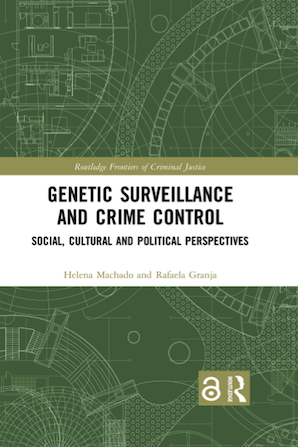
By Helena Machado and Rafaela Granja
Genetic Surveillance and Crime Control presents a new empirical and conceptual framework for understanding trends of genetic surveillance in different countries in Europe and in other jurisdictions around the world. The use of DNA or genome for state-level surveillance for crime governance is becoming the norm in democratic societies. In the post-DNA, contemporary modes of criminal identification are gradually changing through the increasing expansion of transnational sharing of DNA data, along with the development of highly controversial genetic technologies that pose acute challenges to privacy and generate fears of discrimination, racism and stigmatization. Some questions that guide this book are: How is genetic surveillance in the governance of crime intertwined with society, ethics, culture, and politics? What are the views and expectations of diverse stakeholders –scientists, police agencies, and non-governmental organizations? How can social sciences research about genetic surveillance accommodate socio-cultural and historical differences, and be sensitive to specificities of post-authoritarian societies in Europe? Taking an interdisciplinary approach focused on challenges to genetic privacy, human rights and citizenship in contemporary societies , this book will be of interest to students and scholars of social studies of science and technology, sociology, criminology, law and policing, international relations and forensic sciences.