
Open Access Publisher and Free Library
CRIME+CRIMINOLOGY.jpeg

CRIME

Violent-Non-Violent-Cyber-Global-Organized-Environmental-Policing-Crime Prevention-Victimization

Posts tagged diversity in policing
Corporate Crime in European Emerging Markets

By Ichiro Iwasaki and Kocenda, Evzen

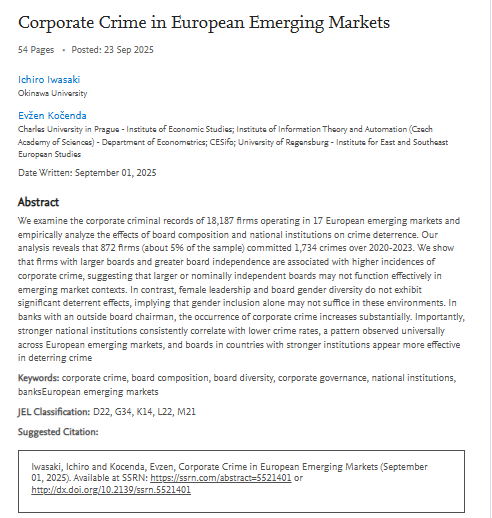
We examine the corporate criminal records of 18,187 firms operating in 17 European emerging markets and empirically analyze the effects of board composition and national institutions on crime deterrence. Our analysis reveals that 872 firms (about 5% of the sample) committed 1,734 crimes over 2020-2023. We show that firms with larger boards and greater board independence are associated with higher incidences of corporate crime, suggesting that larger or nominally independent boards may not function effectively in emerging market contexts. In contrast, female leadership and board gender diversity do not exhibit significant deterrent effects, implying that gender inclusion alone may not suffice in these environments. In banks with an outside board chairman, the occurrence of corporate crime increases substantially. Importantly, stronger national institutions consistently correlate with lower crime rates, a pattern observed universally across European emerging markets, and boards in countries with stronger institutions appear more effective in deterring crime

CESifo Working Paper No. 12132 54 Pages Posted: 23 Sep 2025

Examining the Reasons Why Individuals Want and Do Not Want a Career in Policing

By Weston J. Morrow, Samuel G. Vickovic, and Emilie Whitehouse

Police departments across the country have and continue to experience staffing challenges in full-time sworn officers. In an effort to address this issue, previous research has examined the motivations for becoming police officers, or why people want to become officers. An equally important question that may help with recruitment and staffing efforts among police agencies is ‘Why do people not want to become police officers?’ The current study fills this void using Qualtrics Panel data from 2,000 respondents across the United States. In doing so, this study (1) contributes to the existing body of research on reasons people choose a career in policing, (2) adds insight to the limited body of research that examines why people do not want a career in policing, and (3) provides nuance to this discussion by examining racial, ethnic, and gender variations in these outcomes. The practical and policy implications of these findings are explored within the context of previous and ongoing research to help address police staffing challenges.