Open Access Publisher and Free Library
CRIME+CRIMINOLOGY.jpeg

CRIME

Violent-Non-Violent-Cyber-Global-Organized-Environmental-Policing-Crime Prevention-Victimization

Posts tagged analysis
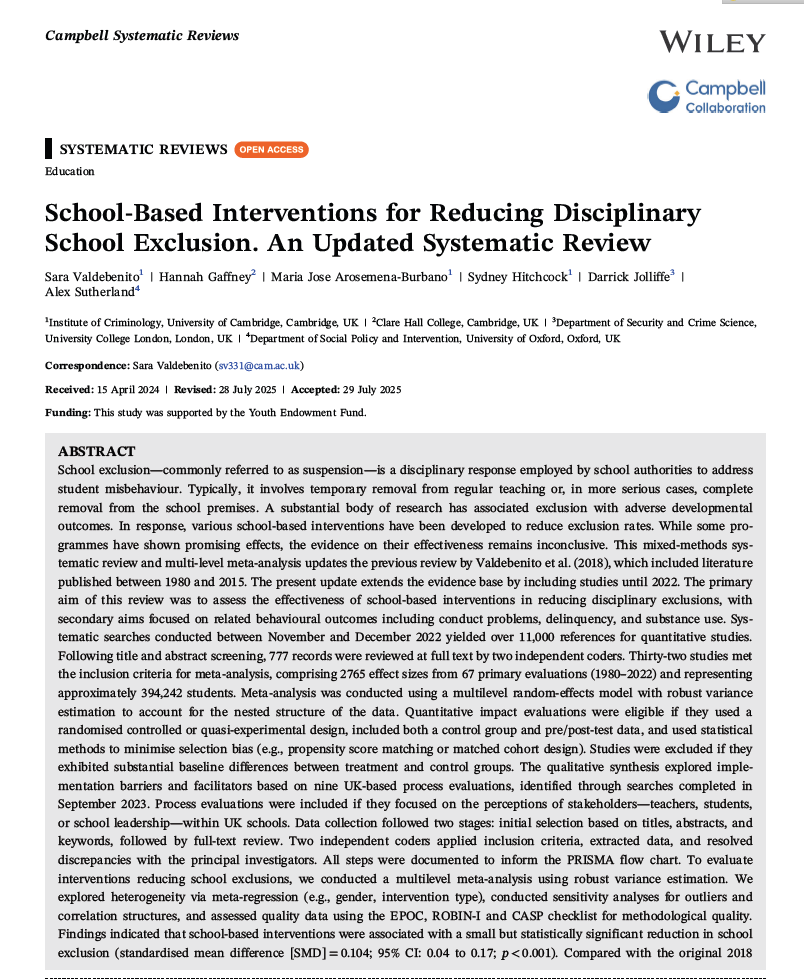
School-Based Interventions for Reducing Disciplinary School Exclusion. An Updated Systematic Review

By

Sara Valdebenito, Hannah Gaffney, Maria Jose Arosemena-Burbano, Sydney Hitchcock, Darrick Jolliffe, Alex Sutherland

School exclusion—commonly referred to as suspension—is a disciplinary response employed by school authorities to address student misbehaviour. Typically, it involves temporary removal from regular teaching or, in more serious cases, complete removal from the school premises. A substantial body of research has associated exclusion with adverse developmental outcomes. In response, various school-based interventions have been developed to reduce exclusion rates. While some programmes have shown promising effects, the evidence on their effectiveness remains inconclusive. This mixed-methods systematic review and multi-level meta-analysis updates the previous review by Valdebenito et al. (2018), which included literature published between 1980 and 2015. The present update extends the evidence base by including studies until 2022. The primary aim of this review was to assess the effectiveness of school-based interventions in reducing disciplinary exclusions, with secondary aims focused on related behavioural outcomes including conduct problems, delinquency, and substance use. Systematic searches conducted between November and December 2022 yielded over 11,000 references for quantitative studies. Following title and abstract screening, 777 records were reviewed at full text by two independent coders. Thirty-two studies met the inclusion criteria for meta-analysis, comprising 2765 effect sizes from 67 primary evaluations (1980–2022) and representing approximately 394,242 students. Meta-analysis was conducted using a multilevel random-effects model with robust variance estimation to account for the nested structure of the data. Quantitative impact evaluations were eligible if they used a randomised controlled or quasi-experimental design, included both a control group and pre/post-test data, and used statistical methods to minimise selection bias (e.g., propensity score matching or matched cohort design). Studies were excluded if they exhibited substantial baseline differences between treatment and control groups. The qualitative synthesis explored implementation barriers and facilitators based on nine UK-based process evaluations, identified through searches completed in September 2023. Process evaluations were included if they focused on the perceptions of stakeholders—teachers, students, or school leadership—within UK schools. Data collection followed two stages: initial selection based on titles, abstracts, and keywords, followed by full-text review. Two independent coders applied inclusion criteria, extracted data, and resolved discrepancies with the principal investigators. All steps were documented to inform the PRISMA flow chart. To evaluate interventions reducing school exclusions, we conducted a multilevel meta-analysis using robust variance estimation. We explored heterogeneity via meta-regression (e.g., gender, intervention type), conducted sensitivity analyses for outliers and correlation structures, and assessed quality data using the EPOC, ROBIN-I and CASP checklist for methodological quality. Findings indicated that school-based interventions were associated with a small but statistically significant reduction in school exclusion (standardised mean difference [SMD] = 0.104; 95% CI: 0.04 to 0.17; p < 0.001). Compared with the original 2018 review, which reported a slightly larger effect size, this update benefits from a broader evidence base and more advanced statistical modelling. However, the results for secondary behavioural outcomes were more limited: effects on conduct problems and delinquency were negligible or non-significant, and the impact on substance use was small and not statistically significant. Risk of bias was assessed using the Cochrane EPOC 2 tool (Higgins and Green 2011) for randomised controlled trials and ROBINS-I (Sterne et al. 2016) for quasi-experimental designs. Randomised studies generally exhibited lower risk of bias, while quasi-experimental studies showed greater variability in quality. Four major themes emerged from the analysis. First, intervention format mattered: flexible, collaborative, and well-structured interventions facilitated implementation, while outdated materials or content misaligned with local context impeded delivery. Second, consistency in school policies and practice enabled smoother implementation, whereas inconsistency acted as a barrier. Third, staff buy-in—particularly among senior leaders—was essential for successful implementation, although resistance from more experienced staff was noted. Finally, perceived effectiveness played a motivational role: visible improvements in pupil behaviour supported continued engagement with the intervention. In summary, the updated review finds that school-based interventions can modestly but significantly reduce school exclusions. While more serious disciplinary sanctions such as permanent exclusions and out-of-school suspensions appear less responsive, in-school exclusion shows greater potential for reduction. Impacts on other behavioural outcomes remain limited. These findings suggest that targeted, context-sensitive interventions supported by strong implementation strategies and whole-school engagement are most likely to achieve sustained reductions in school exclusion.

Property and Violent Crime Rates in Colorado’s Largest Cities

By D.J. Summers

in the past five years, Colorado’s largest cities have had very different experiences of crime.

Colorado’s violent and property crime rates rose sharply in the early 2020s, prompting varying responses from leaders at state and local levels. Some have been more successful than others, according to the most recently available Colorado Bureau of Investigation data.

CSI analyzed the violent and property crime trends of Colorado’s ten largest cities: Denver, Colorado Springs, Aurora, Fort Collins, Lakewood, Thornton, Arvada, Westminster, Pueblo, and Centennial. These ten cities represent just under half the state’s total population, with a combined population of roughly 2.3 million residents. CSI analyzed the average violent and property crime rates per 100,000 people through the first two quarters of each year between 2016 and 2025. Pueblo’s police data is not current and could not be included in the analysis.

Property and violent crime cost the state $27 billion in economic losses in 2022 between the tangible and intangible effects of reported and unreported crime. It is imperative that public leaders continually examine and understand which policies best address crime rates.

Key Findings

Denver’s violent crime rate is the highest among Colorado’s largest cities, with 235 violent crimes per 100,000 people.

 Aurora’s is second highest, with 203 violent crimes per 100,000 people.

Aurora’s violent crime has remained beneath Denver’s for three years, breaking the trend of the late 2010s and early 2020s in which Aurora’s rates were higher.

Only Colorado Springs saw an increase in the violent crime rate between 2022 and 2025.

Among the largest cities, Aurora saw the sharpest decrease in violent crime rate.

Aurora saw the second highest decrease in violent crime rate, with a 36% decrease.

Denver has the highest property crime rate of Colorado’s largest cities, with 1,122 property crimes per 100,000 people.

Lakewood has the second highest rate, with 1,099 per 100,000 people.

Aurora and Centennial had the sharpest decreases in property crime rate since 2021, at 56%, 49%, and 44%, respectively. 


Parental Child Abductions to Third Countries

By Marilyn FREEMAN

Cross-border parental child abductions in the EU are governed by The 1980 Hague Convention on the Civil Aspects of International Child Abduction and (except for Denmark) the Brussels II-ter Regulation. Countries outside of the EU may or may not be Contracting States to ‘the Convention’, but will not be bound by Brussels II-ter. Research has found that the often negative, long-lasting impact of abduction may continue throughout the lifecycle of those who have been abducted. It may also affect future generations of society. This means that every effort to deter abduction should be made. Where that is not possible, the 1980 Hague Child Abduction Convention should be nurtured to support its application in contemporary society. Specialist mediation should be encouraged in relation to international child abduction generally, and specifically in relation to Third Countries which are not Contracting States to ‘the Convention’. This study was commissioned by the European Parliament’s Policy Department for Citizens’ Rights and Constitutional Affairs at the request of the JURI Committee.

Youth Justice by the Numbers

By Joshua Rovner

Youth arrests and incarceration increased dramatically in the closing decades of the 20th century but have fallen sharply since. Public opinion often wrongly assumes that crime (and incarceration) is perpetually increasing. In fact, the 21st century has seen significant declines in both youth arrests and incarceration. Despite positive movement on important indicators, far too many youth—disproportionately youth of color—are incarcerated. Nevertheless, between 2000 and 2023, the number of youth held in juvenile justice facilities, adult prisons, and adult jails fell from 120,200 to 31,800—a 74% decline.

A familiar offence: how households shape juvenile reoffending

By Tobias Auer and Tom Kirchmaier

In this paper we focus on how the criminal history of a household affects juvenile reoffending. Using detailed administrative data from Greater Manchester Police for 2007-2018, we construct a matched sample of 15,548 juvenile first-time offenders. We show causally that juveniles from a household with a previous criminal record are 26.4 to 29.8 percentage points more likely to reoffend within three years, with the greatest additional risk being in the first year after the initial offence. We show that social learning, co-offending by siblings, and differential processing contribute to this effect. Our findings highlight household criminality as an important driver of criminal persistence, underscoring the need to move beyond individual-level predictors and address the criminogenic dynamics within the home.

In this paper we focus on how the criminal history of a household affects juvenile reoffending. Using detailed administrative data from Greater Manchester Police for 2007-2018, we construct a matched sample of 15,548 juvenile first-time offenders. We show causally that juveniles from a household with a previous criminal record are 26.4 to 29.8 percentage points more likely to reoffend within three years, with the greatest additional risk being in the first year after the initial offence. We show that social learning, co-offending by siblings, and differential processing contribute to this effect. Our findings highlight household criminality as an important driver of criminal persistence, underscoring the need to move beyond individual-level predictors and address the criminogenic dynamics within the home.

How Mexican judicial reforms may have fueled crime: Arrest trends and trust erosion

By Catalina Amuedo-Dorantes, Marilyn Ibarra-Caton

Background

Mexico rolled out state-led criminal justice reforms between 2000 and 2017 to modernize procedures and improve rule of law. Whether these changes reduced violent crime—especially in cartel-affected areas—remains uncertain.

Aims

Estimate the impact of reform implementation on homicides and arrests, and assess mechanisms related to enforcement capacity and public cooperation with law enforcement.

Materials & Methods

We build a municipality–year panel (2000–2017) from death certificates (homicides) and administrative records (arrests). Because states adopted reforms at different times, we use difference-in-differences estimators designed for staggered adoption and heterogeneous treatment effects, with rich fixed effects and controls. To probe mechanisms, we analyze nationally representative survey measures of crime reporting, institutional trust, and perceived police/prosecutorial integrity.

Results

Reform implementation is associated with a ~25% increase in homicide rates. Over the same horizon, arrest rates fall by >50%. As homicides are less prone to underreporting than other crimes, the homicide increase is unlikely to be a reporting artifact. Survey evidence shows reduced crime reporting, declining trust in institutions, and more negative views of police and prosecutors; effects are strongest in cartel-affected regions.

Discussion

The pattern is consistent with an erosion of effective enforcement capacity at rollout: fewer arrests and lower public cooperation raise expected returns to violent crime. In high-violence settings, reforms that change procedures without parallel boosts to investigative and prosecutorial capacity—and without safeguards for witnesses—can weaken deterrence.

Conclusion

Mexico’s staggered judicial reforms coincided with higher homicides and sharply lower arrests. Successful reform in violent contexts likely requires coordinated institutional strengthening (policing, prosecution, witness protection), phased implementation with measurable benchmarks, and strategies to sustain public trust and reporting.

SELECTING AND VALIDATING OUTCOME MEASURES FOR THE DOMESTIC VIOLENCE AND ABUSE CORE OUTCOME SET (DVA-COS) 

By Jenna Harewell, Elizabeth Dunk Shivi Bains, Emma Howarth, Claire Powell, Lazaros Gonidis

  Background - The domestic abuse core outcome set (DVA-COS) is an agreed set of five outcomes intended for use in evaluations of interventions or services for children and families with experience of domestic violence and abuse (DVA, hereafter referred to as domestic abuse). A COS is a minimum standard for measurement in intervention studies, the purpose of which is to overcome heterogeneity in outcome selection and measurement. The aim of a COS is to maximise the value of a body of evidence by facilitating comparison between and synthesis across studies, thus reducing research wastage. Since the development of the DVA-COS, work has been undertaken to identify, select, and validate outcome measurement instruments (OMIs) to measure the core outcomes. The Warwick– Edinburgh Mental Wellbeing Scale (WEMWBS) was previously identified as acceptable by stakeholders to capture two outcomes: child and caregiver emotional health and wellbeing. This work seeks to extend those findings by validating the measure for use with domestic abuse experienced populations. Aims Foundations, the national What Works Centre for Children & Families, commissioned two work packages to develop and integrate previous work to outline and validate OMIs for use to assess outcomes comprising the DVA-COS. Work package 1 seeks to identify three OMIs, and this report focuses on work package 2, which aimed to validate the Short WEMWBS (SWEMWBS) for use with children and young people (aged 11 to 18) who have experienced domestic abuse. The studies that make up this work package used mixed methods to examine the acceptability, content validity, structural validity, internal consistency, and measurement invariance for the scale in children and young people experiencing domestic abuse. We also report a validation study of the WEMWBS for adults with experience of domestic abuse. Methods The above aims were addressed across four individual studies: two planned and two supplementary. First, a qualitative ‘think aloud’ study assessed the acceptability of the SWEMWBS with children and young people who had experienced domestic abuse. The remaining three studies were quantitative analyses of secondary data on using the SWEMWBS and WEMWBS with children and young people and adult samples. • Study A: a qualitative think aloud study that involved interviews and a focus group to gather feedback from children and young people with domestic abuse experience on use of the SWEMWBS. • Study B: examined cross-sectional data collected by the OxWell Student Survey to validate the SWEMWBS with children and young people affected by domestic abuse. • Study C: examined anonymised longitudinal service data to validate the SWEMWBS with children and young people affected by domestic abuse. • Study D: validated the WEMWBS with adults who have experienced domestic abuse using cross-sectional data from the Adult Psychiatric Morbidity Survey (APMS). Key findings Our findings demonstrate the validity and acceptability of the SWEMWBS and WEMWBS in domestic abuse-experienced child and adult populations respectively. Study A indicated that the SWEMWBS is broadly acceptable for use with children and young people, while raising important considerations regarding respondents’ interpretation of the measure’s items as well as the emotional impact of the measure on this population. Studies B and C demonstrated robust psychometric validity2 of the SWEMWBS with children and young people affected by domestic abuse, and Study D showed robust psychometric validity of the WEMWBS with adult victims of domestic abuse. These are significant findings given the limited number of measures that have been evaluated for use with this population across practice and research contexts. Moreover, this represents an important step forward in the implementation of the DVA-COS, which we hope will help to unify outcome measurement in domestic abuse research and evaluation, as well as service monitoring. Recommendations We recommend that the SWEMWBS and WEMWBS be used to measure wellbeing in the context of evaluation studies (of any quantitative design) seeking to assess the impact of child-focused domestic abuse interventions. To enhance the acceptability of the measure to children and adults we suggest minor adaptations for use in the domestic abuse context. Finally, we recommend the development of guidelines for practitioners and researchers about how to use the tools in a ‘carefirst’ way and how to guard against the tools being used for screening or triaging, or rationing care, as well as guidance for commissioners on how to interpret and use evidence, generated by the completion of the SWEMWBS and WEMWBS, for the basis of decision making. This guidance needs to reflect the balance between the benefits of data-driven decision making and the risk of unduly narrowing the breadth of services or thwarting innovation in the sector. The OMI’s implementation (including the use of guidance) should be closely monitored and evaluated, to inform any associated refinements and to develop an in-depth understanding of the process and outcomes associated with embedding routine measurement in practice. Further work is also required to identify an alternative OMI or adapt the SWEMWBS for appropriate use with children under the age of.   11.

Foundations UK: 2025. 106p.

Corporate Crime in European Emerging Markets

By Ichiro Iwasaki and Kocenda, Evzen

We examine the corporate criminal records of 18,187 firms operating in 17 European emerging markets and empirically analyze the effects of board composition and national institutions on crime deterrence. Our analysis reveals that 872 firms (about 5% of the sample) committed 1,734 crimes over 2020-2023. We show that firms with larger boards and greater board independence are associated with higher incidences of corporate crime, suggesting that larger or nominally independent boards may not function effectively in emerging market contexts. In contrast, female leadership and board gender diversity do not exhibit significant deterrent effects, implying that gender inclusion alone may not suffice in these environments. In banks with an outside board chairman, the occurrence of corporate crime increases substantially. Importantly, stronger national institutions consistently correlate with lower crime rates, a pattern observed universally across European emerging markets, and boards in countries with stronger institutions appear more effective in deterring crime

CESifo Working Paper No. 12132 54 Pages Posted: 23 Sep 2025

Rhinoceros Poaching in Botswana: A Situational Analysis

By Environmental Investigation Agency

In 2017, rhino poaching started to increase in Botswana as poachers began killing rhinos in the vast Okavango Delta region in the northwest of the country. EIA’s situational analysis highlights some of the key issues facing Botswana’s conservation sector and contains EIA’s recommendations for actions to be taken by Botswana and CITES CoP19.

London; Washington, DC: Environmental Investigation Agency (EIA), 2022. 11p.