
Open Access Publisher and Free Library
CRIME+CRIMINOLOGY.jpeg

CRIME

Violent-Non-Violent-Cyber-Global-Organized-Environmental-Policing-Crime Prevention-Victimization

Posts tagged england and wales
Regional inequality in citizens’ attitudes towards the police and the effect of stop‑and‑search 

By Byeongjun Kim

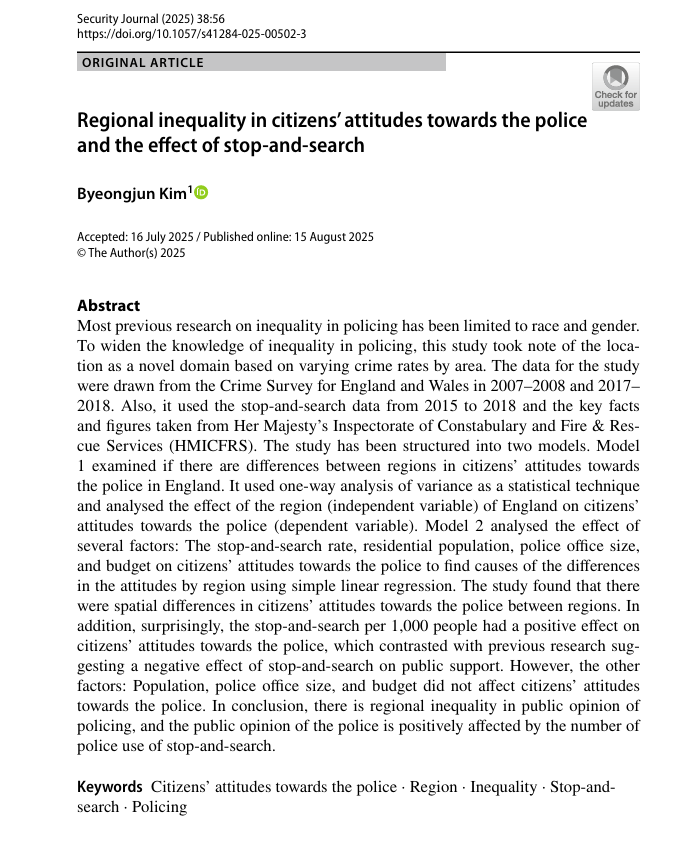
 Most previous research on inequality in policing has been limited to race and gender. To widen the knowledge of inequality in policing, this study took note of the location as a novel domain based on varying crime rates by area. The data for the study were drawn from the Crime Survey for England and Wales in 2007–2008 and 2017– 2018. Also, it used the stop-and-search data from 2015 to 2018 and the key facts and fgures taken from Her Majesty’s Inspectorate of Constabulary and Fire & Rescue Services (HMICFRS). The study has been structured into two models. Model 1 examined if there are diferences between regions in citizens’ attitudes towards the police in England. It used one-way analysis of variance as a statistical technique and analysed the efect of the region (independent variable) of England on citizens’ attitudes towards the police (dependent variable). Model 2 analysed the efect of several factors: The stop-and-search rate, residential population, police ofce size, and budget on citizens’ attitudes towards the police to fnd causes of the diferences in the attitudes by region using simple linear regression. The study found that there were spatial diferences in citizens’ attitudes towards the police between regions. In addition, surprisingly, the stop-and-search per 1,000 people had a positive efect on citizens’ attitudes towards the police, which contrasted with previous research suggesting a negative efect of stop-and-search on public support. However, the other factors: Population, police ofce size, and budget did not afect citizens’ attitudes towards the police. In conclusion, there is regional inequality in public opinion of policing, and the public opinion of the police is positively afected by the number of police use of stop-and-search.

  Security Journal (2025) 38:56

Cybercrime victimisation among older adults: A probability sample survey in England and Wales

By Benjamin Havers, Kartikeya Tripathi, Alexandra Burton, Sally McManus, Claudia Cooper

Background - Younger people are more likely to report cybercrime than older people. As older people spend more time online, this may change. If similarly exposed, risk factors including social isolation and poor health could make older adults disproportionally susceptible. We aimed to explore whether cybercrime risks and their predictors vary between age groups. Methods - We analysed responses from 35,069 participants aged 16+ in the 2019/20 Crime Survey for England and Wales (CSEW). We investigated, among people who have used the internet in the past year, risks of experiencing any cybercrime, repeat victimisation and associated financial loss across age groups. Results - Despite being at lower risk of reporting any cybercrime in the past year, people aged 75+ were more likely to report financial loss resulting from cybercrime victimisation (OR 4.25, p = 0.037) and repeat cybercrime victimisation (OR 2.03, p = 0.074) than younger people. Men, those from Mixed or Black ethnic groups, more deprived areas, managerial professional groups, and with worse health were at greater cybercrime risk. Discussion - While younger adults are more at risk from cybercrime, older adults disclosed more severe cases (repetitive victimisation and associated financial loss), perhaps due to lesser awareness of scams and reporting options. As most people experience declining health as they age, greater understanding of why poor health predicts cybercrime could inform prevention initiatives that would particularly benefit older age groups and mitigate risks of growing internet use among older adults. Health and social care professionals may be well positioned to support prevention.

PLOS ONE | December 18, 2024

Knife Crime Statistics: England and Wales

By Grahame Allen, Helen Wong

Knife-related crime (knife crime) is a crime involving an object with a blade or sharp instrument. Knife crime data is published by the Office for National Statistics (ONS), government departments, police forces and the NHS. This briefing focuses on knife crime statistics for England and Wales. Some of the statistics go up to March 2024, whereas others only go up to March 2023. Further information on knife crime in England and Wales: possession offences, rules for retailers and efforts to prevent serious violence can be found in the Library briefing: Knives, offensive weapons and serious violence

Offences involving a knife The ONS publishes data on crimes recorded by police involving a knife or sharp instrument for a selection of serious violent offences. In the year ending March 2024, there were around 50,500 offences involving a sharp instrument in England and Wales (excluding Greater Manchester). This was 4.4% higher than in 2022/23 and 2.8% lower than in 2019/20.

Homicide offences In the year ending March 2023, Home Office data shows there were 244 homicides (the killing of one person by another) using a sharp instrument, including knives and broken bottles. This meant sharp instruments were used in 41% of the 594 homicides that occurred in England and Wales in 2022/23. Knife crime by police force area ONS data shows that in 2023/24, West Midlands Police recorded the highest rate of 178 offences per 100,000 population. In contrast, Dyfed-Powys Police recorded the lowest rate of 29 offences per 100,000 population. Proven offences and offenders Sentencing statistics from the Ministry of Justice show that in the year ending March 2023, there were almost 18,500 cautions and convictions made for possession of a knife or offensive weapon. Juveniles (aged 10 to 17) were the offenders in around 17.3% of cases. Hospital admissions Police and courts crime data depends on offences being reported to the authorities; this won’t capture all instances of knife crime because some offences may not be reported. It is therefore useful to supplement this information with alternative sources such as NHS hospital data. Data from NHS Digital shows there were 3,900 “hospital episodes” recorded in English hospitals in 2023/24 due to assault by a sharp object. This was a 3.3% increase compared 2022/23, and a 7% increase compared to 2014/15. Scotland and Northern Ireland The data above are for England and Wales. Data for Scotland on the number of crimes involving the possession of an article with a blade or point can be found in table A8 of the Recorded Crime in Scotland 2023-24 publication. Table 7 of Homicide in Scotland 2023-24 shows the victims of homicide by main method of killing, including those where a sharp instrument was used.

Statistics on knife crime in Northern Ireland can be found in the latest Police Recorded Crime Statistics Monthly update from the Police Service of Northern Ireland.

London: House of Commons Library, 2025. 30p.