
Open Access Publisher and Free Library
CRIME+CRIMINOLOGY.jpeg

CRIME

Violent-Non-Violent-Cyber-Global-Organized-Environmental-Policing-Crime Prevention-Victimization

Posts tagged study
Third-Party Policing A Randomized Field Trial to Assess Drug Crime Reduction and Police-Hotel Partnerships

By Jeremy D. Barnum., Kevin D. Lucey,  Meagan E. Cahill,  William H. Sousa, 

  Illicit drug use is a significant problem in the United States, driven in large part by the opioid crisis. In 2023, the nation reported 107,543 drug overdose deaths, with more than 80,000 deaths involving an opioid. Stimulants have also become a growing problem; in 2023, more than 36,000 overdoses involved a psychostimulant, and nearly 30,000 involved cocaine (CDC 2024). Law enforcement is a crucial piece of the broader response to the drug crisis (PERF 2021). Proactive police interventions that leverage problem-solving and involve partnerships with community stakeholders offer the most substantial evidence of effectiveness (Mazerolle, Soole, and Rombouts 2007). One strategy to reduce drug problems is third-party policing (TPP). TPP involves police efforts to persuade or coerce nonoffending third parties (landlords, business owners, etc.) to take on more responsibility for addressing crime and disorder at or around their premises (Mazerolle and Ransley 2006). Typically, police begin by seeking voluntary cooperation of third parties by sharing information with them about specific problems, educating third parties on ways to prevent problems, or providing support to third parties to make changes. When third parties resist collaborative efforts, police may use coercive approaches, such as warnings, property inspections, or enforcement of civil remedies (Bichler, Schmerler, and Enriquez 2013; Eck and Wartell 1998; Mazerolle and Roehl 1998b). The study This report describes a randomized controlled evaluation of a TPP intervention implemented in Anne Arundel County, Maryland. The intervention, called Operation CheckOut, aimed to reduce drug problems at hotel s and motels by fostering trusted partnerships between police and hotel staff. Officers from the Anne Arundel County Police Department (AACOPD) conducted four in-person visits between August 2022 and May 2023 to a randomly selected group of hotels. During in-person visits, officers engaged in a scripted procedural justice dialogue with hotel managers, delivered educational materials, identified legal responsibilities, and provided a dedicated email address that functioned as a “tip line” to report problems or suspicious activity directly to the Operation Check-Out team. The intervention was designed as a partial replication of Operation Galley, a TPP intervention   implemented by the Queensland (Australia) Police Service in 2017 (Mazerolle et al. 2018). The goal of the intervention was to bolster intelligence, investigations, and enforcement actions; reduce crime and disorder; and improve perceptions of police. Key findings Outcome analysis Calls for service data were analyzed to determine the impact of Operation Check-Out on four outcomes: (1) drug activity, (2) sick persons (e.g., overdoses), (3) disorder, and (4) violence. Average monthly calls for service for each outcome were compared among hotels in the treatment and control groups during the pre-intervention period, during the intervention period, and during the post-intervention period. Three findings were significant: 1. Calls reporting drug activity were lower at treatment hotels during the post-intervention period than during the pre-intervention or intervention periods. 2. Calls reporting sick persons were lower at treatment hotels during the post-intervention period than during the pre-intervention or intervention periods. 3. Calls reporting disorder were higher at treatment hotels during the intervention period than during the pre-intervention or post-intervention periods. That there were significantly fewer drug activity calls at treatment hotels following Operation Check-Out than there had been before is encouraging, as the intervention was specifically designed to mitigate drug problems. Reducing drug activity reduces the need for hotel staff to call 911. Also, as part of their efforts to build rapport with hotel management, officers often provided their direct work lines—allowing management to call specific officers familiar with their facility and problems instead of the generic 911 line. That there were significantly fewer sick person calls at treatment hotels during the postintervention period than during the pre-intervention or intervention periods further supports the idea that Operation Check-Out reduced drug activity during the intervention period with impacts realized during the post-intervention period. Given less drug activity, fewer overdoses would be expected. Finally, the finding that there were more disorder calls at treatment hotels during the intervention period than during the pre-intervention or post-intervention periods is somewhat unexpected, as fewer disorder calls would be expected in an environment with greater cooperation, enforcement, and police presence. One plausible explanation is that hotel staff were more willing to contact the police as a result of Operation Check-Out because, for example, they may have felt they had a supportive partner in addressing issues at their hotel, or they may have understood that the intervention involved repeated visits and become concerned about bringing trouble to the hotel if they failed to report problems to police.

Washington, DC: Police Executive Research Forum, 2025. 103p.
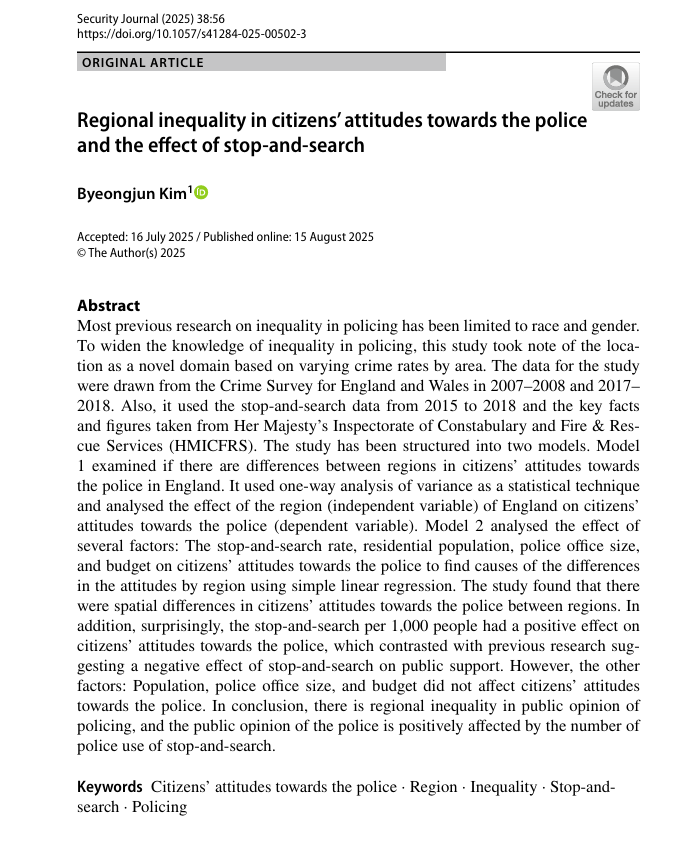
Regional inequality in citizens’ attitudes towards the police and the effect of stop‑and‑search 

By Byeongjun Kim

 Most previous research on inequality in policing has been limited to race and gender. To widen the knowledge of inequality in policing, this study took note of the location as a novel domain based on varying crime rates by area. The data for the study were drawn from the Crime Survey for England and Wales in 2007–2008 and 2017– 2018. Also, it used the stop-and-search data from 2015 to 2018 and the key facts and fgures taken from Her Majesty’s Inspectorate of Constabulary and Fire & Rescue Services (HMICFRS). The study has been structured into two models. Model 1 examined if there are diferences between regions in citizens’ attitudes towards the police in England. It used one-way analysis of variance as a statistical technique and analysed the efect of the region (independent variable) of England on citizens’ attitudes towards the police (dependent variable). Model 2 analysed the efect of several factors: The stop-and-search rate, residential population, police ofce size, and budget on citizens’ attitudes towards the police to fnd causes of the diferences in the attitudes by region using simple linear regression. The study found that there were spatial diferences in citizens’ attitudes towards the police between regions. In addition, surprisingly, the stop-and-search per 1,000 people had a positive efect on citizens’ attitudes towards the police, which contrasted with previous research suggesting a negative efect of stop-and-search on public support. However, the other factors: Population, police ofce size, and budget did not afect citizens’ attitudes towards the police. In conclusion, there is regional inequality in public opinion of policing, and the public opinion of the police is positively afected by the number of police use of stop-and-search.

  Security Journal (2025) 38:56

Social and health characteristics of mothers involved in family court care proceedings in England

By Georgina Ireland, Linda Wijlaars, Matthew A Jay, Claire Grant, Rachel Pearson, Johnny Downs and Ruth Gilbert

This study aimed to determine the risk of mothers being involved in public law family court care proceedings and their social and health characteristics by analysing linked administrative family court and healthcare records. Involvement in care proceedings reflects serious concerns for the care or safety of a child. Local Authority (LA) social care departments can bring care proceedings under Section 31 of the Children Act 1989 due to concerns about significant harm, or risk of significant harm to the child attributable to care given by the parents or the child being beyond parental control. Each year, around 10,000 mothers in England are involved in care proceedings. In 80% of these proceedings, the child is placed with friends or family, unrelated foster carers, in residential care or for adoption. One fifth remain with one or both birth parents, with or without a supervision order.

Recent developments in national and regional linkages of administrative health data to family court or social services data have contributed insights into maternal health needs in Wales, Sweden and Canada, but evidence is lacking for England (5-15). Similar linked data for England would contribute new insights due to the population size, the regional and ethnic variation in England, and variability in determinants of service access and outcomes across different population subgroups. From a policy and practice perspective, evidence from linked data on the health of parents involved in family court care proceedings could inform how and when healthcare and related services could intervene to improve parental health and support, and thereby prevent or mitigate child maltreatment, and in some cases, avoid care proceedings.

Aims and objectives

This study aimed to address the evidence gap in England on the health of mothers involved in care proceedings compared with their peers. We conducted two sub-studies:

  1. In the first, we studied all first-time mothers between 2007-19 in the English NHS, including those involved in care proceedings, to:

  • Create a database of first-time mothers using hospital admission data, linked to care proceedings in England and assess linkage accuracy.

  • Estimate the 10-year risk of care proceedings for first-time mothers in England and describe differences in maternal social and health characteristics at a first birth.

  • Compare the number of births within 10 years to first-time mothers involved and not involved in care proceedings.

  • Assess maternal and birth characteristics associated with recurrent care proceedings.

  • Estimate differences in mortality among mothers involved and not involved in care proceedings.

2. Second, we studied mothers involved in care proceedings and other women using mental health service records in four LAs in south London to:

  • Create a research database that linked records of mothers involved in care proceedings in south London to mental health service data and assess linkage accuracy.

  • Compare the characteristics of mental health service use among mothers involved in care proceedings and other women using mental health services.

  • Compare the risk of death among mothers involved in care proceedings with other women using mental health services.

  • Evaluate patterns of mental health service use before and after start of care proceedings.

London: Nuffield Foundation, 2024. 63p.

Car Theft: The Offender's Perspective

By: Roy Light, Clarie Nee, and Helen Ingham

Most car thieves started in their early to mid-teens, influenced by peers, boredom, and excitement[^1^][1]. Many had extensive criminal careers and came from socially disadvantaged backgrounds. Initial motivations included excitement, financial gain, and a passion for driving. Over time, financial incentives became more prominent. Effective prevention requires early intervention, better car security, and diversionary programs that offer similar excitement to car theft. Offenders often underestimated the likelihood of being caught and the severity of non-custodial penalties. Custodial sentences were seen as a potential deterrent, but not always effective.

ASU Center for Problem-Oriented Policing, HOME OFFICE RESEARCH STUDY NO. 130, 1993