Open Access Publisher and Free Library
CRIME+CRIMINOLOGY.jpeg

CRIME

Violent-Non-Violent-Cyber-Global-Organized-Environmental-Policing-Crime Prevention-Victimization

Posts tagged strain theory
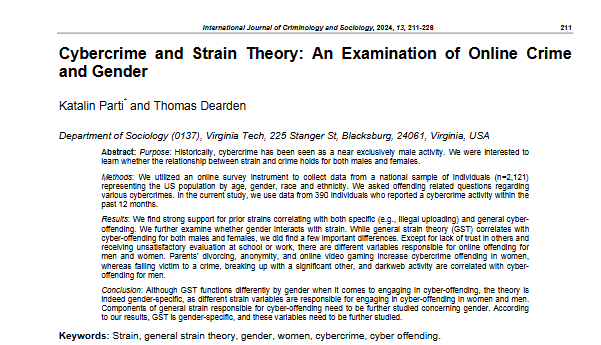
Cybercrime and strain theory: An examination of online crime and gender.

By Katalin Parti, Thomas Dearden

Purpose: Historically, cybercrime has been seen as a near exclusively male activity. We were interested to learn whether the relationship between strain and crime holds for both males and females.

Methods: We utilized an online survey instrument to collect data from a national sample of individuals (n=2,121) representing the US population by age, gender, race and ethnicity. We asked offending related questions regarding various cybercrimes. In the current study, we use data from 390 individuals who reported a cybercrime activity within the past 12 months.

Results: We find strong support for prior strains correlating with both specific (e.g., illegal uploading) and general cyber-offending. We further examine whether gender interacts with strain. While general strain theory (GST) correlates with cyber-offending for both males and females, we did find a few important differences. Except for lack of trust in others and receiving unsatisfactory evaluation at school or work, there are different variables responsible for online offending for men and women. Parents’ divorcing, anonymity, and online video gaming increase cybercrime offending in women, whereas falling victim to a crime, breaking up with a significant other, and darkweb activity are correlated with cyber-offending for men.

Conclusion: Although GST functions differently by gender when it comes to engaging in cyber-offending, the theory is indeed gender-specific, as different strain variables are responsible for engaging in cyber-offending in women and men. Components of general strain responsible for cyber-offending need to be further studied concerning gender. According to our results, GST is gender-specific, and these variables need to be further studied.

International Journal of Criminology and Sociology13, 211–226

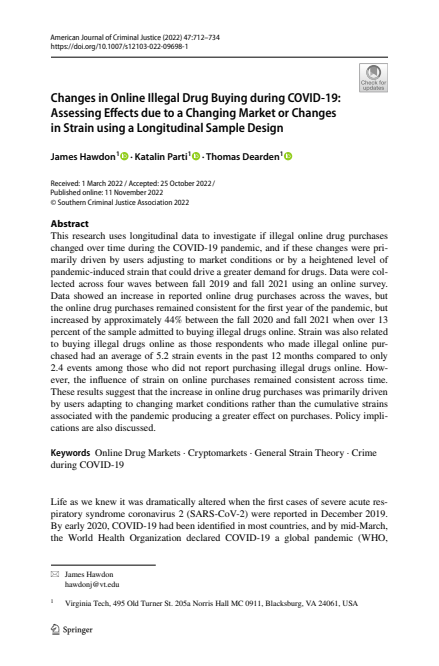
Changes in Online Illegal Drug Buying during COVID‑19: Assessing Effects due to a Changing Market or Changes in Strain using a Longitudinal Sample Design 

By James Hawdon· Katalin Parti  Thomas Dearden

This research uses longitudinal data to investigate if illegal online drug purchases changed over time during the COVID-19 pandemic, and if these changes were primarily driven by users adjusting to market conditions or by a heightened level of pandemic-induced strain that could drive a greater demand for drugs. Data were collected across four waves between fall 2019 and fall 2021 using an online survey. Data showed an increase in reported online drug purchases across the waves, but the online drug purchases remained consistent for the frst year of the pandemic, but increased by approximately 44% between the fall 2020 and fall 2021 when over 13 percent of the sample admitted to buying illegal drugs online. Strain was also related to buying illegal drugs online as those respondents who made illegal online purchased had an average of 5.2 strain events in the past 12 months compared to only 2.4 events among those who did not report purchasing illegal drugs online. However, the infuence of strain on online purchases remained consistent across time. These results suggest that the increase in online drug purchases was primarily driven by users adapting to changing market conditions rather than the cumulative strains associated with the pandemic producing a greater effect on purchases. Policy implications are also discussed.

  American Journal of Criminal Justice (2022) 47:712–734