Open Access Publisher and Free Library
CRIME+CRIMINOLOGY.jpeg

CRIME

Violent-Non-Violent-Cyber-Global-Organized-Environmental-Policing-Crime Prevention-Victimization

Posts in Violence & Oppression
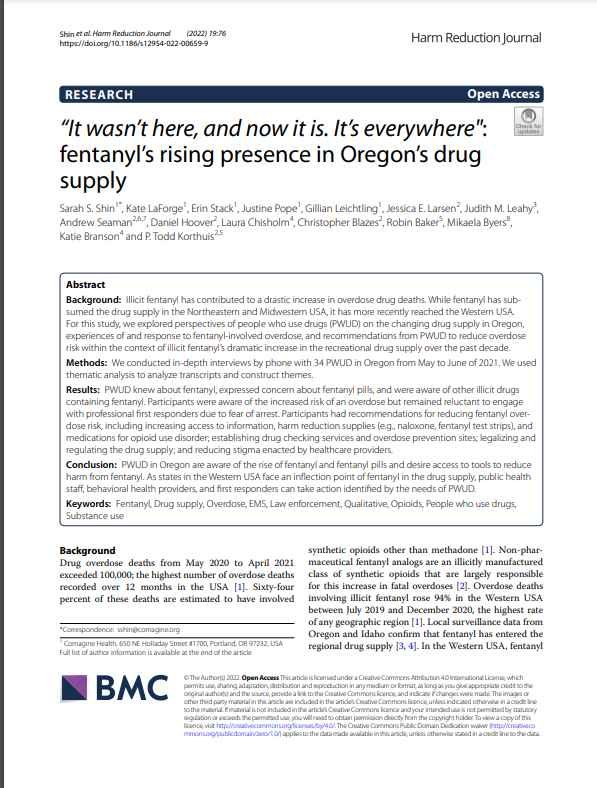
“It wasn’t here, and now it is. It’s everywhere": Fentanyl’s rising presence in Oregon’s drug supply

By Sarah S. Shin, Kate LaForge, Erin Stack, Justine Pope, Gillian Leichtling, Jessica E. Larsen, Judith M. Leahy, Andrew Seaman, Daniel Hoover, Laura Chisholm, Christopher Blazes, Robin Baker, Mikaela Byers, Katie Branson & P. Todd Korthuis

Background

Illicit fentanyl has contributed to a drastic increase in overdose drug deaths. While fentanyl has subsumed the drug supply in the Northeastern and Midwestern USA, it has more recently reached the Western USA. For this study, we explored perspectives of people who use drugs (PWUD) on the changing drug supply in Oregon, experiences of and response to fentanyl-involved overdose, and recommendations from PWUD to reduce overdose risk within the context of illicit fentanyl’s dramatic increase in the recreational drug supply over the past decade.

Methods

We conducted in-depth interviews by phone with 34 PWUD in Oregon from May to June of 2021. We used thematic analysis to analyze transcripts and construct themes.

Results

PWUD knew about fentanyl, expressed concern about fentanyl pills, and were aware of other illicit drugs containing fentanyl. Participants were aware of the increased risk of an overdose but remained reluctant to engage with professional first responders due to fear of arrest. Participants had recommendations for reducing fentanyl overdose risk, including increasing access to information, harm reduction supplies (e.g., naloxone, fentanyl test strips), and medications for opioid use disorder; establishing drug checking services and overdose prevention sites; legalizing and regulating the drug supply; and reducing stigma enacted by healthcare providers.

Conclusion

PWUD in Oregon are aware of the rise of fentanyl and fentanyl pills and desire access to tools to reduce harm from fentanyl. As states in the Western USA face an inflection point of fentanyl in the drug supply, public health staff, behavioral health providers, and first responders can take action identified by the needs of PWUD.

Harm Reduction Journal volume 19, Article number: 76 (2022)
Download
Experiences with rising overdose incidence caused by drug supply changes during the COVID-19 pandemic in the San Diego-Tijuana border metroplex

By C.J. Valaseka , Samantha A. Streuli a, Heather A. Pines , Steffanie A. Strathdeec , Annick Borquez , Philippe Bourgois , Tara Stamos-Buesige , Carlos F. Verac , Alicia Harvey-Verac , Angela R. Bazzi

Background: People who use drugs (PWUD) in the San Diego, USA and Tijuana, Mexico metroplex face high overdose risk related to historic methamphetamine use and relatively recent fentanyl introduction into local drug supplies. The personal overdose experiences of PWUD in this region are understudied, however, and may have been influenced by the COVID pandemic. Methods: From September-November 2021, we conducted 28 qualitative interviews among PWUD ≥18 years old sampled from an ongoing cohort study in the San Diego-Tijuana metroplex. Interviews explored overdose experiences and changes in the drug supply. Thematic analysis of coded interview transcripts explored overdose experiences, perspectives on drug supply changes, interactions with harm reduction services, and naloxone access. Results: Among 28 participants, 13 had experienced an overdose. Participants discussed rising levels of fentanyl in local drug supplies and increasing overdose incidents in their social networks. Participants discussed a general shift from injecting heroin to smoking fentanyl in their networks. Participants’ most common concerns included having consistent access to a safe and potent drug supply and naloxone. Conclusion: Participants prioritized adapting to drug supply changes and preventing overdose compared to other health concerns, such as HIV and COVID-19. Efforts to address overdose in this region could benefit from drug checking services and expanded, equitable delivery of naloxone.

Volume 7, June 2023, 100154, Drug and Alcohol Dependence Reports

Download
Routes of Drug Use Among Drug Overdose Deaths — United States, 2020–2022

By Lauren J. Tanz, R. Matt Gladden, Amanda T. Dinwiddie, Kimberly D. Miller, Dita Broz, Eliot Spector, Julie O’Donnell

Summary

What is already known about this topic?

More than 109,000 drug overdose deaths occurred in the United States in 2022; nearly 70% involved illegally manufactured fentanyls (IMFs). Data from the western United States suggested a transition from injecting heroin to smoking IMFs.

What is added by this report?

From January–June 2020 to July–December 2022, the percentage of overdose deaths with evidence of smoking increased 73.7%, and the percentage with evidence of injection decreased 29.1%; similar changes were observed in all U.S. regions. Changes were most pronounced in deaths with IMFs detected, with or without stimulant detection.

What are the implications for public health practice?

Strengthening and expanding public health and harm reduction services to address overdose risk with smoking and other noninjection routes might reduce deaths.

Preliminary reports indicate that more than 109,000 drug overdose deaths occurred in the United States in 2022; nearly 70% of these involved synthetic opioids other than methadone, primarily illegally manufactured fentanyl and fentanyl analogs (IMFs). Data from the western United States suggested a transition from injecting heroin to smoking IMFs. CDC analyzed data from the State Unintentional Drug Overdose Reporting System to describe trends in routes of drug use in 27 states and the District of Columbia among overdose deaths that occurred during January 2020–December 2022, overall and by region and drugs detected. From January–June 2020 to July–December 2022, the percentage of overdose deaths with evidence of injection decreased 29.1%, from 22.7% to 16.1%, whereas the percentage with evidence of smoking increased 73.7%, from 13.3% to 23.1%. The number of deaths with evidence of smoking increased 109.1%, from 2,794 to 5,843, and by 2022, smoking was the most commonly documented route of use in overdose deaths. Trends were similar in all U.S. regions. Among deaths with only IMFs detected, the percentage with evidence of injection decreased 41.6%, from 20.9% during January–June 2020 to 12.2% during July–December 2022, whereas the percentage with evidence of smoking increased 78.9%, from 10.9% to 19.5%. Similar trends were observed among deaths with both IMFs and stimulants detected. Strengthening public health and harm reduction services to address overdose risk related to diverse routes of drug use, including smoking and other non-injection routes, might reduce drug overdose deaths.

Morbidity and Mortality Weekly Report; February 15, 2024

Download
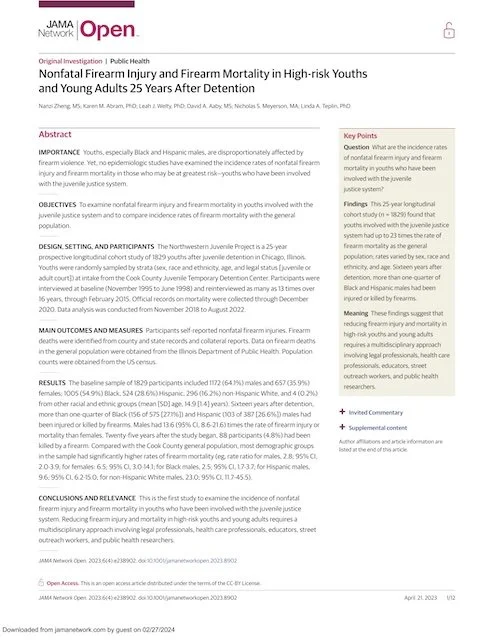
Nonfatal Firearm Injury and Firearm Mortality in High-risk Youths and Young Adults 25 Years After Detention

By Nanzi Zheng, Karen M. Abram,  Leah J. Welty; et alDavid A

Importance  Youths, especially Black and Hispanic males, are disproportionately affected by firearm violence. Yet, no epidemiologic studies have examined the incidence rates of nonfatal firearm injury and firearm mortality in those who may be at greatest risk—youths who have been involved with the juvenile justice system.

Objectives  To examine nonfatal firearm injury and firearm mortality in youths involved with the juvenile justice system and to compare incidence rates of firearm mortality with the general population.

Design, Setting, and Participants  The Northwestern Juvenile Project is a 25-year prospective longitudinal cohort study of 1829 youths after juvenile detention in Chicago, Illinois. Youths were randomly sampled by strata (sex, race and ethnicity, age, and legal status [juvenile or adult court]) at intake from the Cook County Juvenile Temporary Detention Center. Participants were interviewed at baseline (November 1995 to June 1998) and reinterviewed as many as 13 times over 16 years, through February 2015. Official records on mortality were collected through December 2020. Data analysis was conducted from November 2018 to August 2022.

Main Outcomes and Measures  Participants self-reported nonfatal firearm injuries. Firearm deaths were identified from county and state records and collateral reports. Data on firearm deaths in the general population were obtained from the Illinois Department of Public Health. Population counts were obtained from the US census.

Results  The baseline sample of 1829 participants included 1172 (64.1%) males and 657 (35.9%) females; 1005 (54.9%) Black, 524 (28.6%) Hispanic, 296 (16.2%) non-Hispanic White, and 4 (0.2%) from other racial and ethnic groups (mean [SD] age, 14.9 [1.4] years). Sixteen years after detention, more than one-quarter of Black (156 of 575 [27.1%]) and Hispanic (103 of 387 [26.6%]) males had been injured or killed by firearms. Males had 13.6 (95% CI, 8.6-21.6) times the rate of firearm injury or mortality than females. Twenty-five years after the study began, 88 participants (4.8%) had been killed by a firearm. Compared with the Cook County general population, most demographic groups in the sample had significantly higher rates of firearm mortality (eg, rate ratio for males, 2.8; 95% CI, 2.0-3.9; for females: 6.5; 95% CI, 3.0-14.1; for Black males, 2.5; 95% CI, 1.7-3.7; for Hispanic males, 9.6; 95% CI, 6.2-15.0; for non-Hispanic White males, 23.0; 95% CI, 11.7-45.5).

Conclusions and Relevance  This is the first study to examine the incidence of nonfatal firearm injury and firearm mortality in youths who have been involved with the juvenile justice system. Reducing firearm injury and mortality in high-risk youths and young adults requires a multidisciplinary approach involving legal professionals, health care professionals, educators, street outreach workers, and public health researchers.

JAMA Netw Open. 2023;6(4):e238902. doi:10.1001/jamanetworkopen.2023.8902

download
Murder-and-Extremism-in-the-United-States-in-2023

By The Anti-Defamation League Center on Extremism

Every year, individuals with ties to different extreme causes and movements kill people in the United States; the ADL Center on Extremism (COE) tracks these murders. Extremists regularly commit murders in the service of their ideology, to further a group or gang they may belong to, or even while engaging in traditional, non-ideological criminal activities.

In 2023, domestic extremists killed at least 17 people in the U.S., in seven separate incidents. This represents a sharp decrease from the 27 extremist-related murders ADL has documented for 2022—which itself was a decrease from the 35 identified in 2021. It continues a trend of fewer extremist-related killings after a five-year span of 47-79 extremist-related murders per year (2015-2019). One reason for the trend is the decrease in recent years of extremist-related killings by domestic Islamist extremists and left-wing extremists.

The 2023 murder totals include two extremist-related shootings sprees, both by white supremacists, which together accounted for 11 of the 17 deaths. A third shooting spree, also by an apparent white supremacist, wounded several people but luckily did not result in fatalities.

All the extremist-related murders in 2023 were committed by right-wing extremists of various kinds, with 15 of the 17 killings involving perpetrators or accomplices with white supremacist connections. This is the second year in a row that right-wing extremists have been connected to all identified extremist-related killings.

Two of the incidents from 2023 involved women playing some role in the killing or its aftermath. This report includes a special section that examines the role played by women in deadly extremist violence in the United States by analyzing 50 incidents from the past 20 years in which women were involved in some fashion in extremist-related killings

New York: ADL, 2024. 36p.

download
Resistances in the “Resilient City”: Rise and fall of a disputed concept in New Orleans and Medellin

By Patrick Naef

Medellin and New Orleans were regularly presented as resilience flagships of the Rockefeller's 100 Resilient Cities (100RC) program. In this article, I will demonstrate how 100RC was embedded or abandoned in both cities' policies. The two case studies provide an opportunity to understand how the 100RC approach to resilience offered – or failed to offer – an appropriate space for the multiple deployments of resilience. 100RC initially promoted an integrative definition of resilience, aiming to address natural as well as social stresses and shocks. I argue that this holistic approach paradoxically contributed to limiting the multiplicity of resilience in both cities. In Medellin, the project came to a halt after political changes. New Orleans eventually developed a more reductionist and technical approach than that initially formulated, focusing on the effectiveness of infrastructures rather than social changes. Considering the importance of contextualizing resilience to local concerns, this analysis will thus demonstrate some of the challenges implied in the institutionalization of a global model of resilience. Moreover, it will also highlight the importance of contextualizing neoliberalism and question the widespread vision of resilient cities as being merely neoliberal.

June 2022Political Geography 96(1):102603

Download
The Criminal Governance of Tourism: Extortion and Intimacy in Medellin

By Patrick Naef

This article provides a picture of the political economy of tourism and violence in Medellín. It analyses the way criminal actors and tourism entrepreneurs share a territory, by shedding light on the extortion of tour guides, street performers and business owners in some of its barrios populares (poor neighbourhoods). The main objective is to demonstrate how intimate relationships – between and among kin, friends, long-term acquaintances – impact what is considered the criminal governance of tourism. This contribution shows that extortion in Medellín meets only limited resistance from tourism entrepreneurs. It also emphasises how criminals, tourism actors and tourists themselves contribute to the creation of fragile secured spaces in the developing tourist-scapes of Colombia's second city.

Journal of Latin American Studies (2023), 55, 323–348

Download
Sustaining criminal governance with horror: The use of extra-lethal violence to regulate community life

By Reynell Badillo-Sarmiento, Luis Fernando Trejos-Rosero

This article investigates why organised criminal organisations opt for dismemberment, a costly and resource-intensive practice compared to targeted killings. We argue that dismemberment serves two functions for OCGs: first, it demonstrates OCGs' willingness to use gruesome violence against those who challenge their territorial hegemony, and second, it sustains criminal governance regimes by punishing individuals who violate OCGs' regulations. To demonstrate this argument, we analyse 25 cases of dismemberment in Colombia that we compiled during more than four years of fieldwork, review of press archives and databases provided by local authorities. This article contributes to extending the concept of extra-lethal violence to organised crime studies

Working Paper, 2023.

Download
Human-Centered Approach to Technology to Combat Human Trafficking

By Julia Deeb-Swihart

Human trafficking is a serious crime that continues to plague the United States. With the rise of computing technologies, the internet has become one of the main mediums through which this crime is facilitated. Fortunately, these online activities leave traces which are invaluable to law enforcement agencies trying to stop human trafficking. However, identifying and intervening with these cases is still a challenging task. The sheer volume of online activity makes it difficult for law enforcement to efficiently identify any potential leads. To compound this issue, traffickers are constantly changing their techniques online to evade detection. Thus, there is a need for tools to efficiently sift through all this online data and narrow down the number of potential leads that a law enforcement agency can deal with. While some tools and prior research do exist for this purpose, none of these tools adequately address law enforcement user needs for information visualizations and spatiotemporal analysis. Thus to address these gaps, this thesis contributes an empirical study of technology and human trafficking. Through in-depth qualitative interviews, systemic literature analysis, and a user-centered design study, this research outlines the challenges and design considerations for developing sociotechnical tools for anti-trafficking efforts. This work further contributes to the greater understanding of the prosecution efforts within the anti-trafficking domain and concludes with the development of a visual analytics prototype that incorporates these design considerations.

Dissertation. Atlanta: Georgia Institute of Technology, 2022.

Download
How ‘Outlaws’ React: a Case Study on the Reactions to the Dutch Approach to Outlaw Motorcycle Gangs

By Teun van Ruitenburg, Sjoukje van Deuren & Robby Roks

The impact of organized crime measures remains largely unknown. Moreover, for practical and ethical reasons, the perspectives of the individuals who are subjected to organized crime policies are often not included in research. Based on semi-structured interviews with 24 current members of the Dutch Hells Angels Motorcycle Club (HAMC), this study fills this knowledge gap by examining how HAMC members reacted to the multi-agency approach to outlaw motorcycle gangs (OMCGs) in the Netherlands. The results of this study illustrate that the reactions of HAMC members can be divided into four categories: (1) conforming, (2) adapting, (3) resisting, and (4) continuing. The analysis furthermore shows that a variety of different reactions to the OMCG approach coexist within the same club, charter, and even within the same individual member. These findings indicate that crime policies can spark different, sometimes contradicting reactions, within a group that from the outside appears to be a uniform and top-down coordinated organization. Future evaluation studies should take the multifaceted nature of reactions to crime policies into consideration.

Eur J Crim Policy Res (2024). https://doi.org/10.1007/s10610-023-09566-6

download
Revolution and Witchcraft: The Code of Ideology in Unsettled Times

By Gordon C. Chang

Ideas influence people. In particular, extremely well-developed sets of ideas shape individuals, groups, and societies in far-reaching ways. This book establishes these “idea systems” as an academic concept. Through three intense episodes of manipulation and mayhem connected to idea systems—Europe’s witch hunts, the Mao Zedong-era “revolutions,” and the early campaign of the U.S. War on Terror—this book charts the cognitive and informational matrices that seize control of people’s mentalities and behaviors across societies. Through these, the author reaches two conclusions. The first, that we are all vulnerable to the dominating influence of our own matrices of ideas and to those woven by others in the social system. The second, that even the most masterful manipulators of idea programs may lose control of the outcomes of programmatic manipulation. Amongst this analysis, sixty-plus central conceptual terminologies are provided for readers to analyze multiform idea systems that exist across space, time, and cultural contexts.

Cham: Springer Nature, 2023. 415p.

download
Realizing the Witch: Science, Cinema, and the Mastery of the Invisible

By Richard Baxstrom, Todd Meyers

Benjamin Christensen’s Häxan (The Witch, 1922) stands as a singular film within the history of cinema. Deftly weaving contemporary scientific analysis and powerfully staged historical scenes of satanic initiation, confession under torture, possession, and persecution, Häxan creatively blends spectacle and argument to provoke a humanist re-evaluation of witchcraft in European history as well as the contemporary treatment of female “hysterics” and the mentally ill. In Realizing the Witch, Baxstrom and Meyers show how Häxan opens a window onto wider debates in the 1920s regarding the relationship of film to scientific evidence, the evolving study of religion from historical and anthropological perspectives, and the complex relations between popular culture, artistic expression, and concepts in medicine and psychology. Häxan is a film that travels along the winding path of art and science rather than between the narrow division of “documentary” and “fiction.”

New York: Fordham University Press, 2015. 

download
Witchcraft, Gender and Society in Early Modern Germany

By Jonathan B. Durrant

Using the example of Eichstätt, this book challenges current witchcraft historiography by arguing that the gender of the witch-suspect was a product of the interrogation process and that the stable communities affected by persecution did not collude in its escalation. Readership: All those interested in the history of witch persecution, gender history, the history of the Catholic Reformation, and the history of early modern Germany.

Leiden; Boston: Brill,  2007.  317p.

download
Witchcraft narratives in Germany: Rothenburg, 1561-1652

By Alison Rowlands

Given the widespread belief in witchcraft and the existence of laws against such practices, why did witch-trials fail to gain momentum and escalate into 'witch-crazes' in certain parts of early modern Europe? This book answers this question by examining the rich legal records of the German city of Rothenburg ob der Tauber, a city which experienced a very restrained pattern of witch-trials and just one execution for witchcraft between 1561 and 1652. The author explores the factors that explain the absence of a 'witch-craze' in Rothenburg, placing particular emphasis on the interaction of elite and popular priorities in the pursuit (and non-pursuit) of alleged witches at law. By making the witchcraft narratives told by the peasants and townspeople of Rothenburg central to its analysis, the book also explores the social and psychological conflicts that lay behind the making of accusations and confessions of witchcraft. Furthermore, it challenges existing explanations for the gender-bias of witch-trials, and also offers insights into other areas of early modern life, such as experiences of and beliefs about communal conflict, magic, motherhood, childhood and illness. Written in a lively narrative style, this innovative study invites a wide readership to share in the compelling drama of early modern witch trials. It will be essential reading for researchers working in witchcraft studies, as well as those in the wider field of early modern European history.

Manchester, UK: Manchester University Press, 2003. 257p.

download
Envy, Poison, and Death: Women on Trial in Classical Athens

By Esther Eidinow 

At the heart of this book are some trials conducted in Athens in the fourth century BCE. In each case, the charges involved a combination of supernatural activities, including potion-brewing and cult activity; the defendants were all women. Because of the brevity of the ancient sources, and their lack of agreement, the precise charges are unclear; the reasons for taking these women to court, even condemning some of them to die, remain mysterious. This book takes the complexity and confusion of the evidence not as a riddle to be solved, but as revealing multiple social dynamics. It explores the changing factors—material, ideological, and psychological—that may have provoked these events. It focuses in particular on the dual role of envy (phthonos) and gossip as processes by which communities identified people and activities that were dangerous, and examines how and why those local, even individual, dynamics may have come to shape official civic decisions during a time of perceived hardship. At first sight so puzzling, these trials come to provide a vivid glimpse of the sociopolitical environment of Athens during the early to mid-fourth century BCE, including responses to changes in women’s status and behaviour, and attitudes to particular supernatural/religious activities within the city. This study reveals some of the characters, events, and local social processes that shaped an emergent concept of magic: it suggests that the legal boundary of acceptable behaviour was shifting, not only within the legal arena, but also with the active involvement of society beyond the courts.

Oxford, UK: Oxford University Press, 2015. 440p.

download
Older Offenders in the Federal System

By Kristin M. Tennyson, Lindsey Jeralds, Julie Zibulsky

Congress requires courts to consider several factors when determining the appropriate sentence to be imposed in federal cases, among them the “history and characteristics of the defendant.” The sentencing guidelines also specifically authorize judges to consider an offender’s age when determining whether to depart from the federal sentencing guidelines. In this report, the Commission presents information on a relatively small number of offenders who were aged 50 or older at the time they were sentenced in the federal system. In particular, the report examines older federal offenders who were sentenced in fiscal year 2021 and the crimes they committed, then assesses whether age was given a special consideration at sentencing. This report specifically focuses on three issues that could impact the sentencing of older offenders: age and infirmity, life expectancy, and the risk of recidivism.

Washington, DC: United States Sentencing Commission, 2022. 68p.

download
What Does Federal Economic Crime Really Look Like?

By Courtney Semisch

This publication provides data on the broad variety of economic crime sentenced under §2B1.1.  The Commission undertook a project to systematically identify and classify the myriad of economic crimes sentenced under §2B1.1 using offenders' statutes of conviction and offense conduct. The Commission used this two-step methodology to assign the 6,068 offenders sentenced under §2B1.1 in fiscal year 2017 to one of 29 specific types of economic crime. This publication provides, for the first time, data from this new project as well as a brief description of the study's methodology.

Washington, DC: United States Sentencing Commission, 2019. 87p.

download
The Criminal History of Federal Economic Crime Offenders

By Courtney Semisch

For the first time, this report provides in-depth criminal history information about federal economic crime offenders, combining the most recently available data from two United States Sentencing Commission projects. Key findings are that the application of guideline criminal history provisions differed among the different types of economic crime offenders. Also, The extent of prior convictions differed among the different types of economic crime offenders. Federal economic crime offenders did not “specialize” in economic crime. The severity of criminal history differed for offenders in the specific types of economic crime. Only about one-quarter of federal economic crime offenders with prior convictions were not assigned criminal history points under the guidelines.

Washington, DC: United States Sentencing Commission, 2020. 56p.

download
Path of Federal Criminality: Mobility and Criminal History

By Tracey Kyckelhahn, Tiffany Choi

This study expands on prior Commission research by examining the geographic mobility of federal offenders. For this report, mobility is defined as having convictions in multiple states, including the location of the conviction for the instant offense. This report adds to the existing literature on offender criminal history in two important ways. First, the report provides information on how mobile federal offenders are, as measured by the number of offenders with convictions in multiple states. Second, the report provides information on the proportion of offenders with convictions in states other than the state in which the offender was convicted for the instant offense. The report also examines the degree to which out-of-state convictions in offenders’ criminal histories contributed to their criminal history score and their Criminal History Category.

Washington, DC: United States Sentencing Commission, 2020.  24p.

download
Illicitly Manufactured Fentanyl Entering the United States 

By Joseph Pergolizzi , Peter Magnusson , Jo Ann K. LeQuang , Frank Breve

The 'third wave' of the ongoing opioid overdose crisis in the United States (US) is driven in large measure by illicitly manufactured fentanyl (IMF), a highly potent synthetic opioid or an analog developed in clandestine laboratories primarily in China and Mexico. It is smuggled into this country either as IMF or as precursors. The southern border of the US is a frequent point of entry for smuggled IMF and the amounts are increasing year over year. IMF is also sometimes mixed in with other substances to produce counterfeit drugs and dealers as well as end-users may not be aware of IMF in their products. IMF is inexpensive to produce and when mixed with filler materials can be used to cut heroin, vastly expanding profitability. It is an attractive product for smuggling as very tiny amounts can be extremely potent and highly profitable. Drug trafficking over the border also involves the tandem epidemic of money laundering as drugs enter the country and cash payments exit. While drug smuggling in and out of the US (and other nations) has been going on for decades, the patterns are changing. Highly potent and potentially lethal IMF is a dangerous new addition to the illicit drug landscape and one with disastrous consequences. 

Cureus  Open Access Review Article 2021. 11p

download