Open Access Publisher and Free Library
CRIME+CRIMINOLOGY.jpeg

CRIME

Violent-Non-Violent-Cyber-Global-Organized-Environmental-Policing-Crime Prevention-Victimization

Posts in Violence & Oppression
‘We just want to find our children’ Understanding disappearances as a tool of organized crime

By Radha Barooah and Ana Paula Oliveira Siria Gastélum Félix

This brief aims to bring specific local perspectives to the broader global policymaking agenda, and is intended to inform government officials and policymakers, as well as civil society groups working in this field.

EXECUTIVE SUMMARY People from all walks of life have disappeared during Mexico’s so-called ‘war on drugs’; many others become victims of the growing global human trafficking industry; migrants go missing as they travel to seek a better life elsewhere, often displaced by criminal groups. Vulnerable youth, particularly young boys, are co-opted by criminal interests and then ‘disappeared’ to forcibly join gangs, often groomed to provide gang ‘muscle’ or traffic drugs.1 Women and children are often trafficked for sexual exploitation and forced labour.2 Many activists, journalists, politicians and whistle-blowers who campaign against organized crime or corruption have disappeared. Disappearances – as we define the phenomenon in this paper – are deployed for various reasons: to silence the voices of social and political leaders, activists and journalists; to assert violent control over criminal territories and illicit markets; or to monetize vulnerable people as a tradeable commodity. In all these cases, criminal groups have a hand, and although organized crime-related disappearances vary in motive and scope, they disproportionately affect the most marginalized communities. Criminal groups therefore instrumentalize disappearances for different objectives. But a fundamental challenge of dealing with this widespread problem is that cases are rarely differentiated and often assumed by law enforcement authorities to be one-off isolated incidents. However, when examining this issue closely, there is a more menacing pattern behind them, namely that they are often perpetrated by organized criminal groups operating in a particular community or controlling a market territory. By not discerning this broader picture of underlying criminal intent, by focusing on the what and ignoring the why, the phenomenon tends to receive limited attention in public policy agendas. There is also inadequate institutional support and investigative work, which has the effect of impeding victims’ access to justice. The international framework designed to address enforced disappearances – the International Convention for Protection of All Persons from Enforced Disappearances (ICPPED)3 – requires that state involvement in the act (in the form of collusion, authorization or acquiescence) is proven in order to trigger its obligations. Compounding this, the conditions of state involvement and the role of organized crime actors are not clearly set out in the wording of the convention, so cases of disappearances linked to illicit economies tend to be confined to the margins of national and international agendas. Meanwhile, the international human rights discourse on disappearances perpetrated by non-state actors (e.g. criminal groups or networks) has progressed to a certain degree, but it, too, remains ill-equipped to determine the conditions and factors of collusion between organized crime and state actors that would amount to authorization, acquiescence or omission. These imprecisions and gaps in the legal framework result in a general lack of institutional support for victims and their families. Despite this, individuals and communities affected by this crime have developed mechanisms to respond. Since 2019, the Global Initiative Against Transnational Organized Crime (GI-TOC), through its Resilience Fund, has supported over 50 community-based initiatives and activists searching for people who have disappeared, including relatives seeking justice and journalists investigating disappearances related to organized crime around the world.4 The Resilience Fund has documented first-hand experiences through interviews and dialogues and provided financial and capacity-building support.5 This brief draws from the work and perspectives of such civil society and community members who live in environments that are exposed to disappearances. It assesses this form of organized crime as a serious human rights violation. While informed by the global dynamics of this criminal market, it focuses on contexts in which disappearances occur in Latin America, analyzing in particular the cases of Mexico and Venezuela. The first setting examines how criminal groups strategically deploy disappearances to fulfill various objectives; the other considers how disappearances occur in the mining sector, which experiences a high prevalence of criminality. This policy brief therefore aims to bring these specific local perspectives to the broader global policymaking agenda, and is intended to inform government officials and policymakers, as well as civil society groups working in this field. While some of the evidence in the brief is anecdotal, the authors have corroborated it with open-source data and a literature review. The analysis is exploratory and is designed to add to a small yet growing body of literature on disappearances among vulnerable communities exposed to organized crime and amplify understanding of the pressing nature of the problem in policy circles.

Geneva, SWIT: Global Initiative Against Transnational Organized Crime. 2024. 28p.

Download
The War of Thieves: Illicit networks, commoditized violence and the arc of state collapse in Sudan

By J.R. Mailey

Sudan’s current conflict, which erupted in April 2023, is the latest chapter in a story of rival predatory networks competing for control over formal and illicit economies, the information environment and the use of organized violence.

As the Sudan Armed Forces (SAF) and Rapid Support Forces (RSF) spread death and destruction across the country, fuelling a humanitarian crisis, their battle is driven by the desire to preserve their vast economic empires and the systems that support them.

This report explores the intricate web of illicit networks, armed conflicts, and the devastating impact on Sudan’s socio-political landscape. It explores how predatory networks commoditize violence, exploit strategic industries, and manipulate state institutions for their gain. From the militarization of the economy to the instrumentalization of criminal markets, this investigation sheds light on the arc of state collapse and the urgent need for comprehensive peacebuilding strategies.

The paper is the first in a series focusing on Sudan, aiming to present an overview about the competition for control of Sudan’s security services, civilian bureaucracy and strategic industries. The following reports will explore the people, institutions, networks and transactions that have underpinned the enduring ecosystem of crime and corruption in Sudan that ultimately gave way to the current civil war.

Geneva, SWIT: Global Initiative Against Transnational Organized Crime, 2024. 28p.

Download
Haiti: A Path to Stability for a Nation in Shock

By The International Crisis Group Latin America and Caribbean

What’s new? The assassination in July of Haitian President Jovenel Moïse, perpetrated with no apparent resistance from his elite security detail, and a bout of natural disasters weeks later have further destabilised an already fragile Haiti and intensified its humanitarian crisis at a time of extreme insecurity. Why does it matter? Coming amid intersecting political, human rights, economic and humanitarian crises, Moïse’s killing and other recent events have exposed the chronic failings of state authorities and difficulties in ensuring that foreign support is deployed effectively. Growing insecurity is also driving instability and increased migrant flows within and outside the country. What should be done? Funnelling aid to vulnerable people hit by recent natural disasters, preferably through local civil society, is the imperative. International back ing for prosecuting high-level crimes, police reform and support for a broad-based representative and inclusive interim government stand a better chance than a rush to elections of helping restore stability.

Bogotá/New York/Brussels, The International Crisis Group, 30 September 2021 24p.

Download
Haiti’s criminal markets: Mapping Trends in Firearms and Drug Trafficking

By United Nations Office on Drugs and Crime (UNODC); Robert Muggah, et al.

KEY FINDINGS

  • Increasingly sophisticated and high-calibre firearms and ammunition are being trafficked into Haiti amid an unprecedented and rapidly deteriorating security situation.

  • Haiti remains a trans-shipment country for drugs, primarily cocaine and cannabis, which mostly enter the country via boat or plane, arriving through public, private and informal ports as well as clandestine runways.

  • Haiti’s borders are essentially porous, and the challenges of patrolling 1,771 kilometres of coastline and a 392-kilometre land border with the Dominican Republic are overwhelming the capacities of Haiti’s national police, customs, border patrols and coast guard, who are severely under-staffed and under-resourced, a variety of sources with their attendant limitations, including unverified media reports, to take account of recent developments. It opens with a cursory overview of the criminal context in which firearms and drug trafficking are occurring. The second section considers the basic infrastructure that facilitates trafficking, especially seaports, roads and airstrips. Sections three and four examine patterns of trafficking of both firearms and drugs into and out of Haiti. The final section summarizes global, regional and national measures to address related challenges, alongside knowledge gaps warranting deeper investigation. Given the evolving circumstances, any attempt to document firearms and drug trafficking trends in Haiti will be fragmented and partial. Even so, certain tendencies and patterns can be discerned. Very generally, firearms and ammunition typically enter Haiti via land and sea, and drugs usually transit Haiti from seaports, airports and across poorly monitored border points. Most weapons are sourced in the US and make their way to gang members and private residents through intermediaries, often through public and private ports and porous checkpoints. Whether they are interdicted or not, most drugs passing through Haiti are produced in Colombia (cocaine) or Jamaica (cannabis) and shipped directly from source, or pass via Bahamas, Turks and Caicos, and Venezuela. From Haiti they are shipped onward to the Dominican Republic, Western Europe and, primarily, the US. and increasingly targeted by gangs.

  • Heavily armed criminal gangs are targeting ports, highways, critical infrastructure, customs offices, police stations, court houses, prisons, businesses and neighbourhoods.

  • Virtually every metric of insecurity, from homicide, sexual violence and kidnapping to the killing of police and migration out of the country – is trending upward.

  • International, regional and national responses have underscored the importance of increasing support to law enforcement and border management. Comprehensive approaches encompassing investments in community policing, criminal justice reform and anti-corruption measures are crucial to delivering sustainable peace and stability in Haiti.

Haiti is in the grip of multiple, interlocking, and cascading crises. If unattended, there are serious risks of further destabilization from a myriad of increasingly powerful criminal armed groups. The risks of regional spill-over and contagion are widely acknowledged: The United Nations Security Council has repeatedly raised concerns about the country’s “protracted and deteriorating political, economic, security, human rights, humanitarian and food security crises” and “extremely high levels of gang violence and other criminal activities”. 1 A particular preoccupation relates to the contribution of illegal firearms and drug trafficking in fuelling Haiti’s deepening security dilemmas. This assessment provides an overview of the scope, scale and dynamics of firearms and drug trafficking in Haiti, including sources, routes, vectors and destinations. It is based on published and unpublished information and 45 interviews conducted by UNODC with representatives of the Haitian government, bilateral and multilateral agencies, subject matter experts, and Haitian civil society.2 The situation in the country is deteriorating rapidly, and this assessment has drawn upon

Vienna: UNODC, 2023. 47p.

Download
‘County lines’: Racism, safeguarding and statecraft in Britain

By Insa Koch, Patrick Williams, and Lauren Wroe

Government policies relating to dealers in ‘county lines’ drugs trafficking cases have been welcomed as a departure from punitive approaches to drugs and ‘gang’ policing, in that those on the bottom rung of the drugs economy of heroin and crack cocaine are no longer treated as criminals but as potential victims and ‘modern slaves’ in need of protection. However, our research suggests not so much a radical break with previous modes of policing as that the term ‘county lines’ emerged as a logical extension of the government’s racist and classist language surrounding ‘gangs’, knife crime and youth violence. Policies implemented in the name of safeguarding the vulnerable also act as a gateway for criminalisation not just under drugs laws but also modern slavery legislation. The government’s discovery of, and responses to, ‘county lines’ hinge on a moral crisis in the making, which ultimately deepens the state’s pre-emptive and violent criminalisation of the ‘Black criminal other’ at a time of deep political crisis.

First published online November 15, 2023., Race & Class, 0(0). https://doi.org/10.1177/03063968231201325

Download
Jamaica: Fear of organised criminal groups: Country Policy and Information Note

By The U.K. Home Office

Purpose - This note provides country of origin information (COI) and analysis of COI for use by Home Office decision makers handling particular types of protection and human rights claims (as set out in the Introduction section). It is not intended to be an exhaustive survey of a particular subject or theme. It is split into 2 parts: (1) an assessment of COI and other evidence; and (2) COI. These are explained in more detail below. Assessment This section analyses the evidence relevant to this note - that is information in the COI section; refugee/human rights laws and policies; and applicable caselaw - by describing this and its inter-relationships, and provides an assessment of, in general, whether one or more of the following applies:

  • A person is reasonably likely to face a real risk of persecution or serious harm

  • That the general humanitarian situation is so severe that there are substantial grounds for believing that there is a real risk of serious harm because conditions amount to inhuman or degrading treatment as within paragraphs 339C and 339CA(iii) of the Immigration Rules/Article 3 of the European Convention on Human Rights (ECHR)

  • That the security situation is such that there are substantial grounds for believing there is a real risk of serious harm because there exists a serious and individual threat to a civilian’s life or person by reason of indiscriminate violence in a situation of international or internal armed conflict as within paragraphs 339C and 339CA(iv) of the Immigration Rules

  • A person is able to obtain protection from the state (or quasi state bodies)

  • A person is reasonably able to relocate within a country or territory

  • A claim is likely to justify granting asylum, humanitarian protection or other form of leave, and

  • If a claim is refused, it is likely or unlikely to be certifiable as ‘clearly unfounded’ under section 94 of the Nationality, Immigration and Asylum Act 2002. Decision makers must, however, still consider all claims on an individual basis, taking into account each case’s specific facts.

London: Assets Publishing Service, 2022. 84p.

Download
How Organised Crime Operates Illegal Betting, Cyber Scams & Modern Slavery in Southeast Asia

By  James Porteous

This report examines human trafficking linked to organised crime groups involved in illegal betting and related criminal activity in four key regions in Southeast Asia. Research was primarily via desktop information gathering conducted in 2022/23, supplemented by the expertise and existing knowledge of the Mekong Club and the Asian Racing Federation Council on Anti-Illegal Betting and Related Financial Crime in human trafficking and illegal betting, respectively. Key findings are: • Tens of thousands of people are being held in modern slavery conditions to work in organised illegal betting and cyber-scam operations across Southeast Asia. • These operations, which are run by individuals with long histories of involvement in illegal betting and organised crime across Asia, are estimated to make at least USD 40 to 100 billion a year in illicit profits from such activity. • Some individuals are recruited on false job advertisements, have their passports removed and are kept in dormitories attached to fully contained casino compounds as forced labour to promote illegal betting websites and engage in industrial-scale cyber-fraud such as “pig butchering”, romance scams, and cryptocurrency Ponzi schemes. • Workers are typically not permitted to leave without paying large ransoms to their captors, and can be sold and traded between organised crime groups. Fines for breaking rules or failing to hit monetary targets are added to victims’ ransoms. • Reports on victim testimony and online video shows “staff” being beaten with iron bars, shocked with cattle prods, tied up, and subject to other forms of torture. Female victims have been forced into sex work for failing to meet targets. • The groups running such operations have been active in organising and promoting gambling across Asia since at least the 1990s. Because many of the core activities in this business (e.g., movement of money across borders, violent debt collection, bribery of local officials, provision of related “entertainment” such as narcotics and sex), are illicit, such operations have by necessity been closely associated with, or directly run by, individuals with organised crime backgrounds. • In the early 2000s, this business was supercharged by the development of online gambling (both casino games and sports betting), run directly out of existing casinos or related properties, which massively increased the target market, and has grown to be a trillion dollar illegal industry funding organised crime. • Attempts to profit from this by governments in Southeast Asia, typically by licensing operators for a fee, have led to the spread of such operations across the region and had major negative impacts, including widespread corruption. It has also concentrated operations in self-contained compounds and so-called special economic zones which local police are often unwilling or unable to enter or investigate. • Hundreds of thousands of workers are required to serve the industry in marketing, customer recruitment, funds transfers, tech support and related fields. • Pre-pandemic, demand for workers was usually satisfied by voluntary means, although an unknown percentage of “voluntary” arrivals were held in modern-slavery like conditions, and there were related human trafficking aspects such as trafficking of sex workers to serve the industry. • This began to change in 2018 as a result of China’s growing concern over cross-border illegal betting, and change was accelerated massively by travel restrictions due to the pandemic, which cut off the supply of workers. • At the same time, the organised criminal groups had a key business line – land-based casinos – essentially closed down because of travel restrictions. As a result, they greatly expanded and developed existing cyber-scam operations, leveraging their expertise and technology in areas such as social media marketing, customer recruitment and cryptocurrency, which were in place from their online illegal betting operations. • Now, as the pandemic recedes, the organised crime groups running these operations have, in effect, hugely increased their potential revenue by complementing illegal betting with cyber-scam operations of comparable scale. • The success of such operations has been an enormous financial boon to organised crime, for whom cyber scams and illegal betting are just two of many illicit business lines that include money laundering as a service, illicit wildlife trafficking and production and distribution of methamphetamine and heroin. • The vast profits from such operations have provided plentiful ammunition to corrupt local authorities, and the operations in this group are frequently protected by powerful politicians and/or armed militias. • Global attention on the issue has not eliminated this activity, just displaced it into even more vulnerable jurisdictions, leading some to fear the industry could lead to geopolitical instability.   

Hong Kong: Asian Racing Federation, 2023. 39p.

Download
The Politics of Black Joy: Zora Neale Hurston and Neo-Abolitionism

By Lindsey Stewart

In the antebellum period, slave owners weaponized southern Black joy to argue for enslavement while abolitionists wielded sorrow by emphasizing racial oppression. Both arguments were so effective that a political uneasiness on the subject still lingers. Lindsey Stewart wades into these uncomfortable waters by developing Zora Neale Hurston’s contributions to political theory and philosophy of race by introducing the politics of joy as a refusal of neo-abolitionism, a political tradition that reduces southern Black life to tragedy or social death. Zora Neale Hurston’s essays, Beyoncé’s Lemonade, and figures including Frederick Douglass, W.E.B. Du Bois, Toni Morrison, Angela Davis, Saidiya Hartman, Imani Perry, Eddie Glaude, and Audra Simpson offer crucial insights and new paths for our moment. Examining popular conceptions of Black political agency at the intersection of geography, gender, class, and Black spirituality, The Politics of Black Joy is essential reading.

Evanston, IL: Northwestern University Press, 2021. 210p.

Download
The World as Abyss: The Caribbean and Critical Thought in the Anthropocene

By Jonathan Pugh and David Chandler

This book is about a distinctive ‘abyssal’ approach to the crisis of modernity. In this framing, influenced by contemporary critical Black studies, another understanding of the world of modernity is foregrounded – a world violently forged through the projects of Indigenous dispossession, chattel slavery and colonial world-making. Modern and colonial world-making violently forged the ‘human’ by dividing those with ontological security from those without, and by carving out the ‘world’ in a fixed grid of space and time, delineating a linear temporality of ‘progress’ and ‘development’. The distinctiveness of abyssal thought is that it inverts the stakes of critique and brings indeterminacy into the heart of ontological assumptions of a world of entities, essences, and universal determination. This is an approach that does not focus upon tropes of rescue and salvation but upon the generative power of negation. In doing so, it highlights how Caribbean experiences and writings have been drawn upon to provide an important and distinct perspective for critical thought. "How is it that ontology has come to be seen as the antidote for modernity? While Foucault denigrated ontology as a mistaken and parochial exercise, contemporary social theory holds out the promise that new modes of planetary knowledge will save us from our own excesses. Drawing together long traditions in Caribbean scholarship with Afro-pessimist thought, Pugh and Chandler illustrate how the search for more emancipatory ontologies - relational ontologies, indigenous ontologies, non-human ontologies, etc. – not only misunderstands the problem of modernity but (more importantly) works to veil the negative force that marks both the limit and cause of all such knowledge practices: what they term the abyss. To engage in abyssal thought – as they lay out – is to inhabit a site of refusal: a determination not to be drawn into the lure of ontological ‘correction’ and to recognise that the practice of world making cannot not bear the imprint of colonial violence.

Westminster, UK: University of Westminster Press, 2023. 122p.

Download
Report of the Board of Inquiry into historical child sexual abuse in Beaumaris Primary School and certain other government schools

By Kathleen Foley SC Chair, et al.

The Board of Inquiry has found that the Department woefully failed to protect children from the risk of child sexual abuse at Beaumaris Primary School and certain other government schools between 1960 and 1994. The failings were serious and systemic and put many children at risk of sexual abuse.

Child sexual abuse is abhorrent. It can have life-long effects for victim-survivors. It can affect people’s mental health and well-being, relationships, and education and employment outcomes in ways that are profound and enduring. For some people, the weight of trauma can be too heavy to bear, and their loss causes deep grief for those left behind. The impacts are not confined to victim-survivors but extend to their loved ones, those who witnessed the child sexual abuse, and the broader community.

Despite the challenges, healing is possible. The Board of Inquiry heard about many experiences of personal healing from victim-survivors and their families — examples of courage and examples of hope. There were also many experiences shared about difficulties in finding the right help when it was desperately needed. It is important to understand the factors that contribute to healing and recovery, so that healing and recovery are within reach of all who need it.

The Board of Inquiry has examined the past to identify and understand historical wrongs. In addition, examining the past enables the broader community to move forward. By understanding where the education system failed, we can also better understand how to prevent further child sexual abuse occurring in government schools.

The report comprises six parts:

  • The preliminary material contains, in addition to this executive summary, the official documents connected to the delivery of the report, and a message from the Chair.

  • Part A, The Board of Inquiry, describes the establishment of the Board of Inquiry, explains how it approached its work, and contains important information concerning how it interpreted and applied the Terms of Reference.

  • Part B, Experience, places children’s safety in context by describing relevant policy settings and social and cultural factors present in communities between 1960 and 1999, particularly during the 1960s and 1970s, before documenting experiences of child sexual abuse and its impacts from the perspective of victim-survivors. This Part also includes 15 narratives from victim-survivors, secondary victims and affected community members in which they recall their experiences, in their own words.

  • Part C, Accountability, describes the education system between 1960 and 1999. It includes the narratives of four of the relevant employees who were examined in depth by the Board of Inquiry, explores concepts of grooming and disclosure, and outlines various system failings by the Department at that time. It then describes how child safety settings within government schools have since improved.

  • Part D, Healing, support and the future, describes the factors that promote recovery from child sexual abuse and the support services currently available to victim-survivors of historical child sexual abuse in government schools. It then explores barriers to effective support and how they could be addressed as part of an overall approach to healing. This Part includes the Board of Inquiry’s recommendations for the Victorian Government and the Department to support healing and address barriers to effective support. While these recommendations are drawn from the entirety of the Board of Inquiry’s work, they are particularly directed to the ‘healing’ and ‘support services’ aspects of the Terms of Reference.

  • Part E, Appendices, contains a range of documents to assist and inform readers.

Melbourne: Government of Victoria, 2024. 466p.

Download
Forces of Terror: Armed Banditry and Insecurity in North-west Nigeria

By John Sunday Ojo, Samuel Oyewole & Folahanmi Aina

Nigeria has confronted several security conundrums in recent years, including armed banditry, which poses a severe threat to the north-west and the entire nation. North-west Nigeria has been hit by an unprecedented wave of kidnappings, maiming, killings, population displacements, cattle rustling, and disruption of socio-economic activities due to the rise of armed bandits in the region. These events have created a climate of uncertainty that has become a cause for concern for the government and the citizenry. Relying on secondary sources of data, this article examines the causes, manifestations, and dimensions of armed banditry in north-west Nigeria, and its security implications. It provides a survey of both the visible and less-visible actors in the conflict. The article argues that armed banditry in the north-west and other parts of Nigeria transcends pastoralist insurgency, as evident in the dominant narratives, considering the multiplicity of complexly connected causal factors, actors, manifestations, and dimensions that are present in the threats posed by this development. The article also shows the negative impacts of armed banditry on human and national security in the region.

Democracy and Security, Volume 19, 2023 - Issue 4

Download
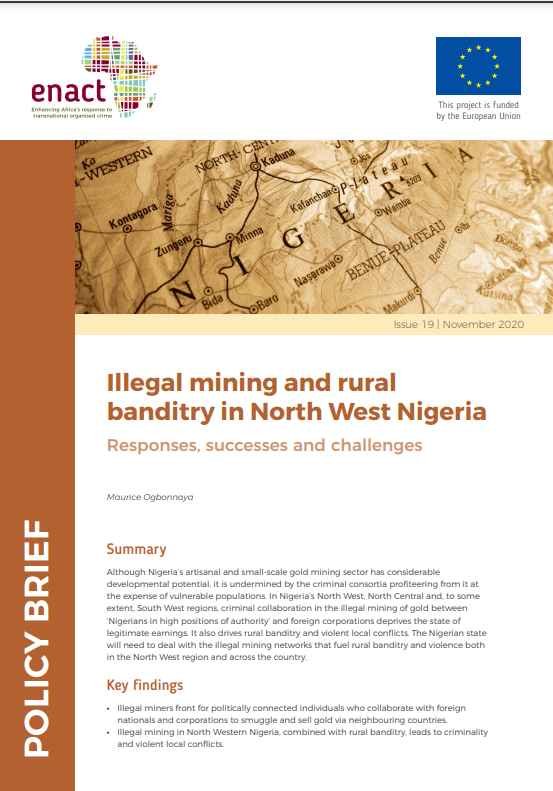
Illegal mining and rural banditry in North West Nigeria Responses, successes and challenges

By Maurice Ogbonnaya

Although Nigeria’s artisanal and small-scale gold mining sector has considerable developmental potential, it is undermined by the criminal consortia profiteering from it at the expense of vulnerable populations. In Nigeria’s North West, North Central and, to some extent, South West regions, criminal collaboration in the illegal mining of gold between ‘Nigerians in high positions of authority’ and foreign corporations deprives the state of legitimate earnings. It also drives rural banditry and violent local conflicts. The Nigerian state will need to deal with the illegal mining networks that fuel rural banditry and violence both in the North West region and across the country.

ENACT Africa, 2020. 12p.

Download
Police officers' perceptions and experiences of promoting honesty in child victims and witnesses

By Gadda Salhab, Lucy Akehurst, Hannah Cassidy, Victoria Talwar

Purpose: This two-phase study employed a mixed-methods design to explore UK police officers' perceptions and experiences of promoting honesty in child witnesses with a special focus on the recommended inclusion of Truth-Lies Discussions (TLDs) at the start of interviews with children.Method: In Phase 1, police officers completed an online survey designed to cover their experiences and perceptions regarding truth-promotion with child witnesses. In Phase 2, police officers were individually interviewed to elicit an in-depth understanding of current practice relating to this aspect of investigative interviews with children.Results: Around half of the survey respondents believed that TLDs promote honesty in children. The majority reported always using TLDs during interviews to ensure compliance with UK best-practice guidance. There was evidence of a misconception among some police officers that children's performance on TLDs was related to their subsequent truth-telling behavior. Following analysis of the interview transcripts, we found a main theme of police officers' uses of TLDs, which included (i) gauging children's conceptual understanding of truths/lies, (ii) ensuring no deviation from guidance and (iii) communicating children's credibility to the court. A second main theme revealed the challenges and obstacles police officers perceived when embarking on TLDs. These were that (i) one type of TLD is not suitable for all children, (ii) the training is insignificant and the application is inappropriate and (iii) participants sometimes use alternative strategies to promote honesty with children.

Legal and Criminological Psychology Volume 29, Issue 1 Feb 2024

Download
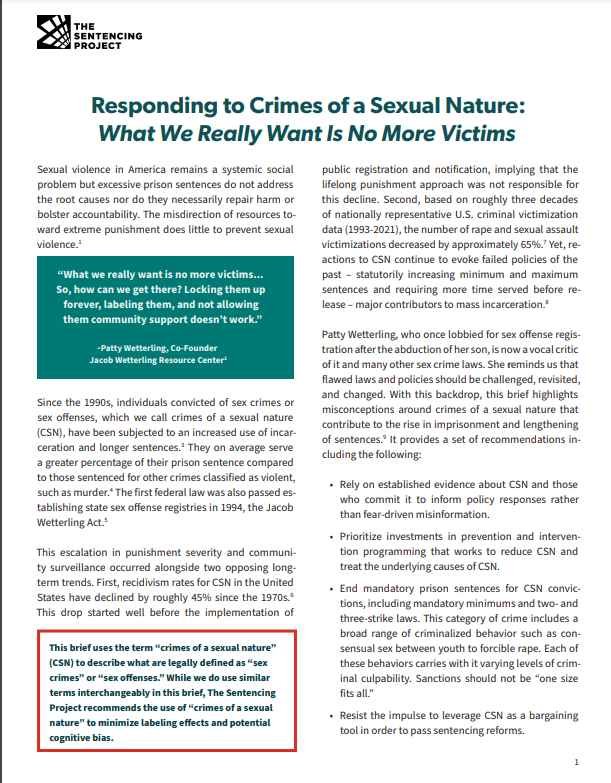
Responding to Crimes of a Sexual Nature: What We Really Want Is No More Victims

By Kristen Budd, Sabrina Pearce and Niki Monazzam

Sexual violence in America remains a systemic social problem but excessive prison sentences do not address the root causes nor do they necessarily repair harm or bolster accountability. The misdirection of resources toward extreme punishment does little to prevent sexual violence. Since the 1990s, individuals convicted of sex crimes or sex offenses, which we call crimes of a sexual nature (CSN), have been subjected to an increased use of incarceration and longer sentences. They on average serve a greater percentage of their prison sentence compared to those sentenced for other crimes classified as violent, such as murder. The first federal law was also passed establishing state sex offense registries in 1994, the Jacob Wetterling Act.

This escalation in punishment severity and community surveillance occurred alongside two opposing long-term trends. First, recidivism rates for CSN in the United States have declined by roughly 45% since the 1970s. This drop started well before the implementation of public registration and notification, implying that the lifelong punishment approach was not responsible for this decline. Second, based on roughly three decades of nationally representative U.S. criminal victimization data (1993-2021), the number of rape and sexual assault victimizations decreased by approximately 65%. Yet, reactions to CSN continue to evoke failed policies of the past – statutorily increasing minimum and maximum sentences and requiring more time served before release – major contributors to mass incarceration.

This brief uses the term “crimes of a sexual nature” (CSN) to describe what are legally defined as “sex crimes” or “sex offenses.” While we do use similar terms interchangeably in this brief, The Sentencing Project recommends the use of “crimes of a sexual nature” to minimize labeling effects and potential cognitive bias.

Washington DC: The Sentencing Project, 2024. 14p.

Download
“It's Like a Drive by Misogyny”: Sexual Violence at UK Music Festivals

By Hannah Bows, Aviah Day and Alishya Dhir

Despite increasing scholarly and media attention on sexual violence in public spaces, including those associated with the night-time economy and licensed venues, music festivals have been largely absent from research and policy. This paper presents the findings from the first UK study of sexual violence at music festivals, drawing on data from interviews with 13 women who have experienced some form of sexual harassment or assault at a festival. Analysis reveals that sexual violence at festivals occurs on a continuum and represents an extension of rape culture through which sexual violence is culturally condoned and normalized, enabled through a number of environmental and culture features that are unique to festivals.

It is widely recognized that sexual violence occurs in both public and private spaces; however, the majority of academic research and public/policy attention has tended to focus on sexual violence that occurs in private spaces, particularly the home (Vera-Gray & Fileborn, 2018). Despite the relative paucity of academic research on sexual harassment and violence in public spaces, anecdotal evidence, grassroots research, and industry surveys reveal that women routinely experience sexual harassment and sexual assault in public spaces, including public transport (London Assembly, 2016; SPA, 2014) university campuses (Brook, 2019) parks, and playgrounds (Budd et al., 2019). An international study of street sexual harassment in 22 countries reports that 50% of women have been fondled or groped and more than 81.5% of women have been harassed before the age of 17 (Hollaback, 2014). In the United Kingdom, 71% of women of all ages reported experiencing some form of sexual harassment in a public space, rising to 86% among 18- to 24-year-olds (UN Women UK, 2021).

Leisure spaces are frequently associated with sexual harassment and violence against women, particularly those linked to the night-time economy (NTE), situated within the “sexualized city” (Hubbard & Colosi, 2012). The existing work has illuminated the role that commercialized and heteronormative spaces play in contributing to developing “cultural atmospheres” (Kavanaugh, 2013, p. 242) where unwanted sexual attention becomes accepted as a normal part of being in these spaces (see Brooks, 2011; Fileborn, 2016; Gunby et al., 2020; Quigg et al., 2020; Sheard, 2011). In the United Kingdom, a Drinkaware study in 2015 reported 54% of women and 15% of men aged 18–24 experienced sexual harassment on a night out. Mellgren et al. (2018) found that sexual harassment of Swedish women occurred frequently at clubs and restaurants. More recently, Miranda and van Nes (2020) report that nearly all sexual violence cases occurring in public spaces at night are close to, or offer, nightlife activities. Moreover, emerging research in the context of live music venues has documented the routine everyday occurrence of harassment and sexual violence experienced by women in these environments (Hill et al., 2020). Thus, as Pain (1991) pointed out, while research may indicate the majority of (interpersonal) violence takes place in the private sphere (usually the victim's home), this does not mean the public sphere is a safe place for women.

Culturally and economically, music festivals are important British leisure events, at the “heart” of the British summer time (McKay & Webster, 2016). The turn of the century saw a massive expansion of the outdoor music festival scene into a large-scale commercial and corporate sector (Morey et al., 2014). Mintel (2018) estimates that there were 918 UK festivals in 2018, more than double that of a decade earlier, while CGA (2019) estimates more than 7.1 million people attended a festival in 2018. Many contemporary music festivals promote themselves by promising freedom, excitement, and hedonistic pleasure, thus encouraging consumers to purchase the experience of 1960’s hippie counterculture. “Freedom” is commodified as central to the marketing of many music festivals, which now form a highly commercialized sector of the UK leisure industry, subject to various regulatory restrictions (Griffin et al., 2018, p. 1). However, as festivals vary significantly in terms of size and audience make up, such as by age and the music genres or cultures being sought, it is important not to homogenize “the music festival.”

Demographically, the festival landscape has also shifted in recent years. Although music festivals were traditionally dominated by men, 60% of UK festival visitors in 2016 were female, an increase from 37% in 2015 (Statista, 2016). Elsewhere, women make up almost half of festival audiences. In Australia, 44.3% of festival attendees in 2018 were female (Hughes et al., 2019) and across European festivals in 2016 just over 45% of attendees were female (Statista.com, 2021).

Despite women occupying increasing space at festivals, the emerging research indicates they are not free to experience these events in the same ways as men (Aborisade, 2021; Baillie et al., 2021; Fileborn et al., 2020; Wadds et al., 2022). The two studies outside of the UK examining sexual violence at festivals through interviews with survivors (Aborisade, 2021 in Nigeria and Fileborn et al., 2020 in Australia) report on the normalcy of sexual violence in festival spaces, low reporting to festival staff or other formal agencies, and a range of negative consequences as a result of their experiences. These findings are supported by data in the United Kingdom and the United States. In the United Kingdom, a YouGov survey in 2018 reported that sexual harassment is prevalent at UK music festivals, revealing 43% of female festival goers under the age of 40 experienced unwanted sexual behavior at a music festival but only 2% reported to the police (although 7% did report it to festival staff). Our research has revealed similar findings, with 34% of women and 6% of men respondents experiencing sexual harassment at a festival in the previous five years, and 9% of women and 1% of men experiencing sexual assault (Bows et al., 2022). Interestingly, these reported levels are significantly lower than the figures reported in a survey of festival attendees in the USA, which revealed more than 90% of female respondents said they had been sexually harassed at a music festival or music gig/venue (OMMB, 2017).

Although there has been very little academic research on sexual violence at festivals, the issue has received high-profile media coverage over the last few years (Davies, 2017; Owen, 2021), leading to grassroots campaigns and activism (e.g., Girls Against and Safe Gigs for Women), in some cases, extraordinary responses from festivals. For example, in 2016 and 2017, a spate of rapes and sexual assaults of women at Bravalla, a Swedish festival, were reported, which led to the cancelation of the event in 2018 until men could “learn to behave themselves” (O’Connor, 2017). Similarly, Clear Lines Festival was set up in 2015—founded and crowd funded by volunteers—with the specific goal of addressing sexual assault and harassment through the arts and discussions. In the UK, the Association of Independent Festival led a campaign where music festival websites went dark for 24 h to raise awareness of sexual violence and call for positive action across the industry (Moore, 2017).

While the survey findings and media reports give some indication of the extent of sexual harassment and assault at festivals, there are major gaps in knowledge about the prevalence, nature, experiences, and responses to sexual violence. This article presents data from the first UK study to explore women's experiences of sexual violence at UK music festivals, contributing to the small but growing body of literature in this area (Aborisade, 2021; Baillie et al., 2021; Bows et al., 2020, 2022; Fileborn et al., 2020) and to the broader literature on gendered experiences of leisure spaces (Aitchison, 1999; Green & Singleton, 2006; Gunby et al., 2020; Hill et al., 2020; Stevenson, 2017).

Violence Against Women Volume 30, Issue 2 Feb 2024 Pages 347-688

Download
The Post Office Scandal in the United Kingdom: Mental health and social experiences of wrongly convicted and wrongly accused individuals

By Bethany Growns, Jeff Kukucka, Richard Moorhead, Rebecca K. Helm

Background: Wrongful criminal conviction can signifi-cantly impair the mental health of exonerees. However, much less is known about wrongful accusation: the impact of wrongful legal allegations or investigations—absent con-viction—on mental health outcomes.Method: To address this gap, we surveyed 101 victims of the Post Office Scandal in the United Kingdom who were wrongly accused, convicted and/or investigated for finan-cial ‘losses’ that were actually caused by software errors.

Results: Most respondents reported clinically significant post-traumatic stress (67%) and depressive (60%) symptoms—irrespective of the outcome of their case. These results suggest that both wrongful accusation and wrongful conviction can significantly impair mental health.

Conclusion: Our findings have important implications for victims of the Post Office Scandal and highlight the unique needs of people impacted by flawed convictions and flawed legal accusations. Our findings underscore the need to pro-vide exonerees with holistic postrelease support and demon-strate that this support should also be extended to victims of wrongful accusation.

Legal and Criminological Psychology Volume 29, Issue 1 Feb 2024

Download
ISLANDS IN THE STREET: Gangs and American Urban Society

MAY CONTAIN MARKUP

By MARTÍN SÁNCHEZ JANKOWSKI

The overall goal of the research in this book was to understand gang phenomenon in the United States. In order to accomplish this goal, the author investigated gangs in different cities in order to understand what was similar in the way all gangs behaved and what was idiosyncratic to certain gangs. The research for this book took place over ten years and five months from 1978 to 1989 and will give the reader a comprehensive overview of gang behavior in the United States in that time period. 

Berkeley. U.C. Press. 1991. 388p.

read
Divine Violence: Spectacle, Psychosexuality, & Radical Christianity In The Argentine "Dirty War"

MAY CONTAIN MARKUP

BY FRANK GRAZIANO

Providing an account of political repression in Argentina, this book takes as its theme the intersection of religion, violence and psychosexuality as they relate to the desire for power and to the myths and rituals manifesting that desire.

Avalon Publishing, Jun 4, 1992 , 328 pages

READ
Narratives of experts by experience: A journey from criminal to expert

By Janika Lindström, Teemu Rantanen and Timo Toikko

Summary: This study focuses on the narratives of participants of a long-term expert-by-experience training programme for people with a history of crime about their past, and how they use their life experience in their work as experts by experience. The research data was collected during interviews of respondents with a history of crime (N=19). The interviews were analysed using a narrative identity framework, and the data further examined in light of various studies focused on a desistance from crime.

Findings: The transformation process from service user or client to expert by experience provided people with a history of crime with a chance to come to terms with their past, and to gain a sense of closure. Expertise by experience gave their difficult life experiences a new meaning, and thus promoted their overall rehabilitation and offered them opportunities through which they could gain the appreciation and acceptance of other people. The new relationships presented to them as experts by experience also paved the way to a new kind of self-concept that strengthened the desister's self-confidence and optimistic outlook on the future.

Applications: This study offers perspectives on how people with a history of crime can re-enter society. Through their survival stories and their journey to become experts by experience, desisters can earn the acceptance and approval of others and gain a more positive perception of themselves. The new identities of people with a history of crime are dependent on society's approval as they continue to desist from crime and re-enter mainstream society.

Journal of Social WorkVolume 0: Ahead of Print, 2024

Download