Open Access Publisher and Free Library
CRIME+CRIMINOLOGY.jpeg

CRIME

Violent-Non-Violent-Cyber-Global-Organized-Environmental-Policing-Crime Prevention-Victimization

Criminal Sociology

By Enrico Ferri.

In this great Italian classic in criminology, its famed author Enrico Ferri describes it as “a work of propaganda and an elementary guide for anyone who intends to dedicate himself to the scientific study of offenders and of the means of prevention and social defense against them.” Published in 1892 and in English in 1896. The book emphasizes the link between crime causation and social justice, setting him apart from his criminal anthropologist forebears.

Harrow and Heston Classic Reprint. 1896.

download
Science And The Criminal

By C. Ainsworth Mitchell.

Conflict between the Law-maker and the Law-breaker — Illustrations of Deductive Reasoning in Criminal Cases — Scientific Evidence — Scientific Assistance for the Accused — Instances of Advantages of Conflict of Scientific Evidence —Scientific Partisanship.

Boston Little Brown (1911) 282p.

download
Unsoundness of Mind

By John Charles Bucknill.

In Relation to Criminal Acts. “Your Lordship, having held successively the Gkeat Seal in England and in Ireland, has been the legal guardian of all insane persons in this Kingdom. Your Lordship has also effected an extensive revision of the statutes, regulating the care and treatment of the insane and the protection of their property.”

London. Samuel Highly (1854) 156 pages.

Learn more
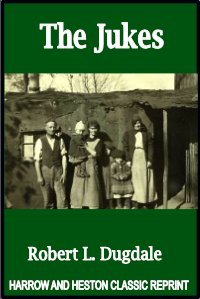
The Jukes

By Robert L. Dugdale.

A study in crime, pauperism, disease and heredity. “‘The Jukes’ has long been known as one of those important books that exert an influence out of all proportion to their bulk. It is doubtful if any concrete study of moral forces is more widely known, or has provoked more discussion, or has incited a larger number of students to examine for themselves the immensely difficult problems presented by the interaction of ‘heredity’ with ‘environment.’“

London Putnam (1910) 137 pages.

download
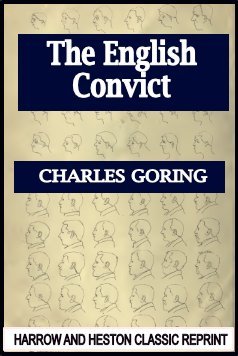
The English Convict

By Charles Goring.

Classic statistical study published in 1913 measuring nearly 100 physical and mental characteristics of English convicts to determine their deviation from the normal. Notable features of the author's research methodology were the use of the newly-developed Pearson product moment correlation coefficient and the method of comparing groups of both criminals and non-criminals for the same characteristics. The author's analysis of the data rejects the view that there are specific physical and mental characteristics identifying the criminal. He further concludes that the influence of heredity and the presence of mental defectiveness are far more significant factors than parental influence in the development of criminal behavior.

HMSO (1913) 450 pages.

download part 1
download part 2
Child of Circumstance

By pages

The Mystery of the Unborn, by pages. “Dr. Wilson believed that criminals are born unfinished. The die is cast at birth. The lack of finish at birth explains the incompetent, the born tired, the unemployed. Then what is the use? Why not painless extinction of those who commit great crimes, and the sterilization of the feebleminded….” Albert Wilson.

John Bale et al., (1928) 477.

download
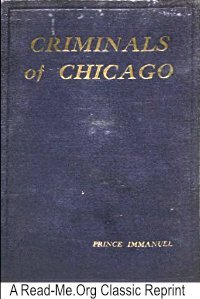
Criminals of Chicago

By Prince Emmanuel of Jerusalem.

“ History shows that hanging did not prevent petit larceny. So we have abandoned the policy of frightfulness in punishment and cannot revert to it even though it still has some few supporters. And yet we feel that the theory of punishment being deterrent is philosophically sound. …The first news from the Laboratory revealed the prevalence of feeble-mindedness among delinquents. “

Rosburgh Publishing (1921) 247 pages.

download
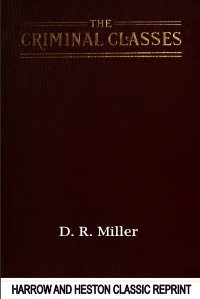
The Criminal Classes

By D. R. Miller.

“A law demanding only a refrain from violence or abstinence from all that may injure others contains but the negative, while it is lacking in the more important, the positive elements. If men, by closing their eyes to the existence of evil, could thereby banish it, then might it be best for all to close their eyes….it is quite certain that we can never hope to discover, through ignorance, what are the various types of criminal abnormality, nor know the many causes or cures for such estrangements. An intelligent and thorough study of the criminal problem will eliminate from our creed that fatalistic formula which asserts that ‘Evil is good not understood’…”

United Brethren Publishing House (1903) 224 pages.

download
Criminal Intelligence

By Carl Murchison.

“This material is offered for the special consideration of lawyers, psychologists, siociologists, social workers, and all those who have to do with the formulation of criminal law, the treatment of criminals, and the molding of public opinion concerning the enemies of organized society…”

A Read-Me.Org Classic Reprint (1926) 483 pages.

download
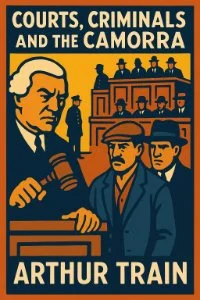
Courts, Criminals And The Camorra

By Arthur Train.

by Arthur Train (Author), Colin Heston (Introduction) Format: Kindle Edition

Arthur Train’s Courts, Criminals and the Camorra (1912) arrives from a moment when the American courtroom was transforming from a dusty forum of local justice into a national spectacle. Crime reporting surged, public fascination with underworld societies ripened, and the newly consolidated profession of the district attorney—Train’s own calling—stood at the intersection of drama and civic responsibility. Few chroniclers were better positioned to capture this world than Train himself: lawyer, storyteller, and one of the most influential interpreters of everyday justice in the early twentieth century.
This book offers a vivid, almost cinematic tour through the people and pressures that shaped the criminal courts of Train’s New York. With a wit sharpened by long service in the district attorney’s office, Train narrates cases, misadventures, and courtroom characters with the briskness of a magazine correspondent and the subtle insight of someone who has lived the system from the inside. He makes the courthouse feel less like a bureaucratic maze and more like a bustling social laboratory—part theater, part battleground, part human comedy.
The title’s reference to the Camorra, the Neapolitan criminal society that briefly dominated headlines in the years preceding publication, allows Train to broaden his canvas. The Camorra trials in Europe—particularly the sensational proceedings in Viterbo (1911–12)—were international news, and Americans consumed tales of conspiracy, vendetta, and secret brotherhoods with a mixture of horror and fascination. Train uses these stories not merely to thrill, but to show how crime everywhere reflects its environment: local culture shapes criminal enterprise just as surely as it shapes courts, policing, and political life.
What makes this volume enduring is Train’s tone—bright, conversational, humane. His criminals are rarely monsters; they are people caught in pressures of poverty, opportunity, folly, or ambition. His courts, for all their flaws, are animated by men and women doing their best under imperfect circumstances. The result is a portrait of justice as a living organism, not an abstract ideal.
More than a century later, these essays feel surprisingly fresh. They remind us that the tensions surrounding criminal justice—media sensationalism, public fear, the allure of organized crime, the frustrations of overburdened courts—are not uniquely modern. The debates that animate today’s legal and political discussions echo those Arthur Train captured with humor and clarity in 1912.
To read Courts, Criminals and the Camorra now is to eavesdrop on the origins of our contemporary legal culture. It is also simply to enjoy a gifted storyteller at work, illuminating the world he knew best with charm, color, and a sharp eye for the human quirks that make justice both necessary and endlessly fascinating.

New York Scribner’s (1912) 256 pages. Read-Me.Org Inc. 2025. 173p.

download free
kindle $2.99 -- PAPERBACK $9.99