Open Access Publisher and Free Library
CRIMINAL JUSTICE.jpeg

CRIMINAL JUSTICE

CRIMINAL JUSTICE-CRIMINAL LAW-PROCDEDURE-SENTENCING-COURTS

Posts in Firearm
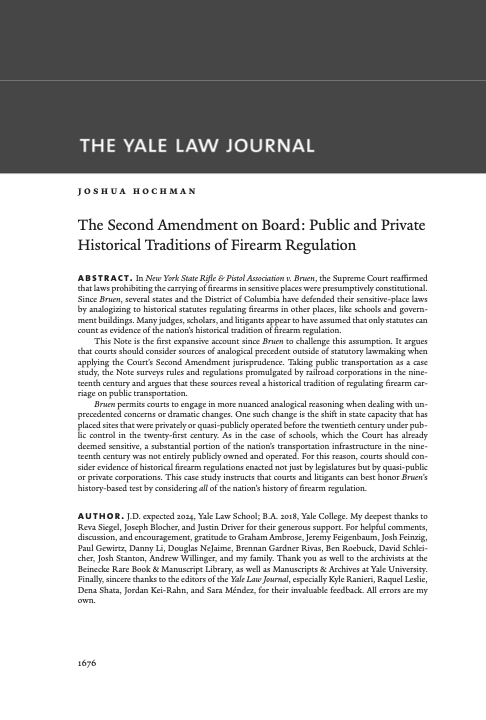
The Second Amendment on Board: Public and Private Historical Traditions of Firearm Regulation

By Joshua Hochman

In New York State Rifle & Pistol Association v. Bruen, the Supreme Court reaffirmed that laws prohibiting the carrying of firearmsin sensitive places were presumptively constitutional. Since Bruen, several states and the District of Columbia have defended their sensitive-place laws by analogizing to historical statutes regulating firearms in other places, like schools and government buildings. Many judges, scholars, and litigants appear to have assumed that only statutescan count as evidence of the nation’s historical tradition of firearm regulation. This Note is the first expansive account since Bruen to challenge this assumption. It argues that courts should consider sources of analogical precedent outside of statutory lawmaking when applying the Court’s Second Amendment jurisprudence. Taking public transportation as a case study, the Note surveys rules and regulations promulgated by railroad corporations in the nineteenth century and argues that these sources reveal a historical tradition of regulating firearm carriage on public transportation. Bruen permits courts to engage in more nuanced analogical reasoning when dealing with unprecedented concerns or dramatic changes. One such change is the shift in state capacity that has placed sites that were privately or quasi-publicly operated before the twentieth century under public control in the twenty-first century. As in the case of schools, which the Court has already deemed sensitive, a substantial portion of the nation’s transportation infrastructure in the nineteenth century was not entirely publicly owned and operated. For this reason, courts should consider evidence of historical firearm regulations enacted not just by legislatures but by quasi-public or private corporations. This case study instructs that courts and litigants can best honor Bruen’s history-based test by considering all of the nation’s history of firearm regulation.
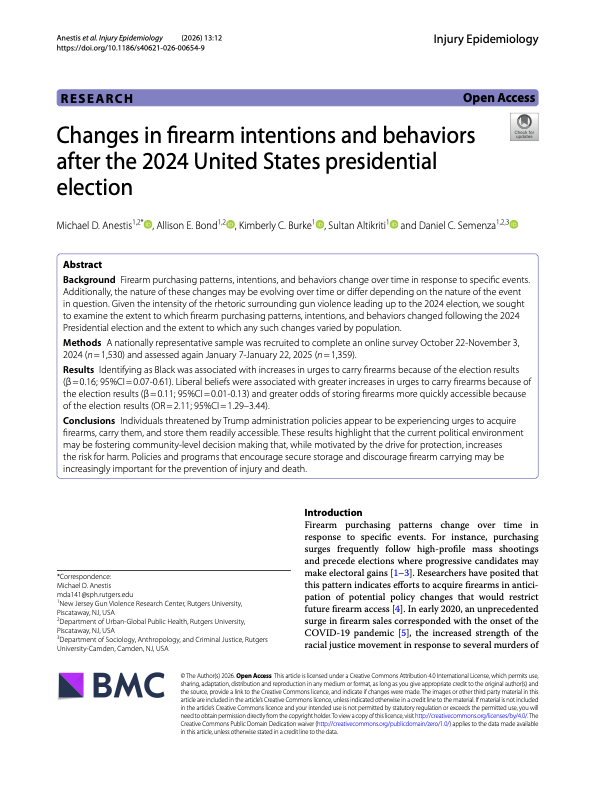
Changes in firearm intentions and behaviors after the 2024 United States presidential election

By Michael D. Anestis, Allison E. Bond, Kimberly C. Burke, Sultan Altikriti & Daniel C. Semenza 

Background

Firearm purchasing patterns, intentions, and behaviors change over time in response to specific events. Additionally, the nature of these changes may be evolving over time or differ depending on the nature of the event in question. Given the intensity of the rhetoric surrounding gun violence leading up to the 2024 election, we sought to examine the extent to which firearm purchasing patterns, intentions, and behaviors changed following the 2024 Presidential election and the extent to which any such changes varied by population.

Methods

A nationally representative sample was recruited to complete an online survey October 22-November 3, 2024 (n = 1,530) and assessed again January 7-January 22, 2025 (n = 1,359).

Results

Identifying as Black was associated with increases in urges to carry firearms because of the election results (β = 0.16; 95%CI = 0.07-0.61). Liberal beliefs were associated with greater increases in urges to carry firearms because of the election results (β = 0.11; 95%CI = 0.01-0.13) and greater odds of storing firearms more quickly accessible because of the election results (OR = 2.11; 95%CI = 1.29–3.44).

Conclusions

Individuals threatened by Trump administration policies appear to be experiencing urges to acquire firearms, carry them, and store them readily accessible. These results highlight that the current political environment may be fostering community-level decision making that, while motivated by the drive for protection, increases the risk for harm. Policies and programs that encourage secure storage and discourage firearm carrying may be increasingly important for the prevention of injury and death.