Open Access Publisher and Free Library
CRIMINAL JUSTICE.jpeg

CRIMINAL JUSTICE

CRIMINAL JUSTICE-CRIMINAL LAW-PROCDEDURE-SENTENCING-COURTS

Posts in History
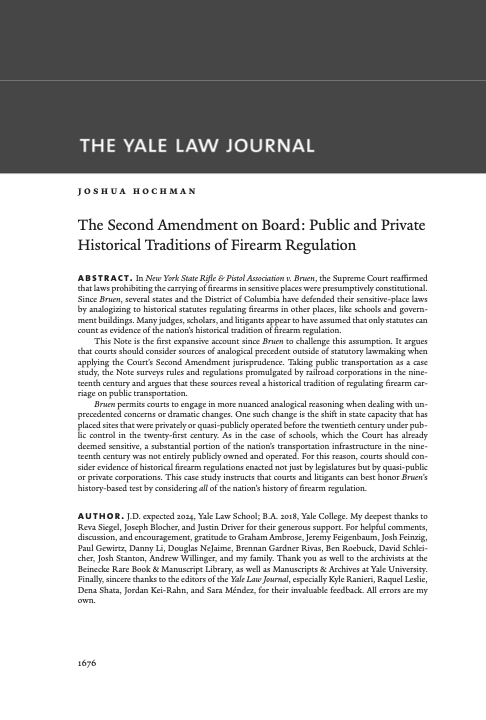
The Second Amendment on Board: Public and Private Historical Traditions of Firearm Regulation

By Joshua Hochman

In New York State Rifle & Pistol Association v. Bruen, the Supreme Court reaffirmed that laws prohibiting the carrying of firearmsin sensitive places were presumptively constitutional. Since Bruen, several states and the District of Columbia have defended their sensitive-place laws by analogizing to historical statutes regulating firearms in other places, like schools and government buildings. Many judges, scholars, and litigants appear to have assumed that only statutescan count as evidence of the nation’s historical tradition of firearm regulation. This Note is the first expansive account since Bruen to challenge this assumption. It argues that courts should consider sources of analogical precedent outside of statutory lawmaking when applying the Court’s Second Amendment jurisprudence. Taking public transportation as a case study, the Note surveys rules and regulations promulgated by railroad corporations in the nineteenth century and argues that these sources reveal a historical tradition of regulating firearm carriage on public transportation. Bruen permits courts to engage in more nuanced analogical reasoning when dealing with unprecedented concerns or dramatic changes. One such change is the shift in state capacity that has placed sites that were privately or quasi-publicly operated before the twentieth century under public control in the twenty-first century. As in the case of schools, which the Court has already deemed sensitive, a substantial portion of the nation’s transportation infrastructure in the nineteenth century was not entirely publicly owned and operated. For this reason, courts should consider evidence of historical firearm regulations enacted not just by legislatures but by quasi-public or private corporations. This case study instructs that courts and litigants can best honor Bruen’s history-based test by considering all of the nation’s history of firearm regulation.

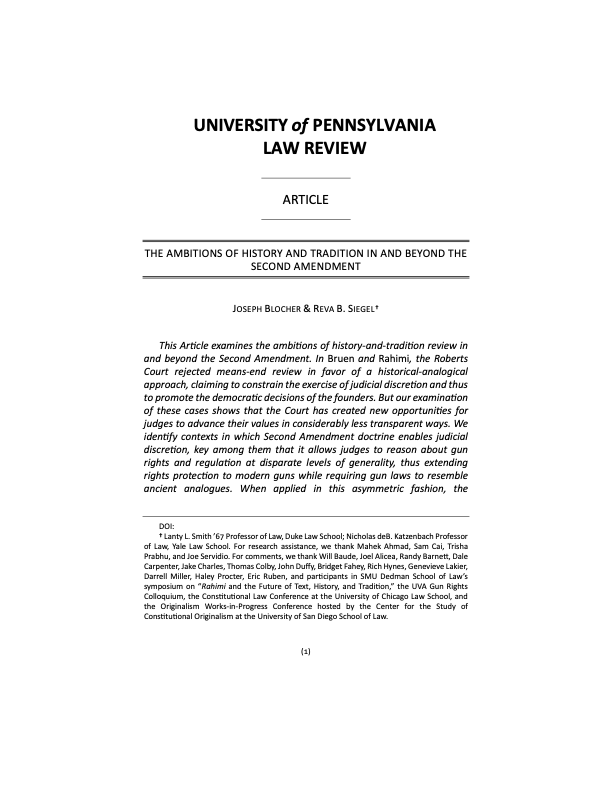
The Ambitions of History and Tradition in and Beyond the Second Amendment

By Joseph Blocher and Reva Siegel

This Article examines the ambitions of history-and-tradition review in and beyond the Second Amendment. In Bruen and Rahimi the Roberts Court rejected means-end review in favor of a historical-analogical approach, claiming to constrain the exercise of judicial discretion, and thus to promote the democratic decisions of the founders. But our examination of these cases shows that the Court has created new opportunities for judges to advance their values in considerably less transparent ways. We identify contexts in which Second Amendment doctrine enables judicial discretion, key among them that it allows judges to reason about gun rights and regulation at disparate levels of generality, extending rights protection to modern guns while requiring gun laws to resemble ancient analogues. When applied in this asymmetric fashion, the historical approach deregulates in ways that are neither acknowledged nor justified. An eight-member majority objected to this strategy in Rahimi and voted to uphold a federal gun law. Yet numerous Justices wrote separately to limit Rahimi’s reach—and, a year later, to suggest that the Court should take a case involving an assault-weapons ban to clarify the method set forth in its earlier cases.

Our close reading of the history-and-tradition (HAT) cases shows that there is a persistent gap between what the Court says and does—between the judicial constraint the Roberts Court promises and the actual decisions it delivers. Understanding this dynamic in the Second Amendment cases helps us recognize it in the First Amendment and Substantive Due Process cases as well.

We can better appreciate the Court’s reasoning in extending HAT review if we excavate the arguments advanced in the decade between Heller and Bruen for substituting the HAT approach for means-ends review. This retrospective shows us that HAT approaches exhibit the very problems imputed to means-ends review: HAT review is not grounded in original understanding and employs shifts in generality to provide judges discretion to enforce value-based understandings. We can see this dynamic unfolding inside and outside the Second Amendment context.

HAT decisions pose distinctive threats to democracy. First, Bruen has implemented HAT through judicial review with a strong presumption of unconstitutionality, a counter-majoritarian practice lacking precedent at the founding. Second, HAT review is not transparent, obscuring reasons for judicial decisions from the people and thus obstructing democratic dialogue. Third, the HAT framework encourages judges to decide the constitutionality of public safety laws on grounds that ignore the public’s most urgent reasons for enacting the laws.

This reading of the Court’s Second Amendment cases indicates that the push to adopt HAT approaches in First Amendment, Due Process, and other areas of constitutional law is likely to compound the problems it is supposed to solve, while insulating the Court’s control of the Constitution from the public governed by it.