
Open Access Publisher and Free Library
CRIMINAL JUSTICE.jpeg

CRIMINAL JUSTICE

CRIMINAL JUSTICE-CRIMINAL LAW-PROCDEDURE-SENTENCING-COURTS

Posts in Gun Safety
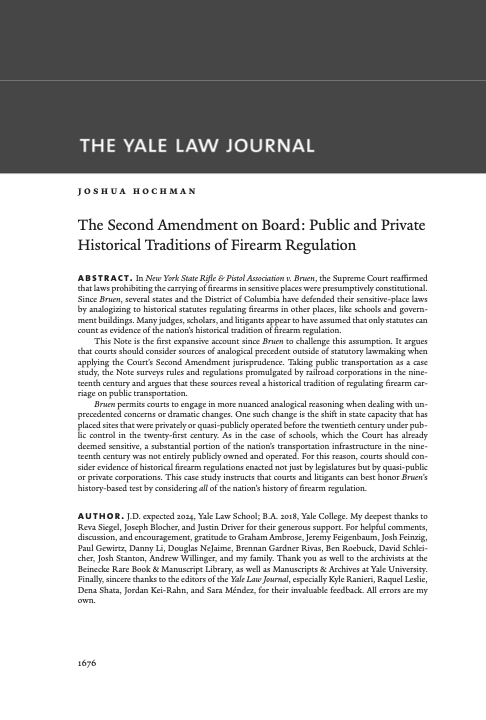
The Second Amendment on Board: Public and Private Historical Traditions of Firearm Regulation

By Joshua Hochman

In New York State Rifle & Pistol Association v. Bruen, the Supreme Court reaffirmed that laws prohibiting the carrying of firearmsin sensitive places were presumptively constitutional. Since Bruen, several states and the District of Columbia have defended their sensitive-place laws by analogizing to historical statutes regulating firearms in other places, like schools and government buildings. Many judges, scholars, and litigants appear to have assumed that only statutescan count as evidence of the nation’s historical tradition of firearm regulation. This Note is the first expansive account since Bruen to challenge this assumption. It argues that courts should consider sources of analogical precedent outside of statutory lawmaking when applying the Court’s Second Amendment jurisprudence. Taking public transportation as a case study, the Note surveys rules and regulations promulgated by railroad corporations in the nineteenth century and argues that these sources reveal a historical tradition of regulating firearm carriage on public transportation. Bruen permits courts to engage in more nuanced analogical reasoning when dealing with unprecedented concerns or dramatic changes. One such change is the shift in state capacity that has placed sites that were privately or quasi-publicly operated before the twentieth century under public control in the twenty-first century. As in the case of schools, which the Court has already deemed sensitive, a substantial portion of the nation’s transportation infrastructure in the nineteenth century was not entirely publicly owned and operated. For this reason, courts should consider evidence of historical firearm regulations enacted not just by legislatures but by quasi-public or private corporations. This case study instructs that courts and litigants can best honor Bruen’s history-based test by considering all of the nation’s history of firearm regulation.
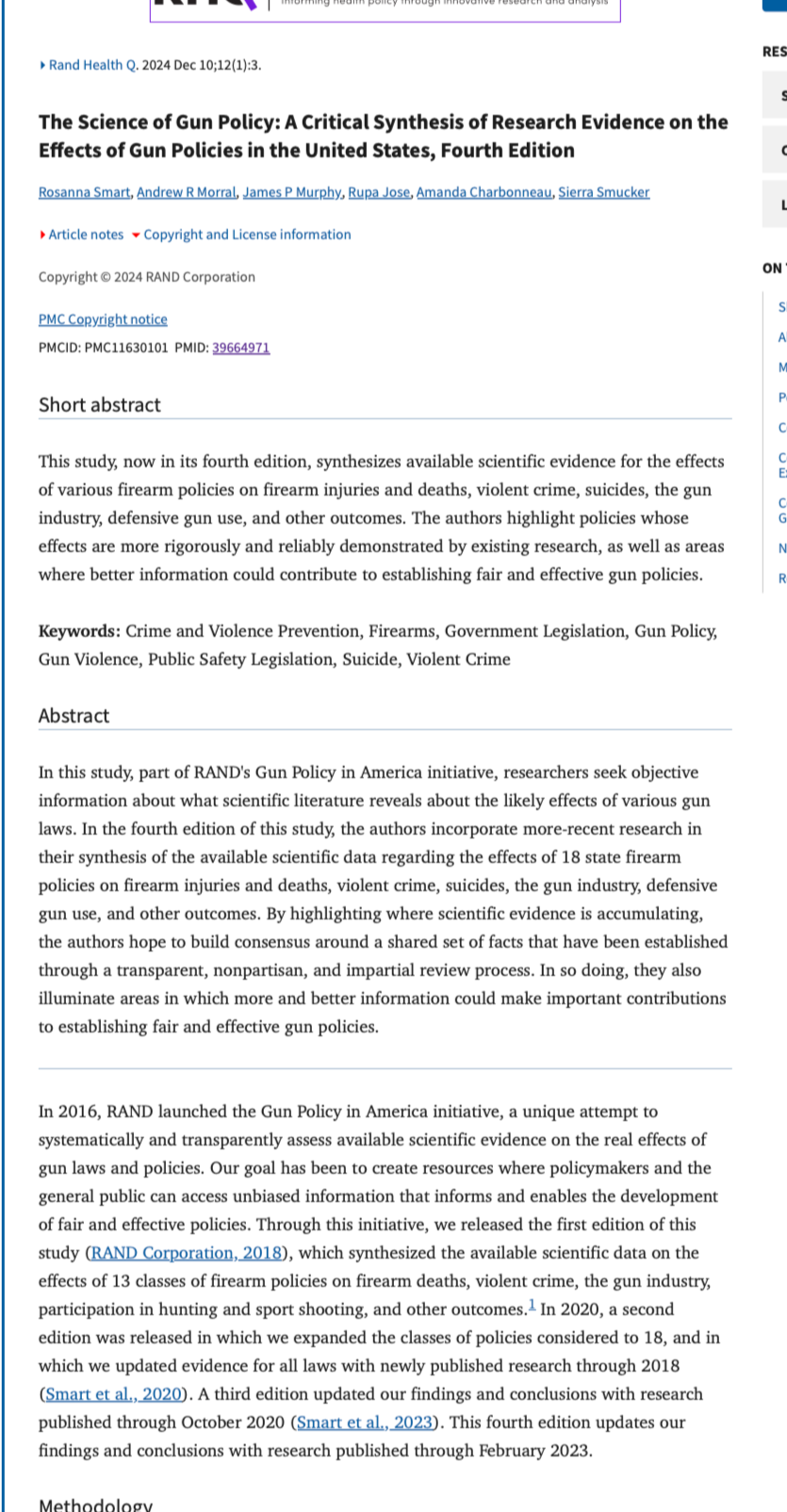

The Science of Gun Policy - A Critical Synthesis of Research Evidence on the Effects of Gun Policies in the United States

By: Rosanna Smart, Andrew R. Morral, James P. Murphy, Rupa Jose, Amanda Charbonneau, Terry L. Schell

In this report, part of RAND's Gun Policy in America initiative, researchers systematically review the scientific literature that has examined the likely effects of various gun laws. In the fifth edition of this report, the authors incorporate more-recent research in their synthesis of the available scientific data regarding the effects of 18 state firearm policies on firearm injuries and deaths, violent crime, suicides, the gun industry, defensive gun use, and other outcomes. By highlighting where scientific evidence is accumulating, the authors hope to build consensus around a shared set of facts that have been established through a transparent, nonpartisan, and impartial review process. In so doing, they also illuminate areas in which more and better information could make important contributions to establishing fair and effective gun policies.

Toward A Safer Louisville: Three Years of Progress in Violence Prevention

By The Louisville Office of Violence Prevention

The Louisville Metro Gun Violence Dashboard is updated daily, providing users with real-time information regarding criminal homicides and shootings [4]. Offering a broad view of gun violence, the dashboard includes information on year-to-date trends, victim demographics, and mapping visuals that use neighborhood, council districts, ZIP codes, and police districts. Since its launch, the dashboard has received approximately 100,000 views through June 30, 2025.

Printing Violence: Urgent Policy Actions Are Needed to Combat 3D-Printed Guns

By Everytown for Gun Safety, Everytown Research and Policy

  The shooting of UnitedHealthcare CEO Brian Thompson using a homemade firearm with a 3D-printed frame and silencer marked the first time many in the general public heard about 3D-printed guns. But this was not the first instance of criminal violence with this type of firearm, and as 3D-printing technology becomes more aordable, accessible, and advanced, it will not be the last. The proliferation of 3D-printed firearms (3DPFs) has emerged as a serious and accelerating public safety challenge. The current state of 3D-printing technology allows an individual to print all or key parts of a firearm at home. Like other kinds of ghost guns, 3DPFs lack serial numbers, so law enforcement is unable to trace them back to their owner when they are recovered in a crime. Because 3DPFs are untraceable and require no background check, they are particularly attractive to gun trackers who can print dozens of firearms and avoid raising alarms. 3DPFs have been linked to violent crimes, including everything from extremist plots to shootings involving teens. And the online community that produces and beta tests these designs includes alarming extremist elements, with many designers viewing 3D printing as a means to bypass or dismantle gun laws altogether. In the United States, as regulatory pressure in recent years has significantly reduced the availability of ghost gun “kits”—a way that online retailers routinely sold easily modified building blocks of firearms—the 3D printing of frames and accessories has accelerated among those looking to manufacture their own guns. Meanwhile, in Europe, new 3DPF designs allowing people to print functioning firearms threaten to undermine the gun safety laws that have long protected the continent from the degree of gun violence in the US. Policymakers, technology firms, and civil society must act urgently to address the dangers of 3DPFs. A multipronged strategy is essential. This includes 3D-printer manufacturers and software companies developing and implementing algorithms that detect and block the printing of firearms and accessories. In concert with the 3D-printing industry, lawmakers should take steps to regulate 3D-printing technology in a manner that makes it impossible to use a 3D printer to print a gun. Public institutions like schools, libraries, and community tech labs should implement clear policies and software restrictions to block the printing of firearm components on 3D printers. Further, social media and other online platforms should significantly improve their moderation of content that promotes or distributes 3Dprinted gun blueprints or features instructions and advice for building 3DPFs.

The Dangers of Shooting First: “Stand Your Ground” Laws Are a License to Kill

By Everytown for Gun Safety, Everytown Research & Policy

For centuries, self-defense laws have given people the right to protect themselves. Shoot First laws, also known as Stand Your Ground laws, go beyond these long-standing principles, aggressively altering criminal law to shield a person who claims self-defense from being arrested, prosecuted, or convicted for using deadly force. In 2005, Florida enacted the first modern Shoot First law, an effort backed by the National Rifle Association (NRA), during a time when they were making concerted efforts to reverse declining gun sales.2 Working with the gun lobby, the American Legislative Exchange Council pushed to turn Florida’s law into a template for a national campaign.3 Now in 29 states,4 these laws change the nature of self-defense, turning everyday disputes into deadly confrontations. Far from empowering victims, Shoot First laws lower the threshold for justifiable homicide, encouraging the escalation of petty arguments and armed vigilantism. 

Although the gun lobby created these laws under the pretense of empowering and protecting victims of crime, the data overwhelmingly shows that the statutes have failed at this. Research on Shoot First laws indicates that they increase gun deaths, leading to hundreds of deaths every year that would not have occurred otherwise. These laws also consistently fail to protect vulnerable communities; in addition to increased risk of victimization in Shoot First states, convictions are unfairly skewed against people of color and women. 

In the decades since the first Shoot First law was enacted, no research shows that these laws lead to better outcomes for anyone. Shoot First was created to solve a problem that does not exist—and Americans are paying the price.