
Open Access Publisher and Free Library
CRIMINAL JUSTICE.jpeg

CRIMINAL JUSTICE

CRIMINAL JUSTICE-CRIMINAL LAW-PROCDEDURE-SENTENCING-COURTS

Posts in Gun Violence
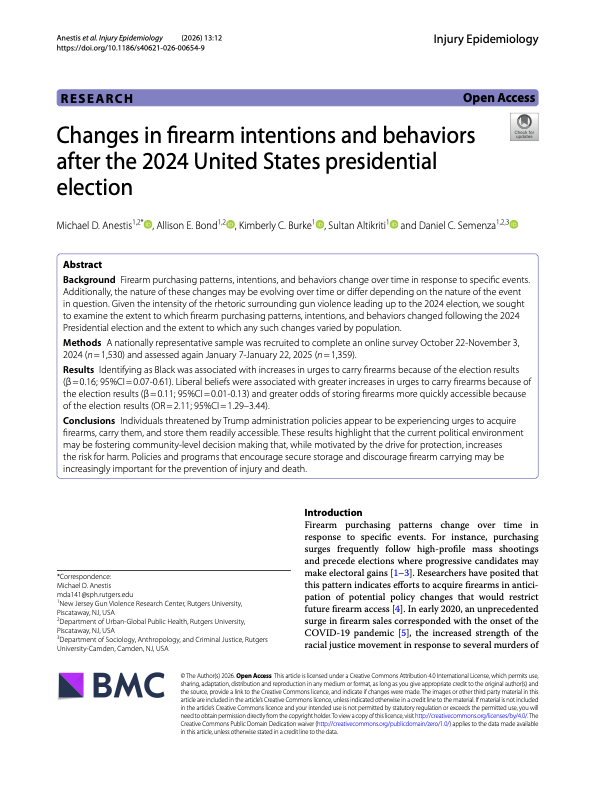
Changes in firearm intentions and behaviors after the 2024 United States presidential election

By Michael D. Anestis, Allison E. Bond, Kimberly C. Burke, Sultan Altikriti & Daniel C. Semenza 

Background

Firearm purchasing patterns, intentions, and behaviors change over time in response to specific events. Additionally, the nature of these changes may be evolving over time or differ depending on the nature of the event in question. Given the intensity of the rhetoric surrounding gun violence leading up to the 2024 election, we sought to examine the extent to which firearm purchasing patterns, intentions, and behaviors changed following the 2024 Presidential election and the extent to which any such changes varied by population.

Methods

A nationally representative sample was recruited to complete an online survey October 22-November 3, 2024 (n = 1,530) and assessed again January 7-January 22, 2025 (n = 1,359).

Results

Identifying as Black was associated with increases in urges to carry firearms because of the election results (β = 0.16; 95%CI = 0.07-0.61). Liberal beliefs were associated with greater increases in urges to carry firearms because of the election results (β = 0.11; 95%CI = 0.01-0.13) and greater odds of storing firearms more quickly accessible because of the election results (OR = 2.11; 95%CI = 1.29–3.44).

Conclusions

Individuals threatened by Trump administration policies appear to be experiencing urges to acquire firearms, carry them, and store them readily accessible. These results highlight that the current political environment may be fostering community-level decision making that, while motivated by the drive for protection, increases the risk for harm. Policies and programs that encourage secure storage and discourage firearm carrying may be increasingly important for the prevention of injury and death.
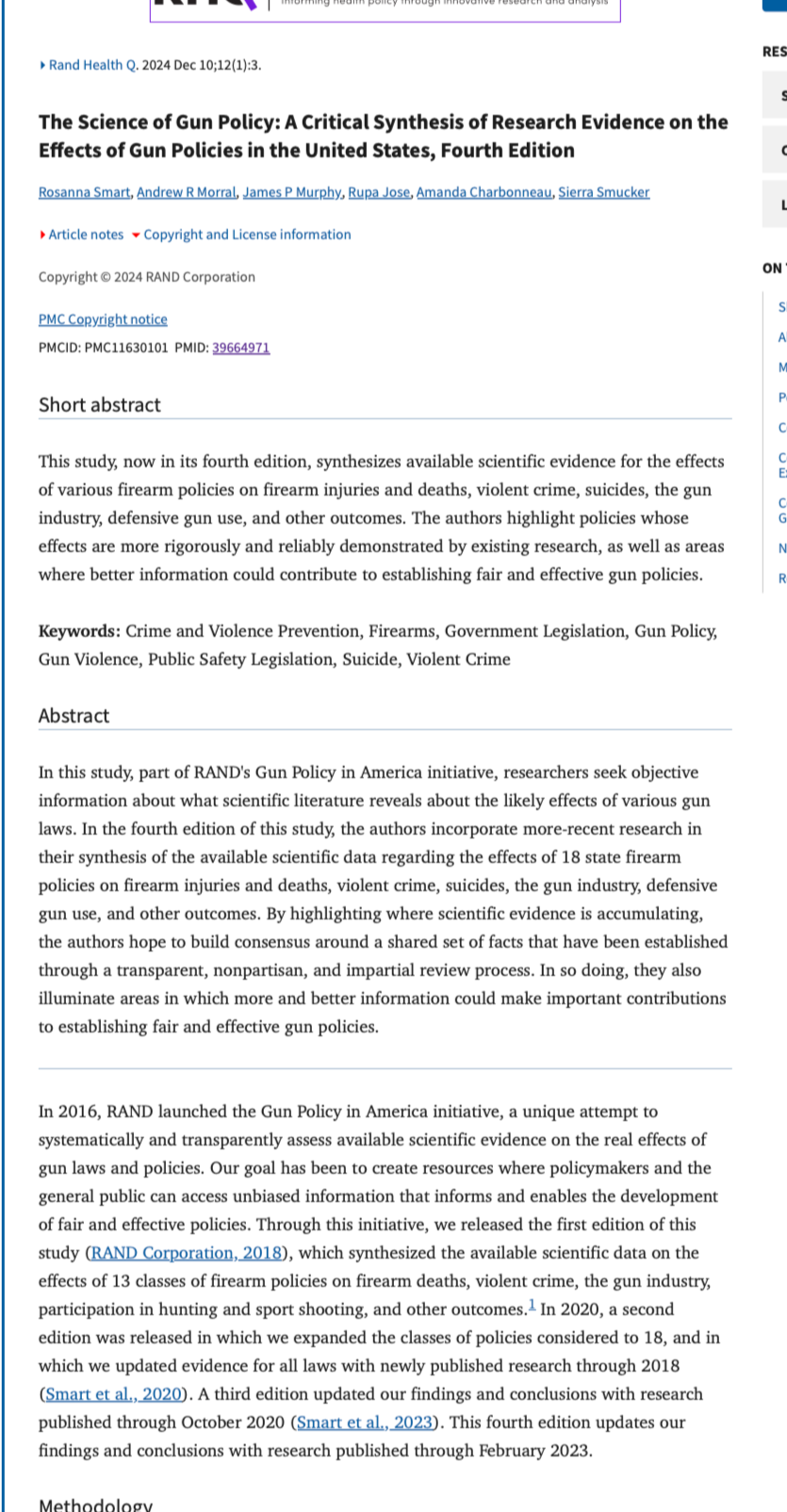
The Science of Gun Policy - A Critical Synthesis of Research Evidence on the Effects of Gun Policies in the United States

By: Rosanna Smart, Andrew R. Morral, James P. Murphy, Rupa Jose, Amanda Charbonneau, Terry L. Schell

In this report, part of RAND's Gun Policy in America initiative, researchers systematically review the scientific literature that has examined the likely effects of various gun laws. In the fifth edition of this report, the authors incorporate more-recent research in their synthesis of the available scientific data regarding the effects of 18 state firearm policies on firearm injuries and deaths, violent crime, suicides, the gun industry, defensive gun use, and other outcomes. By highlighting where scientific evidence is accumulating, the authors hope to build consensus around a shared set of facts that have been established through a transparent, nonpartisan, and impartial review process. In so doing, they also illuminate areas in which more and better information could make important contributions to establishing fair and effective gun policies.

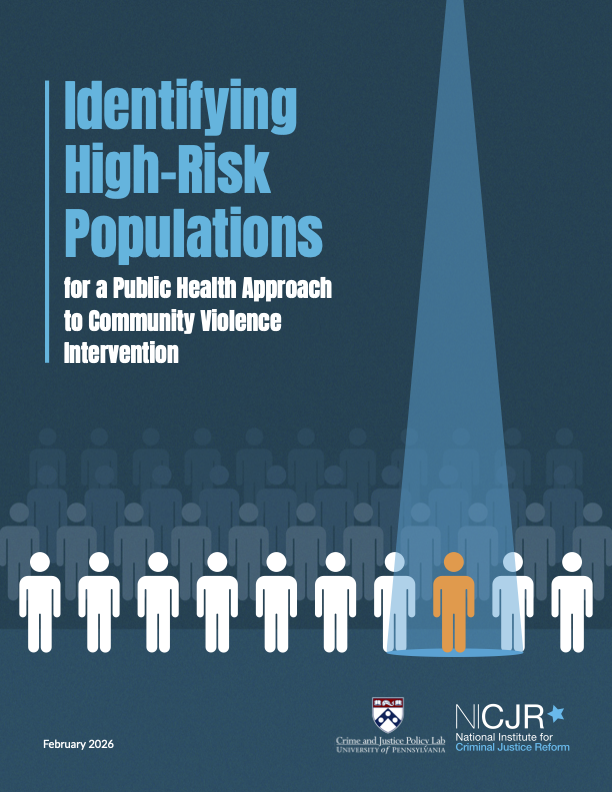
Identifying High-Risk Populations for a Public Health Approach to Community Violence Intervention

By Mikaela Rabinowitz, Vaughn Crandall, and Shantay Jackson. 

Community gun violence in US cities is both rare and highly concentrated. Decades of research and practice show that shootings cluster within a very small number of people, places, and social networks. Effective violence reduction therefore requires identifying and engaging the individuals at very high risk of being involved in gun violence in the immediate future (i.e., very high-risk individuals, or VHRI).

This new brief is designed to support jurisdictions working to implement community violence intervention approaches by improving their ability to identify VHRI. The brief provides 1) a concise synthesis of the research evidence on risk for involvement in community gun violence, and 2) guidance on how to implement structured processes to identify the people driving violence within their communities.