Open Access Publisher and Free Library
CRIMINAL JUSTICE.jpeg

CRIMINAL JUSTICE

CRIMINAL JUSTICE-CRIMINAL LAW-PROCDEDURE-SENTENCING-COURTS

Posts in Gender Studies
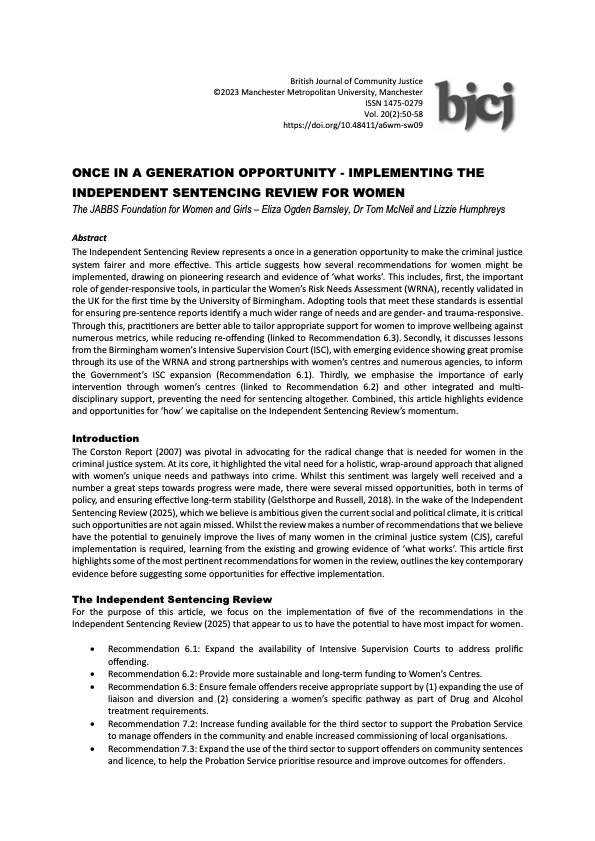
ONCE IN A GENERATION OPPORTUNITY - IMPLEMENTING THE INDEPENDENT SENTENCING REVIEW FOR WOMEN

By: The JABBS Foundation for Women and Girls – Eliza Ogden Barnsley, Dr Tom McNeil and Lizzie Humphreys

Abstract

The Independent Sentencing Review represents a once in a generation opportunity to make the criminal justice system fairer and more effective. This article suggests how several recommendations for women might be implemented, drawing on pioneering research and evidence of ‘what works’. This includes, first, the important role of gender-responsive tools, in particular the Women’s Risk Needs Assessment (WRNA), recently validated in the UK for the first time by the University of Birmingham. Adopting tools that meet these standards is essential for ensuring pre-sentence reports identify a much wider range of needs and are gender- and trauma-responsive. Through this, practitioners are better able to tailor appropriate support for women to improve wellbeing against numerous metrics, while reducing re-offending (linked to Recommendation 6.3). Secondly, it discusses lessons from the Birmingham women’s Intensive Supervision Court (ISC), with emerging evidence showing great promise through its use of the WRNA and strong partnerships with women’s centres and numerous agencies, to inform the Government’s ISC expansion (Recommendation 6.1). Thirdly, we emphasise the importance of early intervention through women’s centres (linked to Recommendation 6.2) and other integrated and multi- disciplinary support, preventing the need for sentencing altogether. Combined, this article highlights evidence and opportunities for ‘how’ we capitalise on the Independent Sentencing Review’s momentum.

Introduction

The Corston Report (2007) was pivotal in advocating for the radical change that is needed for women in the criminal justice system. At its core, it highlighted the vital need for a holistic, wrap-around approach that aligned with women’s unique needs and pathways into crime. Whilst this sentiment was largely well received and a number a great steps towards progress were made, there were several missed opportunities, both in terms of policy, and ensuring effective long-term stability (Gelsthorpe and Russell, 2018). In the wake of the Independent Sentencing Review (2025), which we believe is ambitious given the current social and political climate, it is critical such opportunities are not again missed. Whilst the review makes a number of recommendations that we believe have the potential to genuinely improve the lives of many women in the criminal justice system (CJS), careful implementation is required, learning from the existing and growing evidence of ‘what works’. This article first highlights some of the most pertinent recommendations for women in the review, outlines the key contemporary evidence before suggesting some opportunities for effective implementation.

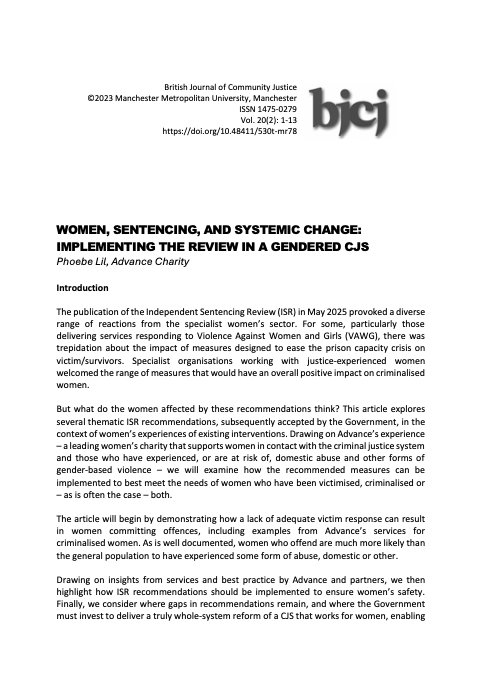
WOMEN, SENTENCING, AND SYSTEMIC CHANGE: IMPLEMENTING THE REVIEW IN A GENDERED CJS

By: Phoebe Lil, Advance Charity

The publication of the Independent Sentencing Review (ISR) in May 2025 provoked a diverse range of reactions from the specialist women’s sector. For some, particularly those delivering services responding to Violence Against Women and Girls (VAWG), there was trepidation about the impact of measures designed to ease the prison capacity crisis on victim/survivors. Specialist organisations working with justice-experienced women welcomed the range of measures that would have an overall positive impact on criminalised women.

But what do the women affected by these recommendations think? This article explores several thematic ISR recommendations, subsequently accepted by the Government, in the context of women’s experiences of existing interventions. Drawing on Advance’s experience – a leading women’s charity that supports women in contact with the criminal justice system and those who have experienced, or are at risk of, domestic abuse and other forms of gender-based violence – we will examine how the recommended measures can be implemented to best meet the needs of women who have been victimised, criminalised or – as is often the case – both.

The article will begin by demonstrating how a lack of adequate victim response can result in women committing offences, including examples from Advance’s services for criminalised women. As is well documented, women who offend are much more likely than the general population to have experienced some form of abuse, domestic or other.

Drawing on insights from services and best practice by Advance and partners, we then highlight how ISR recommendations should be implemented to ensure women’s safety. Finally, we consider where gaps in recommendations remain, and where the Government must invest to deliver a truly whole-system reform of a CJS that works for women, enabling

both the successful implementation of the ISR and other government ambitions, including the Women’s Justice Board and halving VAWG in a decade.

Building Alliances: Community spaces centring justice in times of injustice 

By  Becky Clarke and Zara Manoehoetoe

The numbers of women in prison in England and Wales has risen once again (Prison Reform Trust, 2023), just as women’s imprisonment globally rises exponentially (Fair and Walmsley, 2022). Can existing ‘community-based alternatives’ shift the stubborn use of prison for girls and women? More importantly, how do such approaches engage with the concept of ‘justice’ for women? This article opens by reflecting on the recent past. What lessons must we learn from the failure of ‘gender-responsive’ policies of the last two decades? (Berman and Fox, 2010). Getting things wrong, trying again, taking risks, and experimenting; these are all principles embedded into the imagining and building abolitionist responses (Kaba, 2021). In the main sections of this article, the authors reflect together on recent attempts to convene spaces to centre women’s experiences of policing, punishment and (in)justice. In coming together in community, we are reminded of the radical roots of resistance to the criminalisation and punishment of girls and women. These collective moments offer opportunities to build new alliances and energy. The BJCJ journal was established with the aim ‘to encourage debate about the contested meanings of the concept of ‘community justice’ (Williams, 2002; p1). Our article reflects on collective spaces exploring (in)justice, in recognition that statutory responses too often fail girls and women, with institutional interventions often adding to the harm experienced by girls and women (Clarke and Chadwick, 2023; Clarke and Leah, 2023). The collective offers an opportunity to move beyond a critique of current approaches (HillCollins, 1998) to explore how grassroots spaces, shaped by abolitionist principles, can contribute to transformative justice for girls and women.

The Situational Character Of Prison Violence: An Exploratory Qualitative Study

Author(s): Dante BC Hoek, Ard J Barends, Esther FJC van Ginneken
Focus: This explorative qualitative research on prison violence investigates how, and why, potentially violent situations between incarcerated men occur. Through in-depth interviews with imprisoned and formerly imprisoned men, the research explores the situational circumstances of prison violence.
Conclusion: The article identifies three distinct categories of situations where violence can occur: when incarcerated individuals perceive threats to their (1) status, (2) safety and (3) shared interests (or goals). The findings show how these particular threats impact participants’ interactions and interpretations of situations and subsequent potentially violent behaviour.