
Open Access Free Library
CRIME+CRIMINOLOGY.jpeg

CRIME

Violent-Non-Violent-Cyber-Global-Organized-Environmental-Policing-Crime Prevention-Victimization

Posts in Drug Enforcement
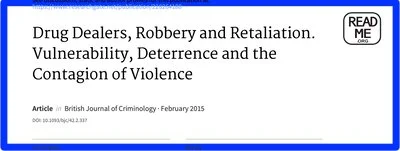
Drug Dealers, Robbery and Retaliation. Vulnerability, Deterrence and the Contagion of Violence

VOLKAN TOPALLI , RICHARD WRIGHT and ROBERT FORNANGO

Because of their illicit status, drug dealers robbed in the course of doing business cannot go to the police. Thus, the deterrent, compensatory and retributive benefits of formal justice are unavailable to them. Informal avenues of redress represent their only means of obtaining justice. This article, based on interviews with 20 recently robbed, active drug dealers in St Louis, Missouri, explores how such victims perceive and respond to the assault. Results indicate that direct retaliation is the preferred response because it serves three important aims: reputation maintenance, loss recovery and vengeance. When dealer/victims are unable or unwilling to retaliate they resort to less satisfactory alternatives such as robbery displacement and the resumption of selling. The implications of these findings for the spread of drug market violence are discussed.

BRIT. J. CRIMINOL.. (2002) 42, 337–351
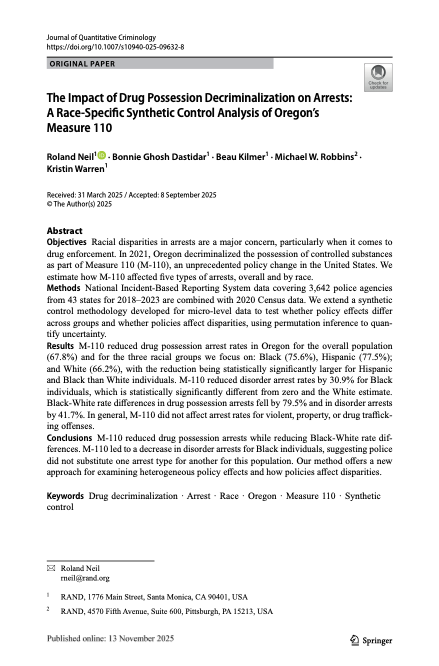
A Race-Specific Synthetic Control Analysis of Oregon’s Measure 110

By Roland Neil, Bonnie Ghosh-Dastidar, Beau Kilmer, Michael W. Robbins, Kristin Warren

Objectives

Racial disparities in arrests are a major concern, particularly when it comes to drug enforcement. In 2021, Oregon decriminalized the possession of controlled substances as part of Measure 110 (M-110), an unprecedented policy change in the United States. We estimate how M-110 affected five types of arrests, overall and by race.

Methods

National Incident-Based Reporting System data covering 3,642 police agencies from 43 states for 2018-2023 are combined with 2020 Census data. We extend a synthetic control methodology developed for micro-level data to test whether policy effects differ across groups and whether policies affect disparities, using permutation inference to quantify uncertainty.

Results

M-110 reduced drug possession arrest rates in Oregon for the overall population (67.8%) and for the three racial groups we focus on: Black (75.6%), Hispanic (77.5%); and White (66.2%), with the reduction being statistically significantly larger for Hispanic and Black than White individuals. M-110 reduced disorder arrest rates by 30.9% for Black individuals, which is statistically significantly different from zero and the White estimate. Black-White rate differences in drug possession arrests fell by 79.5% and in disorder arrests by 41.7%. In general, M-110 did not affect arrest rates for violent, property, or drug trafficking offenses.

Conclusions

M-110 reduced drug possession arrests while reducing Black-White rate differences. M-110 led to a decrease in disorder arrests for Black individuals, suggesting police did not substitute one arrest type for another for this population. Our method offers a new approach for examining heterogeneous policy effects and how policies affect disparities.