Open Access Publisher and Free Library
CRIME+CRIMINOLOGY.jpeg

CRIME

Violent-Non-Violent-Cyber-Global-Organized-Environmental-Policing-Crime Prevention-Victimization

Posts in Addiction
Barriers and facilitators to methadone dispensing for opioid use disorder in community pharmacies: A scoping review

By Caroline Shubel , Mary Ava Nunnery , Grace Marley, Bayla Ostrach , Delesha M. Carpenter

Background: Methadone, an evidence-based medication for opioid use disorder (MOUD), is available through prescription at community pharmacies in countries like Canada, Australia, and the United Kingdom, but not in the United States (U.S.). The objective of this scoping review was to summarize barriers and facilitators related to dispensing methadone in community pharmacies to inform future implementation efforts in the U.S. Methods: A scoping review was conducted using PubMed, Embase, SCOPUS, and CINAHL. Original research articles related to barriers and/or facilitators around community pharmacy-based methadone dispensing were included. No search limits (year of publication, geographic boundaries) were applied to the search strategy. Two independent researchers screened all articles for eligibility, extracted data, and met to reach consensus. Data were extracted on 12 items, with a particular focus on barriers and facilitators to dispensing methadone in community pharmacies. Results: Forty-one articles were included in the review. The most common barriers to methadone dispensing were workload (n = 14), safety concerns for staff and property (n = 13), concern about patient behavior and interactions (n = 12), financial hardship (for pharmacists and patients) (n = 11), and stigma and discrimination towards patients (n = 11). The most common facilitators were pharmacist training and education (n = 14), positive pharmacist-patient relationships (n = 14), and privacy (n = 10). Conclusions: The findings from this review can be used to address barriers and incorporate known facilitators into future protocols or practice of pharmacy-based methadone dispensing. Further research is needed to identify U.S. and state-specific anticipated needs for pharmacy-based methadone dispensing

:Drug Alcohol Depend Rep. 2026 Jan 29;18:100413. doi: 10.1016/j.dadr.2026.100413. PMID: 41695144; PMCID: PMC12906019

Cannabis use within the United States: Prevalence of cannabis use by state legal status and perceptions of benefit and harm

By Andrew P. Bontemps, Elizabeth S. Hawes, Bailey E. Pridgen, William P. Wagner, Dominique Black, Karen L. Cropsey

Background:Cannabis use has increased in the United States as legalization has spread. While Δ-9 THC remains the most-used federally illegal substance, use of other psychoactive hemp-derived products (Δ-8 THC, Δ-10 THC, HHC, THC-O) has grown. The current study investigated patterns of cannabis use and perceptions of harm and benefit of cannabis across states with differing cannabis laws.


Method

Participants (N=639) were adults endorsing past-90-day cannabis use who lived in one of 15 states selected based on cannabis laws (recreational use, medical use, illegal). Participants completed self-report questionnaires endorsing types of cannabis used, methods of consuming and acquiring cannabis, and ranking of potential harm and benefit of consumption methods.


Results

The majority (N=573; 89.7% of participants) endorsed past-30-day use of Δ-9 THC, regardless of legal status. There was significantly greater use of alternate cannabis forms in states where Δ-9 THC remains illegal (past-90-day: χ2(2)=16.78, p<.001; past-30-day: χ2(2)=9.50, p=.009). Individuals from states with legal recreational cannabis most frequently purchased cannabis legally (52.0%), but high levels of non-legal purchase existed regardless of legal status (47.5%). Participants reported primarily consuming Δ-9 THC through smoking (86.1%), CBD through ingestion (50.5%), and alternative cannabis types through vaping (43.8-57.7%). Average harm rankings were lower for smoking if it was the primary method of consumption.


Conclusions

Individuals purchased and consumed cannabis regardless of legal status and legal status was not significantly associated with harm or benefit rating, controlling for demographic and use data. Individuals appear more likely to purchase through legal means, if available.


Drug and Alcohol Dependence Reports

Available online 14 March 2026, 100431


Community supervision during Oregon’s partial decriminalization Measure 110: Criminal legal system involvement, overdose, and naloxone access

Bt Hope M. Smiley-McDonald,  Esther O. Chung , Lynn D. Wenger, Danielle Good , Gillian Leichtling c, Barrot H. Lambdin , Alex H. Kral 

Background

In 2020, the U.S. state of Oregon passed Measure 110 (M110), which aimed to address substance use disorder as a public health issue and reduce disparities in the criminal legal system by decriminalizing personal drug possession and increasing services. The impact of partial drug decriminalization on individuals under community supervision—whose release conditions often prohibit drug use and who M110 excluded—is understudied.

Methods

We used targeted sampling to recruit and survey people who use drugs (PWUD; N=468) in eight Oregon counties in 2023. We compared PWUD under community supervision to those who were not to assess opioid-related overdose, naloxone access, and law enforcement engagement.

Results

Compared to PWUD who were not under community supervision, those under supervision had higher prevalence of past year opioid-related overdose. There were no differences by naloxone access. Eighty-two percent (82%) of PWUD on community supervision were stopped by law enforcement in the past year. PWUD on community supervision were more likely than those not on community supervision to report in the past year being searched by law enforcement at least once (adjusted prevalence differences [APD]=0.33; 95% CI: 0.23, 0.43), spent time in jail at least once (APD=0.33; 95% CI: 0.23, 0.43), and to have concerns about getting into trouble if they called 911 for a drug-related health problem (APD=0.12; 95% CI: 0.00, 0.18).

Conclusion

Under M110, Oregon PWUD experienced more police engagement and overdoses. Findings have implications for less police presence at overdose scenes, greater access to naloxone and support services, and protections under future decriminalization laws.

Drug and Alcohol Dependence Reports

Available online 15 March 2026, 100430

In Press, Journal Pre-proof

The Federal Status of Marijuana and the Policy Gap with States

By Lisa N. Sacco, Joanna R. Lampe, Hassan Z. Sheikh

Marijuana is a psychoactive drug that generally consists of leaves and flowers of the cannabis sativa plant. It is a Schedule I controlled substance under the federal Controlled Substances Act (CSA; 21 U.S.C. §§801 et seq.), and thus is strictly regulated by federal authorities. In contrast, over the last several decades, most states and territories have deviated from a comprehensive prohibition of marijuana and have laws and policies allowing for some cultivation, sale, distribution, and possession of marijuana.


Marijuana is the most commonly used illicit drug in the United States. According to data from the National Survey on Drug Use and Health (NSDUH), in 2024 an estimated 64.2 million individuals aged 12 or older used marijuana in the past year, and 44.3 million reported using it in the past month. The percentage of individuals 12 or older who reported past-month marijuana use gradually increased from 6.1% in 2008 to 15.4% in 2024—a time frame during which a majority of states repealed state criminal prohibitions on marijuana and allowed for its recreational and/or medical use. The rate of past-month marijuana use among youth (ages 12-17) was 6.0% in 2024 and since 2008 has fluctuated from a low of 6.0% (in 2023 and 2024) to a high of 7.9% (in 2011), while adult (ages 18+) use steadily increased—from 6.3% in 2008 to 16.3% in 2024.


Washington, DC: Congressional Research Service; March 10, 2026.

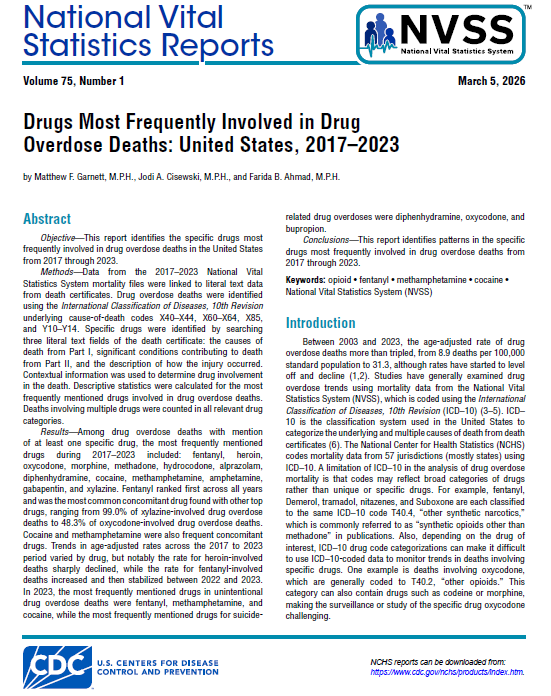
Drugs Most Frequently Involved in Drug Overdose Deaths: United States, 2017–2023

By Matthew F. Garnett, Jodi A. Cisewski, Farida B. Ahmad

Objective:

This report identifies the specific drugs most frequently involved in drug overdose deaths in the United States from 2017 through 2023.

Methods:

Data from the 2017–2023 National Vital Statistics System mortality files were linked to literal text data from death certificates. Drug overdose deaths were identified using the International Classification of Diseases, 10th Revision underlying cause-of-death codes X40–X44, X60–X64, X85, and Y10–Y14. Specific drugs were identified by searching three literal text fields of the death certificate: the causes of death from Part I, significant conditions contributing to death from Part II, and the description of how the injury occurred. Contextual information was used to determine drug involvement in the death. Descriptive statistics were calculated for the most frequently mentioned drugs involved in drug overdose deaths. Deaths involving multiple drugs were counted in all relevant drug categories.

Results:

Among drug overdose deaths with mention of at least one specific drug, the most frequently mentioned drugs during 2017–2023 included: fentanyl, heroin, oxycodone, morphine, methadone, hydrocodone, alprazolam, diphenhydramine, cocaine, methamphetamine, amphetamine, gabapentin, and xylazine. Fentanyl ranked first across all years and was the most common concomitant drug found with other top drugs, ranging from 99.0% of xylazine-involved drug overdose deaths to 48.3% of oxycodone-involved drug overdose deaths. Cocaine and methamphetamine were also frequent concomitant drugs. Trends in age-adjusted rates across the 2017 to 2023 period varied by drug, but notably the rate for heroin-involved deaths sharply declined, while the rate for fentanyl-involved deaths increased and then stabilized between 2022 and 2023. In 2023, the most frequently mentioned drugs in unintentional drug overdose deaths were fentanyl, methamphetamine, and cocaine, while the most frequently mentioned drugs for suicide-related drug overdoses were diphenhydramine, oxycodone, and bupropion.

Conclusions:

This report identifies patterns in the specific drugs most frequently involved in drug overdose deaths from 2017 through 2023.National Vital Statistics Reports; CDC National Center for Health Statistics; 2026.

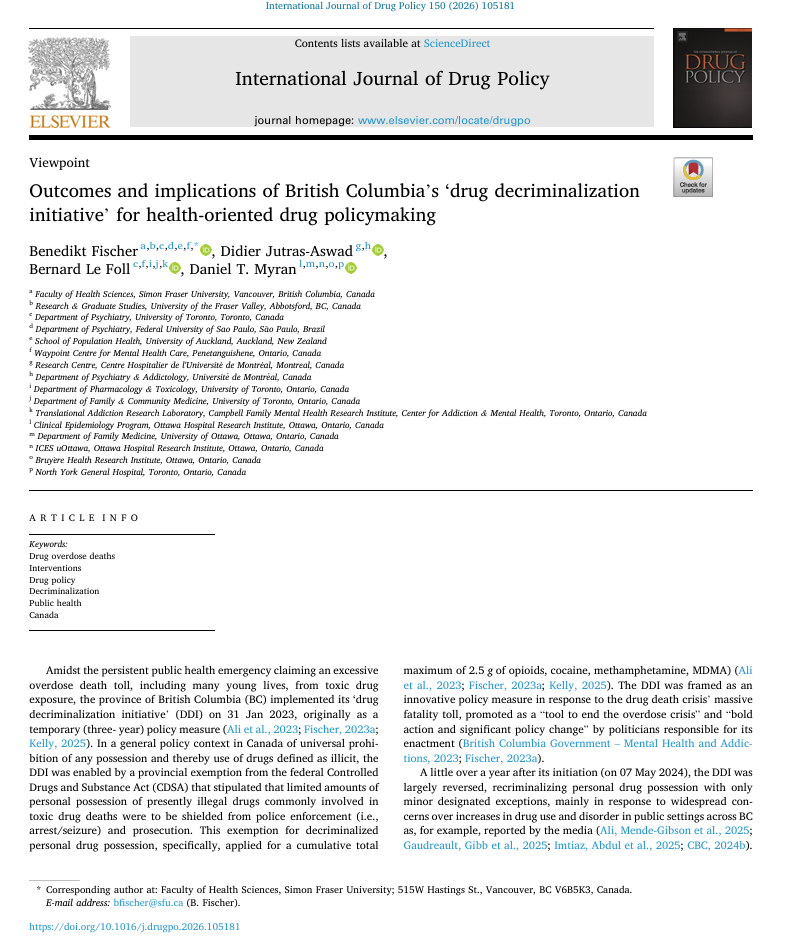
Outcomes and implications of British Columbia’s ‘drug decriminalization initiative’ for health-oriented drug policymaking

By lBenedikt Fischer,  Didier Jutras-Aswad, Bernard Le Foll, Daniel T. Myra

Highlights

The province of British Columbia (Canada) temporarily implemented a decriminalization initiative for personal drug possession/use (2023–2024) in contexts of a toxic drug death crisis.

  1. The decriminalization initiative was a priori promoted as a “tool to end the overdose crisis” and widely expected to reduce adverse health outcomes from toxic drug use.

  2. Emerging evaluation data indicate that the drug decriminalization initiative was not associated with population-level changes in drug use-related mortality (e.g., overdose deaths) or morbidity (e.g., hospitalizations).

  3. Drug use decriminalization remains an essential step to align prohibition-based drug policy frameworks with public health and human rights principles, but must be approached realistically and designed sensibly.

  4. To tangibly address toxic drug use-related harms, expanded measures are required that are effectively capable of preventing and reducing PWUDs’ exposure to and use of toxic drugs
    International Journal of Drug Policy

Volume 150, April 2026, 105181

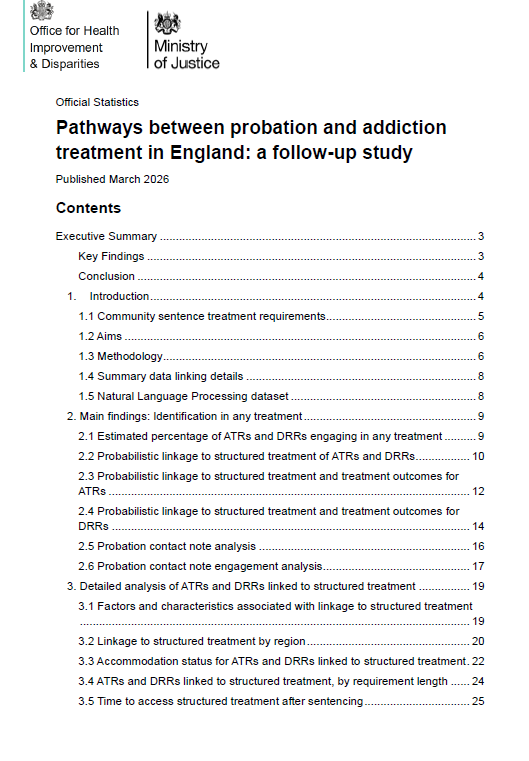
Pathways between probation and addiction treatment in England: a follow-up study

By the U.K.Ministry of Justice, and the Office of Health Improvement and Disparities


Executive Summary This report presents follow-up analysis building on Pathways between probation and addiction treatment in England: report - GOV.UK focusing on people sentenced to community orders (COs) and suspended sentence orders (SSOs) with an Alcohol Treatment Requirement (ATR) or Drug Rehabilitation Requirement (DRR). It examines engagement with alcohol and drug treatment, how engagement relates to reconvictions https://www.sciencedirect.com/science/article/pii/S0955395926000332 outcomes, and their characteristics. The analysis covers all ATRs and DRRs issued between August 2018 and March 2023. The study linked probation case management records with the National Drug Treatment Monitoring System (NDTMS) using probabilistic data linkage. This was supplemented by Natural Language Processing (NLP) analysis of probation contact notes. This approach aimed to assess whether the absence of ATRs and DRRs in structured treatment data reflected a true lack of treatment or gaps in data linkage. A total of 45,943 ATR and DRR requirements were issued during the period. Of these, 22,636 were linked to structured treatment through data linkage. The NLP approach derived an engagement rate from the unlinked sample. This was then applied to all unlinked records, resulting in an estimated 18,712 requirements with evidence of treatment engagement. Key Findings 1. Up to 90%1 of ATRs and DRRs were estimated to involve some form of treatment engagement. This is based on 49% linked to structured treatment through probabilistic data linking and an additional 41% of unlinked records showing treatment engagement in probation contact notes. Engagement was estimated to be higher for ATRs (93%) than for DRRs (88%). 2. Reconviction was less common following ATRs and DRRs linked to structured treatment. Within 12 months of sentencing, 36% of those linked to structured treatment were reconvicted, compared with 44% of those not linked to structured treatment. 

3. Characteristics associated with being more likely to be linked to structured treatment included being: • aged over 50 • female • in settled accommodation, (least likely when associated with rough sleeping) • engaged by treatment services within: 


▪ 3 weeks of an ATR, ▪ 3–6 weeks of a DRR 4. Reconviction outcomes varied by treatment outcome: • Reconvictions associated with ATRs and DRRs were lowest when they remained in structured treatment at the end of the observation period (13% for ATR; 26% for DRR). • Reconvictions associated with ATRs and DRRs were highest when they dropped out of structured treatment (41% for ATR; 60% for DRR). • Reconvictions associated with ATRs and DRRs that were not identified in structured treatment were higher than completed or remained in structured treatment but lower than those that dropped out of structured treatment (37% for ATR; 51% for DRR). Conclusion The analysis shows clear associations between treatment engagement and both individual characteristics and justice system factors. Individuals with ATRs and DRRs who completed or remained in structured treatment had better reconviction outcomes than those who dropped out of or had no identified structured treatment. This highlights the value of sustained engagement. The report also demonstrates the value of AI based NLP methods to strengthen insight by identifying treatment activity not captured through data linkage alone.

London: U.K. Ministry of Justice and the Office of Health Improvement and Disparities, 2026. 47p.

CONTRABAND TOBACCO: SYSTEMATIC PROFILING OF CIGARETTE PACKS FOR FORENSIC INTELLIGENCE

By Laurie Caron, Frank Crispino and Cyril Muehlethaler

Tobacco smuggling remains a widespread illegal activity in Canada, associated with important social and economic impacts, and often linked to organized crime. This study explores the application of forensic profiling as an intelligence tool to support the analysis of contraband cigarette production and distribution. Physical and chemical manufacturing characteristics of seized contraband cigarette packs, provided by the Canada Border Services Agency (CBSA), were observed and coded using macroscopic, microscopic, and spectroscopic techniques. Multivariate statistical analyses were then conducted to compare manufacturing characteristics between packs and identify potential links. The analyses highlighted links between cigarette packs and seizures based on shared manufacturing characteristics. The results and the identified groups were also compared with seizure data provided by the CBSA. The results demonstrate the relevance of forensic profiling to formulate hypotheses regarding shared production processes or supply networks. These hypotheses provide information that contributes to understanding tobacco smuggling and aim to examine how forensic intelligence can support law enforcement and measures to prevent and disrupt this criminal activity. A preliminary optimal procedure for applying forensic profiling in operational contexts targeting contraband tobacco was finally proposed. Despite limitations in the dataset creation that were beyond our control, this study represents a starting point for applying this scientific approach to tobacco smuggling

Assessment Of The Abuse and Dependence Potential Of New Psychoactive Substances: Synthetic Opioids

By The Laboratory and Scientific Services
United Nations Office on Drugs and Crime; 

The scientific evaluation of substances for inclusion in international and most national legislations requires an assessment of a range of chemical, pharmacological, and toxicological properties of a substance. Also, for many of the NPS that have emerged, quality comparable scientific data on these properties are either scarce or do not exist. The aim of these UNODC guidelines is to support Member States in the generation of quality scientific data on key pharmacological properties used in the scientific evaluation of substances, specifically the determination of the abuse and dependence potential of NPS. Given the continued emergence of highly potent synthetic opioids in recent years, this guideline will focus on synthetic opioids and future volumes will contain information on other groups of NPS.

Vienna: UNODC< 2025. 58p.

Abnormal Man : Volume 2 - Bibliography

By Arthur MacDonald.

The narrative in Volume 1 asks many pointed questions: What does it mean to be “abnormal”? Who decides? And how have these judgments shaped modern science, education, and criminal justice?

First published in 1893, Arthur MacDonald’s Abnormal Man is one of the earliest American attempts to systematically study human difference through the emerging tools of psychology, anthropology, and criminology. Drawing on international research—from European criminal anthropology to American child-study movements—MacDonald sought to classify the physical, mental, and moral traits considered “aberrant” in his era. His work reflects the hopes and anxieties of a society confronting rapid industrialization, immigration, social change, and new scientific approaches to crime and mental health.

To the modern reader, Abnormal Man reveals both the ambition and the pitfalls of nineteenth-century science. Its pages contain pioneering observations about child development, deviance, and social responsibility, alongside early theories—now discredited—about heredity, physiognomy, and race. What emerges is a vivid and sometimes unsettling portrait of a culture striving to understand human variation without the benefit of modern psychology or ethical safeguards.

The Read-Me.org edition Volume 1 presents Abnormal Man as both a historical artifact and a gateway to critical reflection. It illustrates how scientific thought evolves, how cultural bias can shape research, and how early debates about abnormality laid the groundwork for contemporary approaches to mental health, special education, criminology, and social policy. To make such work, much of it controversial then as it is today, minimally believable, requires extensive documentation. The voluminous Bibliography of Abnormal Man reproduced here in Volume 2, contains all that Macdnald referred to within his detailed exposition. To some, his arguments may seem unsupported, or lacking in evidence. But he left no stone untuned as this amazing bibliographical documentation of all relative contemporary research

A foundational text at the crossroads of science and society, Abnormal Man invites readers to explore the origins of modern debates about deviance, diversity, and the boundaries of the “normal.”

Read-Me.Org Inc. New York-Philadelphia-Australia. 2025. 240p.

Abnormal Man : Volume 1 --Digest of Literature

By Arthur MacDonald. Introduction by Graeme R. Newman

What does it mean to be “abnormal”? Who decides? And how have these judgments shaped modern science, education, and criminal justice?

First published in 1893, Arthur MacDonald’s Abnormal Man is one of the earliest American attempts to systematically study human difference through the emerging tools of psychology, anthropology, and criminology. Drawing on international research—from European criminal anthropology to American child-study movements—MacDonald sought to classify the physical, mental, and moral traits considered “aberrant” in his era. His work reflects the hopes and anxieties of a society confronting rapid industrialization, immigration, social change, and new scientific approaches to crime and mental health.

To the modern reader, Abnormal Man reveals both the ambition and the pitfalls of nineteenth-century science. Its pages contain pioneering observations about child development, deviance, and social responsibility, alongside early theories—now discredited—about heredity, physiognomy, and race. What emerges is a vivid and sometimes unsettling portrait of a culture striving to understand human variation without the benefit of modern psychology or ethical safeguards.

This new Read-Me.org edition presents Abnormal Man as both a historical artifact and a gateway to critical reflection. It illustrates how scientific thought evolves, how cultural bias can shape research, and how early debates about abnormality laid the groundwork for contemporary approaches to mental health, special education, criminology, and social policy.

A foundational text at the crossroads of science and society, Abnormal Man invites readers to explore the origins of modern debates about deviance, diversity, and the boundaries of the “normal.”

Read-Me.Org Inc. New York-Philadelphia-Australia. 2025. p.193.

World Drug Report 2024

UNITED NATIONS OFFICE ON DRUGS AND CRIME

From the webpage description: "A global reference on drug markets, trends and policy developments, the World Drug Report offers a wealth of data and analysis and in 2024 comprises several elements tailored to different audiences. The web-based Drug market patterns and trends [hyperlink] module contains the latest analysis of global, regional and subregional estimates of and trends in drug demand and supply in a user-friendly, interactive format supported by graphs, infographics and maps. The Key findings and conclusions booklet [hyperlink] provides an overview of selected findings from the analysis presented in the Drug market patterns and trends module and the thematic Contemporary issues on drugs booklet, while the Special points of interest [hyperlink] fascicle offers a framework for the main takeaways and policy implications that can be drawn from those findings. As well as providing an in-depth analysis of key developments and emerging trends in selected drug markets, the Contemporary issues on drugs booklet [hyperlink] looks at several other developments of policy relevance. [...] The World Drug Report 2024 is aimed not only at fostering greater international cooperation to counter the impact of the world drug problem on health, governance and security, but also at assisting Member States in anticipating and addressing threats posed by drug markets and mitigating their consequences."

UNITED NATIONS OFFICE ON DRUGS AND CRIME. 2024

CCP's Role in the Fentanyl Crisis

UNITED STATES. CONGRESS. HOUSE. SELECT COMMITTEE ON THE STRATEGIC COMPETITION BETWEEN THE UNITED STATES AND THE CHINESE COMMUNIST PARTY

From the document: "The fentanyl crisis is one of the most horrific disasters that America has ever faced. On average, fentanyl kills over 200 Americans daily, the equivalent of a packed Boeing 737 crashing every single day. Fentanyl is the leading cause of death for Americans aged 18-45 and a leading cause in the historic drop in American life expectancy. It has led to millions more suffering from addiction and the destruction of countless families and communities. Beyond the United States, fentanyl and other mass-produced synthetic narcotics from the People's Republic of China (PRC) are devastating nations around the world. It is truly a global crisis. The PRC, under the leadership of the Chinese Communist Party (CCP), is the ultimate geographic source of the fentanyl crisis. Companies in China produce nearly all of illicit fentanyl precursors, the key ingredients that drive the global illicit fentanyl trade. The House Select Committee on the Strategic Competition between the United States and the Chinese Communist Party (Select Committee) launched an investigation to better understand the role of the CCP in the fentanyl crisis. This investigation involved delving deep into public PRC websites, analyzing PRC government documents, acquiring over 37,000 unique data points of PRC companies selling narcotics online through web scraping and data analytics, undercover communications with PRC drug trafficking companies, and consultations with experts in the public and private sectors, among other steps. [...] [T]he Select Committee found thousands of PRC companies openly selling [...] illicit materials on the Chinese internet--the most heavily surveilled country-wide network in the world. The CCP runs the most advanced techno-totalitarian state in human history that 'leave[s] criminals with nowhere to hide' and has the means to stop illicit fentanyl materials manufacturers, yet it has failed to pursue flagrant violations of its own laws."

UNITED STATES. CONGRESS. HOUSE. SELECT COMMITTEE. 16 APR, 2024. 64p.

Illegal synthetic opioids: Can Europe prevent a crisis?

By Mafalda Pardal, Elle Wadsworth, Beau Kilmer

Potent synthetic opioids, illegally produced, are starting to emerge in Europe. Considering the damaging harms caused by the opioid crisis in North America, which has led to a substantial surge in overdose deaths, it is crucial that European leaders understand the challenges associated with synthetic opioids. In this Perspective, we present and discuss the current situation in Europe concerning synthetic opioids, and draw on earlier and ongoing crises involving this group of substances to reflect on likely challenges ahead and ways to improve preparedness.

Santa Monica, CA: RAND, 2024. 20p.

Characterizing prescription opioid, heroin, and fentanyl initiation trajectories: A qualitative study

By Tasha Perdue aRobert Carlson bRaminta Daniulaityte cSydney M. Silverstein bRicky N. Bluthenthal dAvelardo Valdez eAlice Cepeda

The purpose of this study is to describe opioid initiation within each of the three waves from the perspective of people who use illicit opioids, with a focus on emerging pathways into fentanyl use. We noted supply-side changes as influencing trajectories in all three waves. However, we also noted differences in the experiences of prescription opioid and heroin initiation, with these trajectories influenced by pharmacological effects, pain management, curiosity, intergenerational use, pricing, and peers. In comparison, most participants were unaware that they were initiating fentanyl, and many reported overdosing with their first use of fentanyl. We identified a trajectory into fentanyl with limited to no prior heroin use among a few participants.

Social Science & Medicine Volume 340. January 2024, 11pg