
Open Access Free Library
CRIME+CRIMINOLOGY.jpeg

CRIME

Violent-Non-Violent-Cyber-Global-Organized-Environmental-Policing-Crime Prevention-Victimization

Posts in Crime and Society
Two Families and a Laboratory: Heredity, Crime, and the Study of Man

A. E. Winship and Arthur MacDonald. Introduction nad Review Questions, Graeme Newman.

Are people born to crime and poverty, or made by their surroundings? This volume brings together two influential American works from the turn of the twentieth century that tried to answer that question.

In Jukes–Edwards: A Study in Education and Heredity (1900), educator A. E. Winship sets the infamous “Jukes” family against the descendants of the great colonial theologian Jonathan Edwards. The Jukes were the subject of Richard Dugdale’s famous study of crime and pauperism. Edwards’s descendants included college presidents, judges, physicians, senators, and a vice-president of the United States. Winship’s vivid portraits, from Sarah Edwards’s household to the troubled brilliance of Aaron Burr, make a case for the combined power of inheritance, training, and education.

In A Plan for the Study of Man (1902), Arthur MacDonald of the U.S. Bureau of Education urges Congress to establish a national laboratory for the scientific study of “the criminal, pauper, and defective classes.” He wanted it to study ordinary people as well. His wide-ranging survey covers anthropometry, measurements of schoolchildren, instruments for gauging sensitivity to heat, touch, and pain, and hypnotism and suggestion. It also takes in the Mafia and the Camorra, alcoholism, moral education, prison reform, and a detailed case history of a young murderer. His original illustrations of laboratory instruments are reproduced.

The new introduction places both works in historical context. It traces their influence on the eugenics movement, the later criticism of their methods, and their surprising anticipation of modern child development and criminological research. Spelling and wording have been modernized throughout, tables have been summarized in prose, and review and discussion questions are included. The book will interest students and general readers in criminology, sociology, education, and the history of science.

Read-Me.Org Inc. New York-Philadelphia-Australia. 2026. p.196.

Drug Dealers, Robbery and Retaliation. Vulnerability, Deterrence and the Contagion of Violence

VOLKAN TOPALLI , RICHARD WRIGHT and ROBERT FORNANGO

Because of their illicit status, drug dealers robbed in the course of doing business cannot go to the police. Thus, the deterrent, compensatory and retributive benefits of formal justice are unavailable to them. Informal avenues of redress represent their only means of obtaining justice. This article, based on interviews with 20 recently robbed, active drug dealers in St Louis, Missouri, explores how such victims perceive and respond to the assault. Results indicate that direct retaliation is the preferred response because it serves three important aims: reputation maintenance, loss recovery and vengeance. When dealer/victims are unable or unwilling to retaliate they resort to less satisfactory alternatives such as robbery displacement and the resumption of selling. The implications of these findings for the spread of drug market violence are discussed.

BRIT. J. CRIMINOL.. (2002) 42, 337–351

AN EXPLANATION FOR THE END OF POLITICAL BANK ROBBERY IN THE REPUBLIC OF KOREA

James C. Schopf

Many statist accounts of development, especially that which has occurred in East Asia, emphasize the autonomous role of the bureaucracy. Civil servants in these accounts are often assumed to give planrational guidance to economic forces. This argument fits nicely with the claims of some strong-state advocates that the messiness, conflict, and jockeying for position characteristic of democratic politics do disrupt the efficient contributions to development that a state-led or dirigiste system makes possible. This article, however, argues to the contrary, in favor of a different theoretical analysis to which comparative examination of Korean regimes gives some empirical confirmation. In Korea, authoritarian leaderships extracted funds and rewarded political supporters by using banks and bureaucracies to coddle inefficient but favored firms with close ties…….

Asian Survey, 41:5, pp. 693–715. ISSN: 0004–4687.

An Evaluation of the 1977 Canadian Firearm Legislation: Robbery Involving a Firearm

by Gary A. Mauser

The effect of the 1977 Canadian firearm legislation on robberies involving firearms is evaluated between 1974 and 1992 using a pooled cross-section, time series model. The results show that the 1977 legislation did not reduce robbery involving firearms, nor did it have a significant effect on the total robbery or armed robbery rates. The legislation may even have acted perversely in that it may have increased robberies with firearms. In general, these results are consistent with previous published findings but contrast with unpublished governmental studies. The implication that this legislation may have acted perversely is new and requires further investigation.

Unpublished.

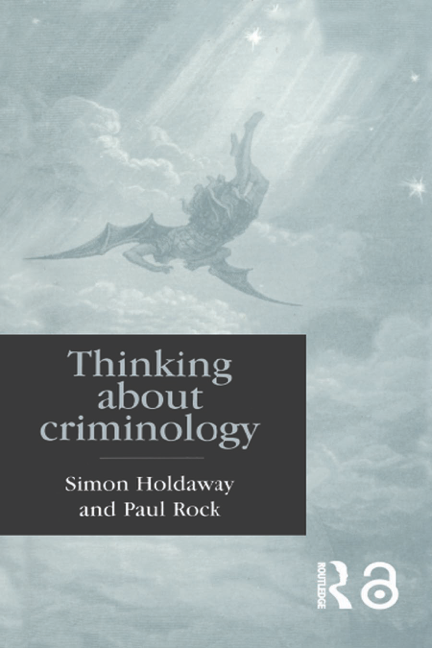
Thinking About Criminology

Edited by Simon Holdaway and Paul Rock

First published in 1998. Thinking about criminology draws together the expertise of respected criminologists from the principle contemporary schools of thought. The book aims to provide a clear analysis of the relationship between sociological theory and contemporary empirical criminological research, discussing the ways in which theoretical perspectives have contributed to the understanding of relevant criminal justice institutions, law and policy.