

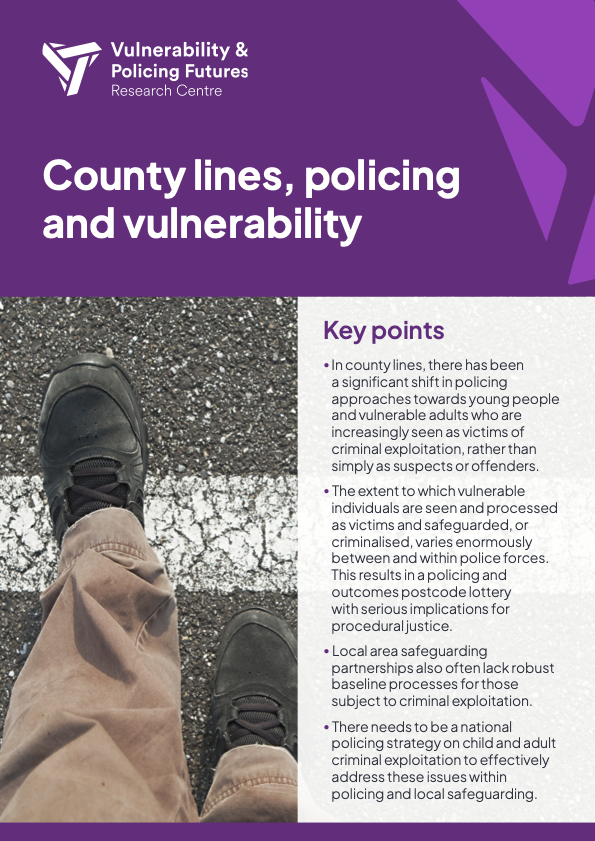
By Ross Coomber; Charles Lloyd; Kate Brown: and Laura Bainbridge
In county lines, there has been a significant shift in policing approaches towards young people and vulnerable adults who are increasingly seen as victims of criminal exploitation, rather than simply as suspects or offenders. The extent to which vulnerable individuals are seen and processed as victims and safeguarded, or criminalized, varies enormously between and within police forces. This results in a policing and outcomes
postcode lottery with serious implications for procedural justice. Local area safeguarding partnerships also often lack robust baseline processes for those subject to criminal exploitation. There needs to be a national policing strategy on child and adult criminal exploitation to effectively address these issues within policing and local safeguarding.
Summary : This is the UK’s first national study of police responses to county lines drug distribution and related child and adult criminal exploitation. The study examined how the police identify and process young people and vulnerable adults involved in drug distribution in cross-border and local drug markets. The findings show that police forces are changing how they consider and process young people and vulnerable adults involved in drug markets. However, while they increasingly recognize vulnerability and investigate possible criminal
exploitation, policing practice varies significantly between and even within forces. The findings suggest that to help establish an appropriate minimum baseline safeguarding response, consistent across all forces, there needs to be more detailed national guidance, policy, and centralized oversight in this area.
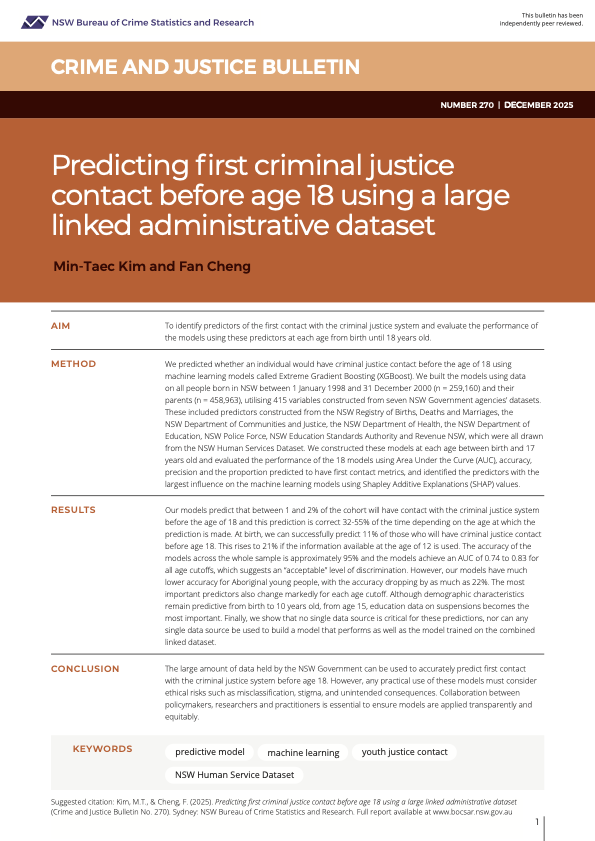
By Min-Taec Kim, Fan Cheng
The Bureau of Crime Statistics and Research (BOCSAR) has released a new study that considered whether linked data from health, education, child protection (and more) can be used to predict which children are likely to offend before turning 18. The study found: Whole-of-population level: Machine learning methods applied to large-linked data can identify future young offenders with reasonable accuracy. Aboriginal young people: The models were far less accurate for Aboriginal young people and could not be reliably used for this group. Offending predictions for Aboriginal young people were more likely to be wrong than for non-Aboriginal young people – a higher rate of false positives. This raises significant ethical concerns about the practical use of such models for Aboriginal people and other sub-populations. Predictive factors over time: The study also identified key predictors of offending and how these change with age. At birth, gender and parental characteristics are most influential. Between ages 5 and 10, child protection reports and disability become important. By age 15, school suspension is the strongest predictor of youth offending.
By Sophie King-Hill
This evidence review explores how masculinity influences offending, vulnerability and engagement with the criminal justice system. It examines the impact of gender norms, trauma and online influences, and considers how gender-informed, trauma-aware approaches can support prevention, rehabilitation and safer communities.