
Open Access Free Library
CRIME+CRIMINOLOGY.jpeg

CRIME

Violent-Non-Violent-Cyber-Global-Organized-Environmental-Policing-Crime Prevention-Victimization

Posts in Youth Offending
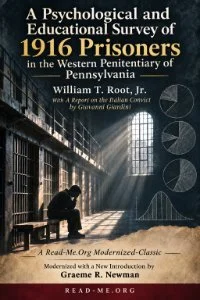
A Psychological and Educational Survey of 1916 Prisoners in the Western Penitentiary of Pennsylvania (Copy)

By William T. Root, Jr.. With A Report on the Italian Convict, by Giovanni Giardini. . Modernized with a new Introduction by Graeme R. Newman.

Originally published in 1927, this pioneering study offers a remarkable examination of the psychological, educational, and social characteristics of 1,916 prisoners in Pennsylvania's Western Penitentiary. Based on extensive individual interviews, intelligence testing, psychiatric assessments, and institutional records collected between 1924 and 1926, William T. Root, Jr. investigates the complex relationship between criminal behavior, intelligence, education, poverty, family circumstances, and social environment.

Challenging the prevailing emphasis on punishment and vengeance, Root argues that criminal conduct must be understood through its underlying causes. His findings raise enduring questions about personal responsibility, social inequality, rehabilitation, and the capacity of prisons to reform rather than merely confine offenders.

The volume also includes Giovanni Giardini's revealing investigation of Italian immigrant prisoners, examining the influence of cultural background, immigration, and changing social conditions on patterns of offending.

Although rooted in the psychological theories and classifications of the 1920s, some now discredited, this work remains an important historical contribution to criminology, correctional psychology, and the development of evidence-based prison reform.

This Read-Me.Org Modernized-Classic edition presents a carefully condensed and modernized text, replacing extensive statistical tables with accessible summaries while retaining selected original graphs. A new Introduction by Graeme R. Newman places the study in its historical and intellectual context, critically examines its assumptions, and explains its continuing relevance. Review and discussion questions make the volume particularly useful for students, researchers, and readers interested in the history of criminal justice.

A compelling historical document that asks a question as urgent today as it was a century ago: Should society seek to understand and reform those who commit crimes, or simply punish them?

Read-Me.Org Inc. New York-Philadelphia-Australia. 2026. p.105.

A Psychological and Educational Survey of 1916 Prisoners in the Western Penitentiary of Pennsylvania

By William T. Root, Jr.. With A Report on the Italian Convict, by Giovanni Giardini. . Modernized with a new Introduction by Graeme R. Newman.

Originally published in 1927, this pioneering study offers a remarkable examination of the psychological, educational, and social characteristics of 1,916 prisoners in Pennsylvania's Western Penitentiary. Based on extensive individual interviews, intelligence testing, psychiatric assessments, and institutional records collected between 1924 and 1926, William T. Root, Jr. investigates the complex relationship between criminal behavior, intelligence, education, poverty, family circumstances, and social environment.

Challenging the prevailing emphasis on punishment and vengeance, Root argues that criminal conduct must be understood through its underlying causes. His findings raise enduring questions about personal responsibility, social inequality, rehabilitation, and the capacity of prisons to reform rather than merely confine offenders.

The volume also includes Giovanni Giardini's revealing investigation of Italian immigrant prisoners, examining the influence of cultural background, immigration, and changing social conditions on patterns of offending.

Although rooted in the psychological theories and classifications of the 1920s, some now discredited, this work remains an important historical contribution to criminology, correctional psychology, and the development of evidence-based prison reform.

This Read-Me.Org Modernized-Classic edition presents a carefully condensed and modernized text, replacing extensive statistical tables with accessible summaries while retaining selected original graphs. A new Introduction by Graeme R. Newman places the study in its historical and intellectual context, critically examines its assumptions, and explains its continuing relevance. Review and discussion questions make the volume particularly useful for students, researchers, and readers interested in the history of criminal justice.

A compelling historical document that asks a question as urgent today as it was a century ago: Should society seek to understand and reform those who commit crimes, or simply punish them?

Read-Me.Org Inc. New York-Philadelphia-Australia. 2026. p.105.
CRIMINOLOGY: A Read-Me.Org Modernized-Classic

By. Albert Morris. Modernized with a new introduction and discussion questions by Graeme R. Newman

Criminals are not born. They are made.

In this classic American textbook, first published in 1934 and revised in 1938, Albert Morris of Boston University set out to show how. He treated crime as a problem of human behavior, not of laws and punishments. He follows the offender’s life from beginning to end: the home and the street corner, the gang and the restless years of adolescence, the hardening of a criminal habit, and on through the police, the courts, probation, the jail, the prison, and parole.

Morris was clear-eyed, humane, and often witty, and many of his ideas were well ahead of their time:

  • He warned that most criminals never see the inside of a prison, so studies of convicts tell us little about criminals in general.

  • He exposed the “criminals of the upperworld,” respectable businessmen and politicians the law rarely touches, years before “white-collar crime” became a familiar phrase.

  • He argued that the causes of crime work differently at different ages, an early version of today’s life-course criminology.

  • He gave an unsparing account of the county jail, the chain gang, and the convict-lease system.

  • He traced the history of punishment from the gallows and the prison hulks to the rival Pennsylvania and Auburn prison systems.

  • He examined the first statistical tables for predicting success on parole, the forerunners of today’s risk-assessment tools.

This Read-Me.Org Modernized-Classic edition abridges the 1938 text to about seventy percent of its length and updates the language for today’s readers, while keeping Morris’s own voice. Historical charts are kept, and a new Introduction and Review and Discussion Questions by Graeme R. Newman place the book in the history of criminology.

It is suited to students of criminology, criminal justice, sociology, and the history of corrections, and to anyone curious about how Americans have tried to understand and control crime.

Read-Me.Org Inc. New York-Philadelphia-Australia. 2026. p.338.

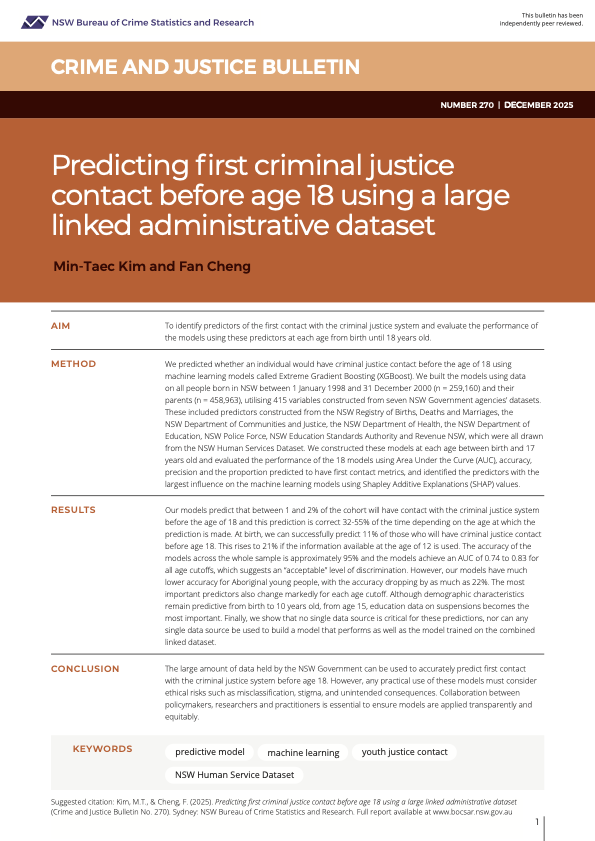
Predicting first criminal justice contact before age 18 using a large linked administrative dataset

By Min-Taec Kim, Fan Cheng
The Bureau of Crime Statistics and Research (BOCSAR) has released a new study that considered whether linked data from health, education, child protection (and more) can be used to predict which children are likely to offend before turning 18. The study found: Whole-of-population level: Machine learning methods applied to large-linked data can identify future young offenders with reasonable accuracy. Aboriginal young people: The models were far less accurate for Aboriginal young people and could not be reliably used for this group. Offending predictions for Aboriginal young people were more likely to be wrong than for non-Aboriginal young people – a higher rate of false positives. This raises significant ethical concerns about the practical use of such models for Aboriginal people and other sub-populations. Predictive factors over time: The study also identified key predictors of offending and how these change with age. At birth, gender and parental characteristics are most influential. Between ages 5 and 10, child protection reports and disability become important. By age 15, school suspension is the strongest predictor of youth offending.