
Open Access Publisher and Free Library
CRIME+CRIMINOLOGY.jpeg

CRIME

Violent-Non-Violent-Cyber-Global-Organized-Environmental-Policing-Crime Prevention-Victimization

Posts tagged Naloxone
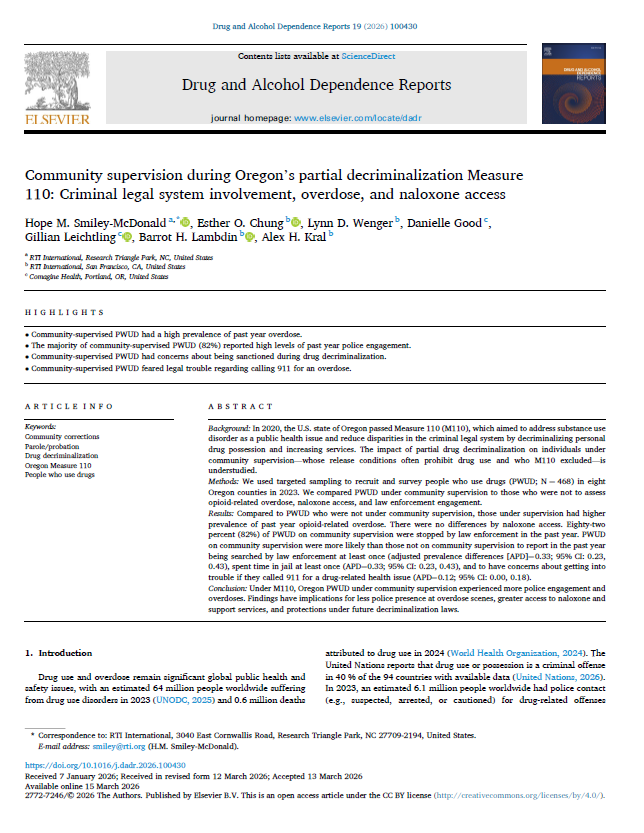
Community supervision during Oregon’s partial decriminalization Measure 110: Criminal legal system involvement, overdose, and naloxone access

Bt Hope M. Smiley-McDonald,  Esther O. Chung , Lynn D. Wenger, Danielle Good , Gillian Leichtling c, Barrot H. Lambdin , Alex H. Kral 

Background

In 2020, the U.S. state of Oregon passed Measure 110 (M110), which aimed to address substance use disorder as a public health issue and reduce disparities in the criminal legal system by decriminalizing personal drug possession and increasing services. The impact of partial drug decriminalization on individuals under community supervision—whose release conditions often prohibit drug use and who M110 excluded—is understudied.

Methods

We used targeted sampling to recruit and survey people who use drugs (PWUD; N=468) in eight Oregon counties in 2023. We compared PWUD under community supervision to those who were not to assess opioid-related overdose, naloxone access, and law enforcement engagement.

Results

Compared to PWUD who were not under community supervision, those under supervision had higher prevalence of past year opioid-related overdose. There were no differences by naloxone access. Eighty-two percent (82%) of PWUD on community supervision were stopped by law enforcement in the past year. PWUD on community supervision were more likely than those not on community supervision to report in the past year being searched by law enforcement at least once (adjusted prevalence differences [APD]=0.33; 95% CI: 0.23, 0.43), spent time in jail at least once (APD=0.33; 95% CI: 0.23, 0.43), and to have concerns about getting into trouble if they called 911 for a drug-related health problem (APD=0.12; 95% CI: 0.00, 0.18).

Conclusion

Under M110, Oregon PWUD experienced more police engagement and overdoses. Findings have implications for less police presence at overdose scenes, greater access to naloxone and support services, and protections under future decriminalization laws.

Drug and Alcohol Dependence Reports

Available online 15 March 2026, 100430

In Press, Journal Pre-proof

More Is Not Always Better: Challenging Calls for High-Dose Naloxone

By Stacey Mckenna

Overdose deaths have skyrocketed across the United States in recent years, increasing by 622 percent between 2000 and 2020, with more than 112,000 lives lost in 2023. This crisis has been largely driven by the proliferation of potent synthetic opioids such as illicitly manufactured fentanyl, which is up to 50 times stronger than heroin.

The opioid antagonist, naloxone, is an especially important harm reduction tool in this landscape. Naloxone binds to opioid receptors in the brain, preventing other opioids, such as fentanyl or heroin, from binding to and activating them. The U.S. Food and Drug Administration (FDA) first approved the medication for the reversal of opioid overdoses in 1971. When administered in a timely manner, naloxone can restore breathing within minutes and successfully reverse 75 to 100 percent of overdoses.

Consequently, lawmakers and government agencies across the country have taken steps to improve access to naloxone. State legislatures have passed laws providing immunity to laypeople who administer the medication, authorized statewide standing orders to facilitate prescription-free pharmacy access, and purchased naloxone in bulk for direct distribution and to pass along to community-based organizations and first responders. Last year, the FDA approved intranasal naloxone products for over-the-counter sale for the first time.

However, with novel, increasingly potent synthetic opioids dominating the illicit supply, some medical experts worry that naloxone as we know it is simply not good enough anymore. In fact, in 2021, the FDA approved both higher-dose naloxone products and new, longer-lasting opioid antidotes, and some government agencies have begun purchasing these products for distribution in their communities.

This policy study aims to inform legislators and public health decision-makers about how high-dose naloxone fits into federal, state, and local efforts to combat the opioid overdose crisis. We examine the research on naloxone efficacy—in laboratory and medical settings and in the real world—and assess potential drawbacks associated with alternatives to standard-dose naloxone.

R Street Shorts No. 135 Washington, DC: R Street, 2024. 10p.