
Open Access Free Library
CRIME+CRIMINOLOGY.jpeg

CRIME

Violent-Non-Violent-Cyber-Global-Organized-Environmental-Policing-Crime Prevention-Victimization

Posts tagged Stress
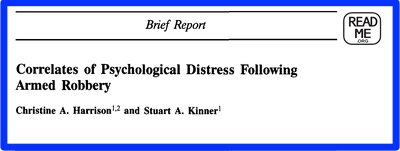
Correlates of Psychological Distress Following Armed Robbery

Christine A. Harrison and Stuart A. Kinner

Although mental health professionals have long been aware of the impact of traumatic events, it was not until 1980 that the term posttraumatic stress disorder (PTSD) was introduced into the DSM-III. Since then, one major goal of research has been to identify factors associated with distress following trauma; as yet, few reliable indicators have emerged. Within the population of armed robbery victims, this is particularly true. The purpose of this study was to investigate possible correlates of posttrauma distress in armed robbery victims, and to assess the overall level of distress within this group. A questionnaire was mailed out to 57 robbery victims, aged 15 to 65, who were recruited as study volunteers via community outreach. Severity of the trauma, vulnerability attributions, and avoidant coping were significantly related to distress level, and victims exhibited a high level of distress.

Journal of Traumatic Stress, Vol. 11, No, 4, 1998
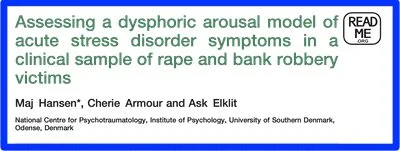
Assessing a dysphoric arousal model of acute stress disorder symptoms in a clinical sample of rape and bank robbery victims

Maj Hansen*, Cherie Armour and Ask Elklit

Background: Since the introduction of Acute Stress Disorder (ASD) into the 4th edition of the Diagnostic and Statistical Manual of Mental Disorders (DSM-IV) research has focused on the ability of ASD to predict PTSD rather than focusing on addressing ASD’s underlying latent structure. The few existing confirmatory factor analytic (CFA) studies of ASD have failed to reach a clear consensus regarding ASD’s underlying dimensionality. Although, the discrepancy in the results may be due to varying ASD prevalence rates, it remains possible that the model capturing the latent structure of ASD has not yet been put forward. One such model may be a replication of a new five-factor model of PTSD, which separates the arousal symptom cluster into Dysphoric and Anxious Arousal. Given the pending DSM-5, uncovering ASD’s latent structure is more pertinent than ever.

Objective: Using CFA, four different models of the latent structure of ASD were specified and tested: the proposed DSM-5 model, the DSM-IV model, a three factor model, and a five factor model separating the arousal symptom cluster.

Method: The analyses were based on a combined sample of rape and bank robbery victims, who all met the diagnostic criteria for ASD (N404) using the Acute Stress Disorder Scale.

Results: The results showed that the five factor model provided the best fit to the data.

Conclusions: The results of the present study suggest that the dimensionality of ASD may be best characterized as a five factor structure which separates dysphoric and anxious arousal items into two separate factors, akin to recent research on PTSD’s latent structure. Thus, the current study adds to the debate about how ASD should be conceptualized in the pending DSM-5.

European Journal of Psychotraumatology. 2012.

A Randomized Controlled Trial of an Adapted Form of Individual Critical Incident Stress Debriefing for Victims of an Armed Robbery

Victims of an armed robbery are at great risk of psychological distress. This research is a prospective randomized controlled clinical trial of an adapted form of Critical Incident Stress Debriefing (CISD-A) with victims of an armed robbery. The specific goals are to examine whether the CISD-A is superior to the control group in both preventing the development of a posttraumatic stress disorder (PTSD) and attenuating the frequency and severity of posttraumatic stress symptoms. Following pretest, 75 participants were randomly assigned to individual debriefing or to a control group. Results revealed no differences between the CISD-A and the control group in preventing PTSD or attenuating posttraumatic symptoms 1 and 3 months later. [Brief Treatment and Crisis Intervention 6:122–129 (2006)]

Contact author: Andre´Marchand, Department of Psychology, Universite´du Que´bec a ` Montre´al, C.P. 8888, Succ. Centre-ville, Montre´al, Que´bec, Canada H3C 3P8. E-mail: marchand.andre@uqam.ca.

doi:10.1093/brief-treatment/mhj007 Advance Access publication March 24, 2006

Leaving The Gang is Good For Your Health: A Stress Process Perspective on Disengagement From Gangs

By John Leverso, Cyrus Schleifer, David C. Pyrooz

During the last decade, health criminology—the study of health outcomes for justice-involved individuals and their families—has gained traction in the field. We extend health criminology to the study of street gangs by drawing on the stress process perspective. Gang membership is conceptualized as a primary stressor that leads to secondary stressors with direct and indirect adverse effects on mental health. Leaving a gang, we hypothesize, offers relief by shrinking the stress universe to improve mental health. We test the gang disengagement–mental health link using panel data from a sample of 510 active gang members in the Northwestern Juvenile Project, longitudinal entropy balancing models, and mental health outcomes related to both clinical diagnosis and functional impairment. The results indicate that gang disengagement leads to improvements in mental health and functioning. Compared with those who stayed in gangs, those who left experienced improvements in global functioning, overall mental health diagnosis, behavior toward others functioning, substance abuse functioning, and alcohol-related diagnoses. Secondary stressors partially, but not fully, mediated this association. Our findings extend the inventory of research on the benefits of disengagement from gangs to health outcomes and support interventions designed to promote gang disengagement.

Criminology Volume 62, Issue 3 Aug 2024 Pages 377-618