Open Access Publisher and Free Library
CRIME+CRIMINOLOGY.jpeg

CRIME

Violent-Non-Violent-Cyber-Global-Organized-Environmental-Policing-Crime Prevention-Victimization

Posts tagged systematic review
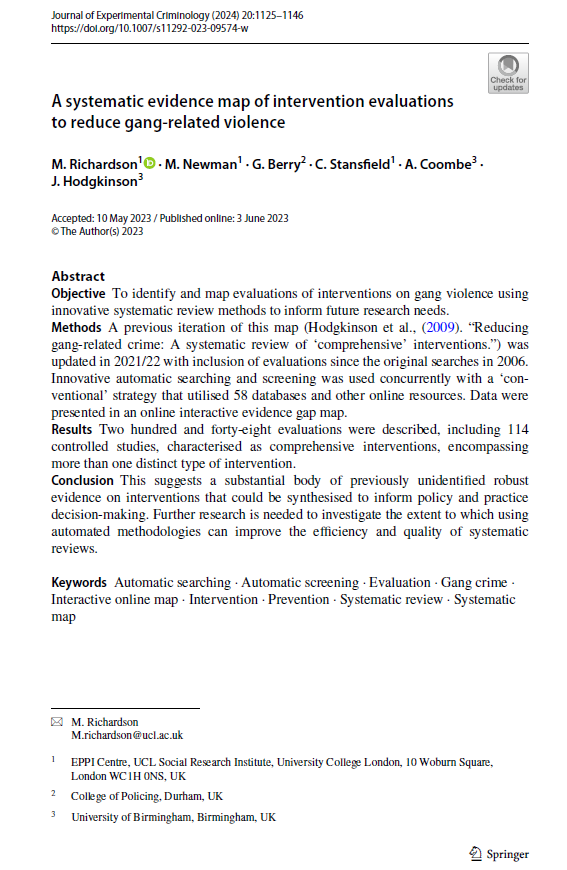
A systematic evidence map of intervention evaluations to reduce gang-related violence


By : M. Richardson, M. Newman, G. Berry, C. Stansfield, A. Coombe & J. Hodgkinson

  • Objective

    To identify and map evaluations of interventions on gang violence using innovative systematic review methods to inform future research needs.

    Methods

    A previous iteration of this map (Hodgkinson et al., (2009). “Reducing gang-related crime: A systematic review of ‘comprehensive’ interventions.”) was updated in 2021/22 with inclusion of evaluations since the original searches in 2006. Innovative automatic searching and screening was used concurrently with a ‘conventional’ strategy that utilised 58 databases and other online resources. Data were presented in an online interactive evidence gap map.

    Results

    Two hundred and forty-eight evaluations were described, including 114 controlled studies, characterised as comprehensive interventions, encompassing more than one distinct type of intervention.

    Conclusion

    This suggests a substantial body of previously unidentified robust evidence on interventions that could be synthesised to inform policy and practice decision-making. Further research is needed to investigate the extent to which using automated methodologies can improve the efficiency and quality of systematic reviews.

  •  J Exp Criminol 20, 1125–1146 (2024).

Non-Criminal Justice Interventions for Countering Cognitive and Behavioural Radicalisation Amongst Children and Adolescents: A Systematic Review of Effectiveness and Implementation

By James Lewis, Sarah Marsden, James Hewitt, Chloe Squires, Anna Stefaniak


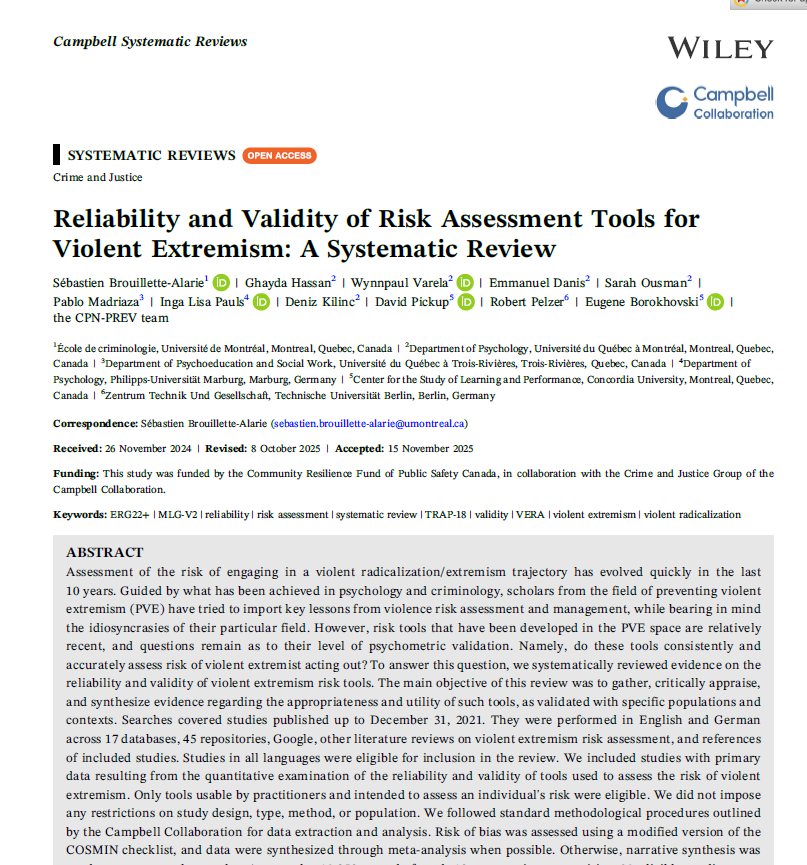
Reliability and Validity of Risk Assessment Tools for Violent Extremism: A Systematic Review


By Sébastien Brouillette-Alarie, Ghayda Hassan, Wynnpaul Varela, Emmanuel Danis, Sarah Ousman, Pablo Madriaza, Inga Lisa Pauls, Deniz Kilinc, David Pickup, Robert Pelzer, Eugene Borokhovski, the CPN-PREV team


Assessment of the risk of engaging in a violent radicalization/extremism trajectory has evolved quickly in the last 10 years. Guided by what has been achieved in psychology and criminology, scholars from the field of preventing violent extremism (PVE) have tried to import key lessons from violence risk assessment and management, while bearing in mind the idiosyncrasies of their particular field. However, risk tools that have been developed in the PVE space are relatively recent, and questions remain as to their level of psychometric validation. Namely, do these tools consistently and accurately assess risk of violent extremist acting out? To answer this question, we systematically reviewed evidence on the reliability and validity of violent extremism risk tools. The main objective of this review was to gather, critically appraise, and synthesize evidence regarding the appropriateness and utility of such tools, as validated with specific populations and contexts. Searches covered studies published up to December 31, 2021. They were performed in English and German across 17 databases, 45 repositories, Google, other literature reviews on violent extremism risk assessment, and references of included studies. Studies in all languages were eligible for inclusion in the review. We included studies with primary data resulting from the quantitative examination of the reliability and validity of tools used to assess the risk of violent extremism. Only tools usable by practitioners and intended to assess an individual's risk were eligible. We did not impose any restrictions on study design, type, method, or population. We followed standard methodological procedures outlined by the Campbell Collaboration for data extraction and analysis. Risk of bias was assessed using a modified version of the COSMIN checklist, and data were synthesized through meta-analysis when possible. Otherwise, narrative synthesis was used to aggregate the results. Among the 10,859 records found, 19 manuscripts comprising 20 eligible studies were included in the review. These studies focused on the Terrorist Radicalization Assessment Protocol (TRAP-18), the Extremism Risk Guidance Factors (ERG22+), the Multi-Level Guidelines (MLG-V2), the Identifying Vulnerable People guidance (IVP guidance), and the Violent Extremism Risk Assessment (VERA)—all structured professional judgment tools—as well as Der Screener—Islamismus, an actuarial scale. Studies mostly involved adult male participants susceptible to violent extremism (N = 1106; M = 58.21; SD = 55.14). The types of extremist ideologies endorsed by participants varied, and the same was true for ethnicity and country/continent of provenance. Encouraging results were found concerning the inter-rater agreement of scales in research contexts (kappas between 0.76 and 0.93), but one of the two studies that examined it in a field setting obtained disappointing results (kappas ranging between of 0.47 and 0.80). Content validity studies indicated that PVE risk tools adequately cover the risk factors and offending processes of individuals who go on to commit extremist violence. Construct validity analyses were few and far between, with results indicating that empirical divisions of scales did not match their conceptual divisions. The internal consistency of subscales was lackluster (Cronbach's alphas between 0.19 and 0.85), whereas full scales demonstrated acceptable internal consistency when assessed (0.80 for the ERG22+ and 0.64 for the IVP guidance). Only one study examined convergent validity, and it revealed a lack of convergence, primarily due to particularities of the scale under study (the MLG-V2). Discriminant validity analyses were exploratory in nature, but suggested that PVE risk tools might not be ideology-specific and may apply to both group and lone actors. Finally, although the TRAP-18 showed a relatively strong postdictive effect size (pooled r = 0.62 [0.35–0.77], p = 0.000), the results were highly heterogeneous (I2 = 86%), and all studies used retrospective designs, meaning the outcome was already known at the time of assessment. As such, no included study evaluated true predictive validity (i.e., the ability to forecast future violent extremist outcomes based on prospective risk assessment). This represents a significant evidence gap. Threats to validity were substantial: (a) Many studies were case studies or had very small samples, (b) nearly all samples were constituted through the triangulation of publicly available data, and (c) convenience outcome measures were often used. Although having imperfect data is better than having no data, the current state of empirical validation precludes the recommendation of one tool over another for specific populations and contexts, and calls for higher-quality validation studies for PVE risk assessment tools. Nevertheless, these tools constitute useful checklists of relevant risk and protective factors that could be taken into account by evaluators who wish to assess the risk of violent extremism and identify intervention targets.


Campbell Systematic Reviews, Volume21, Issue4

December 2025, 2025.

Recidivism and Reintegration Among Women with Cognitive Disabilities: A Systematic Review

By Rose Tingate , Rachael Fullam , and Margaret Nixon

Research has largely neglected the intersection of gender and disabil-ity in reintegration, resulting in a poor understanding of the reintegra-tion needs of women with cognitive disabilities. This paper useda systematic review of research published between 1995 and 2024 todevelop a profile of formerly incarcerated women with cognitive dis-abilities and their needs on reentry. Twelve studies met inclusioncriteria, and a content analysis revealed themes of disadvantage, dis-connection from family and support networks, mental illness, andunmet criminogenic needs. The limited research on the reintegrationneeds of formerly incarcerated women with cognitive disabilities high-lights significant challenges, including service gaps and specificvulnerabilities.

Victims & Offenders, 1–24.

Female Perpetrators of Intimate Partner Homicide: Stereotyping and Factors. A Systematic Review of Twenty Years of Literature, 2003–2023

By Sally Crosland, Calli Tzani & Maria Ioannou

When considering intimate partner homicide (IPH), there is a comparative lack of recent research focusing on the specific stereotypes relating to female perpetrators, although recent findings suggest that there is a marked gender difference in instances of IPH perpetration. The current systematic review explored stereotyping of female IPH defendants between 2003 and 2023. Findings suggest stereotypes regarding female IPH perpetrators have a marked effect across several areas. Existence and extent of courtroom and media stereotyping are identified, and factors influencing jury verdicts are considered. Research limitations, implications of findings and directions for further research are specified.

Deviant Behavior, May 2025.

The Association Between Academic Achievement and Subsequent Youth Offending: A Systematic Review and Meta-Analysis

By M. Lankester, C. Coles, A. Trotter, S. Scott, J. Downs, H. Dickson, A. Wickersham

The association between academic achievement and youth offending has yet to be clearly quantified. This meta-analysis aims to provide a robust estimate of the longitudinal association between academic achievement and subsequent youth offending. We searched PsycINFO, ERIC, British Education Index, and Web of Science from inception to 2 April 2024 using a comprehensive search strategy. We identified eligible studies reporting on the association between academic achievement and subsequent youth offending, as measured using self-report or administrative records up to the age of 25 years. Correlation coefficients and odds ratios were pooled in a meta-analysis. Effect modifiers were investigated in a sub-group analysis, and other findings were narratively synthesised. PROSPERO record: CRD42023402103. Seventeen studies were included, of which eight were pooled in a meta-analysis. The findings showed a small but statistically significant association between lower academic achievement and youth offending (pooled Fisher z= −0.21, 95% CI [−0.29,−0.12], I 2=98.4%). Subgroup analysis and narrative synthesis yielded mixed findings on the possible role of measurement timing and offence types. Lower academic achievement was associated with subsequent youth offending, underlining the need for a child-first approach to early prevention and intervention strategies in educational and forensic settings.

Journal of Developmental and Life-Course Criminology (2024) 10:457–476

Trans and gender diverse offenders’ experiences of custody: A systematic review of empirical evidence

By Sally M. Evans, Bethany A. Jones, Daragh T. McDermott

Literature regarding trans and gender diverse (TGD) prisoners’ experiences of prison custody is limited. Reviewing international literature enables a better understanding of these experiences and how effectively TGD policies are implemented. This systematic review employed PRISMA and ENTREQ guidelines to enhance transparency in reporting the synthesis of qualitative and mixed-methods research. Seventeen papers were included and through meta-ethnographic synthesis three overarching themes emerged: structural, interpersonal and intrapersonal. Recommendations include reducing reliance on survival strategies by TGD prisoners through implementation of policies which meet TGD prisoners’ needs and to enabling better informed decision making regarding housing. Further research into lived experiences would allow for a better understanding of what currently works, how services could be improved, and identify potential training needs

Howard Journal of Crime and Justice, Volume63, Issue3, September 2024, Pages 321-349