
Open Access Publisher and Free Library
CRIME+CRIMINOLOGY.jpeg

CRIME

Violent-Non-Violent-Cyber-Global-Organized-Environmental-Policing-Crime Prevention-Victimization

Posts tagged political authority
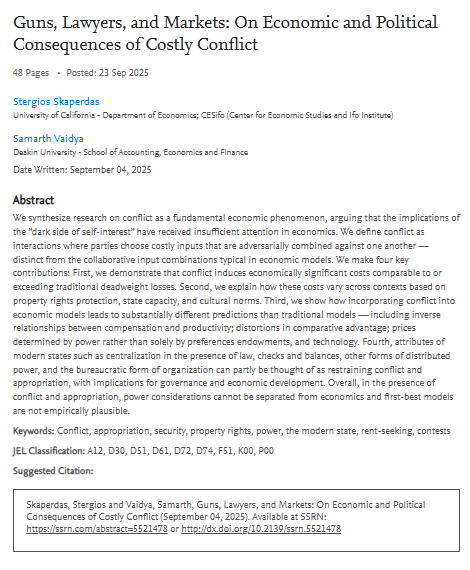
Guns, Lawyers, and Markets: On Economic and Political Consequences of Costly Conflict

By Stergios Skaperdas and Samarth Vaidya

We synthesize research on conflict as a fundamental economic phenomenon, arguing that the implications of the ”dark side of self-interest” have received insufficient attention in economics. We define conflict as interactions where parties choose costly inputs that are adversarially combined against one another — distinct from the collaborative input combinations typical in economic models. We make four key contributions: First, we demonstrate that conflict induces economically significant costs comparable to or exceeding traditional deadweight losses. Second, we explain how these costs vary across contexts based on property rights protection, state capacity, and cultural norms. Third, we show how incorporating conflict into economic models leads to substantially different predictions than traditional models — including inverse relationships between compensation and productivity; distortions in comparative advantage; prices determined by power rather than solely by preferences endowments, and technology. Fourth, attributes of modern states such as centralization in the presence of law, checks and balances, other forms of distributed power, and the bureaucratic form of organization can partly be thought of as restraining conflict and appropriation, with implications for governance and economic development. Overall, in the presence of conflict and appropriation, power considerations cannot be separated from economics and first-best models are not empirically plausible.

 CESifo Working Paper No. 12135, 2025

The Rule of Dons

By Rivke Jaffe

Rivke Jaffe explains how despite Jamaica’s “dons” are associated with crime and violence, they have become figures of political authority and seen as legitimate leaders.

Throughout Kingston, Jamaica, figures known as “dons” exercise political authority and are seen as legitimate leaders despite their associations with crime and violence. In the absence of strong government support, they provide impoverished residents with access to security, conflict resolution, and various forms of welfare through their own resources and connections to Jamaica’s political parties. In The Rule of Dons, Rivke Jaffe shows how dons’ power relies on a widespread belief in their right to rule, explaining how criminal power is legitimized through a set of aesthetic, affective, and spatial mechanisms. She argues that dons must credibly embody an outlaw persona that stands outside of the political establishment while also connecting strategically to state institutions and mobilizing democratic ideals such as freedom and equality. As such, dons represent a form of authority that involves balancing an autocratic form of rule

with an established democratic order. While donmanship represents a historically and culturally specific type of political authority, Jaffe’s analysis of this phenomenon offers insights into the entanglement of violent autocratic rule and democratic institutions far beyond Jamaica.

Durham, NC: Duke University Press, 2024. 217p.