Open Access Publisher and Free Library
CRIME+CRIMINOLOGY.jpeg

CRIME

Violent-Non-Violent-Cyber-Global-Organized-Environmental-Policing-Crime Prevention-Victimization

The World as Abyss: The Caribbean and Critical Thought in the Anthropocene

By Jonathan Pugh and David Chandler

This book is about a distinctive ‘abyssal’ approach to the crisis of modernity. In this framing, influenced by contemporary critical Black studies, another understanding of the world of modernity is foregrounded – a world violently forged through the projects of Indigenous dispossession, chattel slavery and colonial world-making. Modern and colonial world-making violently forged the ‘human’ by dividing those with ontological security from those without, and by carving out the ‘world’ in a fixed grid of space and time, delineating a linear temporality of ‘progress’ and ‘development’. The distinctiveness of abyssal thought is that it inverts the stakes of critique and brings indeterminacy into the heart of ontological assumptions of a world of entities, essences, and universal determination. This is an approach that does not focus upon tropes of rescue and salvation but upon the generative power of negation. In doing so, it highlights how Caribbean experiences and writings have been drawn upon to provide an important and distinct perspective for critical thought. "How is it that ontology has come to be seen as the antidote for modernity? While Foucault denigrated ontology as a mistaken and parochial exercise, contemporary social theory holds out the promise that new modes of planetary knowledge will save us from our own excesses. Drawing together long traditions in Caribbean scholarship with Afro-pessimist thought, Pugh and Chandler illustrate how the search for more emancipatory ontologies - relational ontologies, indigenous ontologies, non-human ontologies, etc. – not only misunderstands the problem of modernity but (more importantly) works to veil the negative force that marks both the limit and cause of all such knowledge practices: what they term the abyss. To engage in abyssal thought – as they lay out – is to inhabit a site of refusal: a determination not to be drawn into the lure of ontological ‘correction’ and to recognise that the practice of world making cannot not bear the imprint of colonial violence.

Westminster, UK: University of Westminster Press, 2023. 122p.

Download
Report of the Board of Inquiry into historical child sexual abuse in Beaumaris Primary School and certain other government schools

By Kathleen Foley SC Chair, et al.

The Board of Inquiry has found that the Department woefully failed to protect children from the risk of child sexual abuse at Beaumaris Primary School and certain other government schools between 1960 and 1994. The failings were serious and systemic and put many children at risk of sexual abuse.

Child sexual abuse is abhorrent. It can have life-long effects for victim-survivors. It can affect people’s mental health and well-being, relationships, and education and employment outcomes in ways that are profound and enduring. For some people, the weight of trauma can be too heavy to bear, and their loss causes deep grief for those left behind. The impacts are not confined to victim-survivors but extend to their loved ones, those who witnessed the child sexual abuse, and the broader community.

Despite the challenges, healing is possible. The Board of Inquiry heard about many experiences of personal healing from victim-survivors and their families — examples of courage and examples of hope. There were also many experiences shared about difficulties in finding the right help when it was desperately needed. It is important to understand the factors that contribute to healing and recovery, so that healing and recovery are within reach of all who need it.

The Board of Inquiry has examined the past to identify and understand historical wrongs. In addition, examining the past enables the broader community to move forward. By understanding where the education system failed, we can also better understand how to prevent further child sexual abuse occurring in government schools.

The report comprises six parts:

  • The preliminary material contains, in addition to this executive summary, the official documents connected to the delivery of the report, and a message from the Chair.

  • Part A, The Board of Inquiry, describes the establishment of the Board of Inquiry, explains how it approached its work, and contains important information concerning how it interpreted and applied the Terms of Reference.

  • Part B, Experience, places children’s safety in context by describing relevant policy settings and social and cultural factors present in communities between 1960 and 1999, particularly during the 1960s and 1970s, before documenting experiences of child sexual abuse and its impacts from the perspective of victim-survivors. This Part also includes 15 narratives from victim-survivors, secondary victims and affected community members in which they recall their experiences, in their own words.

  • Part C, Accountability, describes the education system between 1960 and 1999. It includes the narratives of four of the relevant employees who were examined in depth by the Board of Inquiry, explores concepts of grooming and disclosure, and outlines various system failings by the Department at that time. It then describes how child safety settings within government schools have since improved.

  • Part D, Healing, support and the future, describes the factors that promote recovery from child sexual abuse and the support services currently available to victim-survivors of historical child sexual abuse in government schools. It then explores barriers to effective support and how they could be addressed as part of an overall approach to healing. This Part includes the Board of Inquiry’s recommendations for the Victorian Government and the Department to support healing and address barriers to effective support. While these recommendations are drawn from the entirety of the Board of Inquiry’s work, they are particularly directed to the ‘healing’ and ‘support services’ aspects of the Terms of Reference.

  • Part E, Appendices, contains a range of documents to assist and inform readers.

Melbourne: Government of Victoria, 2024. 466p.

Download
Forces of Terror: Armed Banditry and Insecurity in North-west Nigeria

By John Sunday Ojo, Samuel Oyewole & Folahanmi Aina

Nigeria has confronted several security conundrums in recent years, including armed banditry, which poses a severe threat to the north-west and the entire nation. North-west Nigeria has been hit by an unprecedented wave of kidnappings, maiming, killings, population displacements, cattle rustling, and disruption of socio-economic activities due to the rise of armed bandits in the region. These events have created a climate of uncertainty that has become a cause for concern for the government and the citizenry. Relying on secondary sources of data, this article examines the causes, manifestations, and dimensions of armed banditry in north-west Nigeria, and its security implications. It provides a survey of both the visible and less-visible actors in the conflict. The article argues that armed banditry in the north-west and other parts of Nigeria transcends pastoralist insurgency, as evident in the dominant narratives, considering the multiplicity of complexly connected causal factors, actors, manifestations, and dimensions that are present in the threats posed by this development. The article also shows the negative impacts of armed banditry on human and national security in the region.

Democracy and Security, Volume 19, 2023 - Issue 4

Download
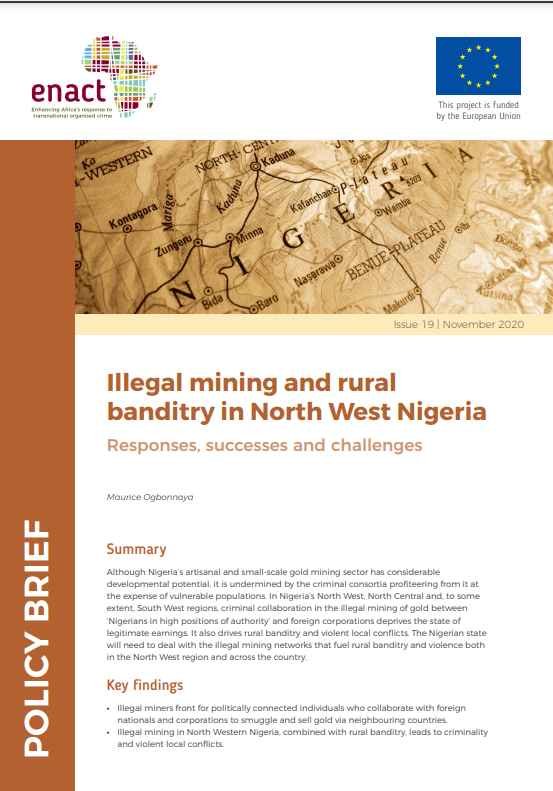
Illegal mining and rural banditry in North West Nigeria Responses, successes and challenges

By Maurice Ogbonnaya

Although Nigeria’s artisanal and small-scale gold mining sector has considerable developmental potential, it is undermined by the criminal consortia profiteering from it at the expense of vulnerable populations. In Nigeria’s North West, North Central and, to some extent, South West regions, criminal collaboration in the illegal mining of gold between ‘Nigerians in high positions of authority’ and foreign corporations deprives the state of legitimate earnings. It also drives rural banditry and violent local conflicts. The Nigerian state will need to deal with the illegal mining networks that fuel rural banditry and violence both in the North West region and across the country.

ENACT Africa, 2020. 12p.

Download
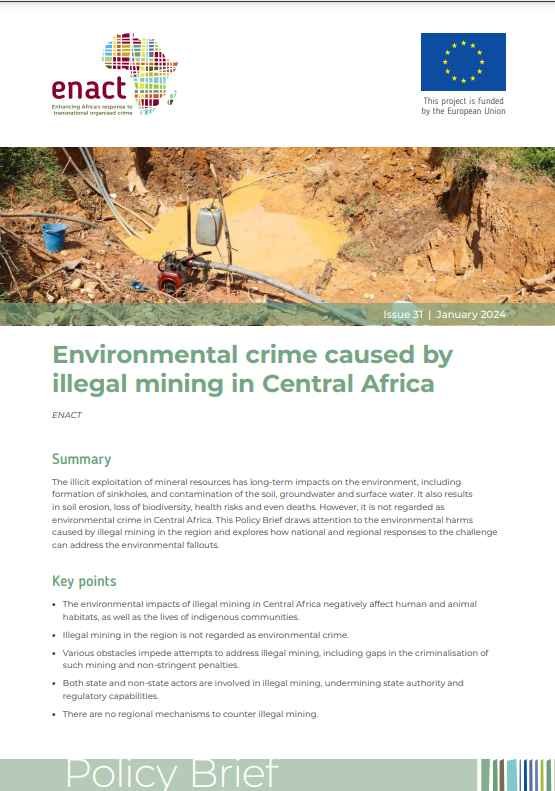
Environmental crime caused by illegal mining in Central Africa

By ENACT

The illicit exploitation of mineral resources has long-term impacts on the environment, including formation of sinkholes, and contamination of the soil, groundwater and surface water. It also results in soil erosion, loss of biodiversity, health risks and even deaths. However, it is not regarded as environmental crime in Central Africa. This Policy Brief draws attention to the environmental harms caused by illegal mining in the region and explores how national and regional responses to the challenge can address the environmental fallouts.

Key points

  • The environmental impacts of illegal mining in Central Africa negatively affect human and animal habitats, as well as the lives of indigenous communities.

  • Illegal mining in the region is not regarded as an environmental crime.

  • Various obstacles impede attempts to address illegal mining, including gaps in the criminalization of such mining and non-stringent penalties.

  • Both state and non-state actors are involved in illegal mining, undermining state authority and regulatory capabilities.

  • There are no regional mechanisms to counter illegal mining.

ENACT Africa, 2024. 12p.

Download
On Borrowed Time - The ongoing illegal totoaba trade driving the critically endangered vaquita to extinction

By The Environmental Investigation Agency

A thriving online illegal trade in the swim bladders of endangered totoaba fish is helping to drive the vaquita porpoise to the brink of extinction.

Vaquita are the most endangered marine mammal on the planet and exist only in a small area of Mexico’s Gulf of California. It is estimated as few as 10 individuals remain, with the population devastated in the past decade as a result of being caught in illegal gillnets set to capture totoabas.

Totoaba swim bladders – known as maws – are in high demand in China and, increasingly, in other Asian countries as a symbol of wealth and for their purported, but unproven, medicinal value.

London: EIA, 2024. 20p.

Download
SEDUCTIONS OF CRIME: Moral and Sensual Attractions in Doing Evil

MAY CONTAIN MARKUP

JACK KATZ

SEDUCTIONS OF CRIME delves into the complex and intriguing world where moral boundaries blur and the allure of transgression thrives. In this thought-provoking exploration, the author examines the seductive nature of crime, shedding light on the moral and sensual attractions that accompany acts of wrongdoing. Through insightful analysis and compelling narratives, SEDUCTIONS OF CRIME challenges readers to confront their perceptions of good and evil, inviting them to ponder the intricate forces that drive individuals towards illicit behaviors. A captivating read that resonates long after the final page is turned, SEDUCTIONS OF CRIME offers a unique perspective on the darker facets of human nature and the enigmatic pull of the forbidden.

Basic Books, Inc., Publishers. New York. 1988. 376p.

read
Police officers' perceptions and experiences of promoting honesty in child victims and witnesses

By Gadda Salhab, Lucy Akehurst, Hannah Cassidy, Victoria Talwar

Purpose: This two-phase study employed a mixed-methods design to explore UK police officers' perceptions and experiences of promoting honesty in child witnesses with a special focus on the recommended inclusion of Truth-Lies Discussions (TLDs) at the start of interviews with children.Method: In Phase 1, police officers completed an online survey designed to cover their experiences and perceptions regarding truth-promotion with child witnesses. In Phase 2, police officers were individually interviewed to elicit an in-depth understanding of current practice relating to this aspect of investigative interviews with children.Results: Around half of the survey respondents believed that TLDs promote honesty in children. The majority reported always using TLDs during interviews to ensure compliance with UK best-practice guidance. There was evidence of a misconception among some police officers that children's performance on TLDs was related to their subsequent truth-telling behavior. Following analysis of the interview transcripts, we found a main theme of police officers' uses of TLDs, which included (i) gauging children's conceptual understanding of truths/lies, (ii) ensuring no deviation from guidance and (iii) communicating children's credibility to the court. A second main theme revealed the challenges and obstacles police officers perceived when embarking on TLDs. These were that (i) one type of TLD is not suitable for all children, (ii) the training is insignificant and the application is inappropriate and (iii) participants sometimes use alternative strategies to promote honesty with children.

Legal and Criminological Psychology Volume 29, Issue 1 Feb 2024

Download
The Jack-Roller at Seventy A Fifty-Year Follow-Up

MAY CONTAIN MARKUP

By The Jack-Roller and Jon Snodgrass, with Gilbert Geis James F. Short, Jr. Solomon Kobrin

Jack-Roller at Seventy: A Fifty-Year Follow-Up delves into the compelling story of the once notorious Jack-Roller, now at the age of seventy. In this long-awaited follow-up, readers are taken on a journey through the protagonist's remarkable life over the course of five decades. Exploring themes of redemption, resilience, and the passage of time, this poignant tale sheds light on the complex evolution of a character once defined by his turbulent youth. With insightful reflections and unexpected twists, Jack-Roller at Seventy offers a fresh perspective on a timeless narrative, captivating both loyal fans and new readers alike.

Lexington Mass. Lexington Books. 1982. 189p.

read
THE CRIMINAL EVENT

MAY CONTAIN MARKUP

By Vincent F. Sacco and Leslie W. Kennedy

Sacco/Kennedy is a concise, economical text that offers a unifying element to aid student understanding of the material presented. The organizing tool ('the criminal event') presents crime as consisting of many facets, and it shows the relationships between the various facets of crime. With an emphasis on spatial analysis, the authors examine crime from all sides, what motivates people to commit crime, who suffers and how, and how society should respond.

Wadsworth/Thomson Learning, 2002, 180 pages

read
A CRIMINAL AS HERO: Angelo Duca

MAY CONTAIN MARKUP

By Paul F. Angiolillo

In the world of crime and deception, Angelo Duca stands out as a notorious figure with a mysterious allure. Known for his daring heists and cunning tactics, Angelo has built a reputation as a skilled criminal mastermind. Despite his illegal activities, there are those who see him as a hero - a modern-day Robin Hood who takes from the rich and gives to the poor. But beneath the surface of his charming facade lies a complex individual driven by his own code of honor and morality. As Angelo navigates the dangerous underworld, he must constantly confront the blurred line between right and wrong, challenging our perception of what it means to be a hero. Join Angelo Duca on a thrilling journey through the shadows where the line between criminal and hero is razor-thin.

Regents Press of Kansas, 1979, 211 pages

read
Corporate and Governmental Deviance Problems of Organizational Behavior in Contemporary Society

may contain markup

By M. David Ermann and Richard J. Lundman

Corporate and Governmental Deviance is the most complete and accessible treatment and exploration of the deviant behavior of big business and big government. Now in its fifth edition, this popular collection has been thoroughly updated to include an expanded introductory essay by the editors, new selections on corporate cover-ups, including such controversial issues as the Pinto fire hazards, the health risks associated with Rely tampons, as well as the current debates on excessive force by police and price-fixing. Moral issues within government, such as the rationalization of the use of genocide during the Nazi Holocaust, along with an essay of the media coverage and the public reactions to such crimes are covered as well. The new edition also retains the familiar classic essays by major scholars featured in previous editions. Intended for use in sociology and criminology courses, this book provides readers with an even clearer appreciation of the fact that organizations, and not just individuals, commit acts of deviance.

Oxford University Press, 1996, 331 pages

read
Human aggression in everyday life: An empirical test of the general aggression model

By Riccarda Kersten, Tobias Greitemeyer

With the general aggression model (GAM), Anderson and Bushman (2002) provided an integrative framework to explain the complex nature of aggression. Based on the GAM, we examined whether personological and situational factors (interactively) have an impact on the person's internal state (consisting of aggressive cognition, affect, and physiological arousal), which in turn is assumed to lead to aggressive behaviour. In a large-scale experience sampling study, 403 participants answered 7558 questionnaires over a period of 2 weeks. As hypothesized, participants were more likely to exhibit an aggressive internal state the higher they scored on antagonistic personality traits (trait aggression, narcissism, psychopathy, sadism, anger rumination) and the more interpersonal, intrapersonal, and environmental triggers they experienced. Aggressive behaviour was positively related to trait aggression, psychopathy, sadism, anger rumination, and all situational triggers. Furthermore, the impact of antagonistic personality traits and situational triggers on aggressive behaviour was considerably reduced when the aggressive internal state was taken into account. Contrary to predictions, the relationship between antagonistic personality traits and the aggressive internal state was most pronounced when situational triggers were low. Overall, however, the process by which personal and situational variables predict aggression in daily life can be well explained by the GAM.

British Journal of Social Psychology Early View, 2024.

Download
CHOOSING CRIME: The Criminal Calculus of Property Offenders

may contain markup

By Kenneth D. Tunnell

The major issues explored through this study were the motivation to commit property crimes, alternatives to crime commission, neutralization of fears during criminal decision making, and decision making processes. During the analysis of the data, five basic themes emerged. Offenders typically decided to commit crimes by using one or more neutralization techniques, most frequently alcohol or drugs, that aided them in the decision making and in the actual crime commission. Persistent criminals did not give any thought to the potentially negative consequences of their actions. The decision making types explicated in this study characterize individuals who are problematic for society, the judicial system, and the other people whose lives they disrupt. The study found that offenders typically specialized in one type of crime for a period of time, then moved on to another specialty area. Finally, the results indicated that these offenders committed a disproportionate number of crimes because they lacked other alternatives. The author maintains that these findings dispute the generally accepted view of the effectiveness of deterrence and instead point to needed policy changes in the areas of wealth redistribution, educational reform, and structural changes in the criminal justice system.

Nelson-Hall Publishers / Chicago, 1992, 191p

read
CESARE BECCARIA : ON CRIMES AND PUNISHMENTS

may contain markup

Translated from the Italian in the Author's Original Order With Notes and Introduction by David Young

On Crimes and Punishments is a seminal treatise on legal reform written by the Italian philosopher and thinker Cesare Beccaria between 1763 and 1764. The essays proposed many reforms for the criminal justice system, including prompt administration of clearly prescribed and consistent punishments, well-publicized laws made by the legislature rather than individual courts or judges, the abolition of torture in prisons and the use of the penal system to deter would-be offenders, rather than simply punishing those convicted. It is also one of the earlier, and most famous, works against death penalty. The main reason put forward against that measure is that the State, by putting people to death, was committing a crime to punish another one.On Crimes and Punishments is widely considered one of the founding texts of Classical Criminology.

Indiana. Hackett Publishing. 1986.

read
ON CRIMES AND PUNISHMENTS

may contain markup

By CESARE BECCARIA. Translated, with an introduction, by HENRY PAOLUCCI

On Crimes and Punishments is a seminal treatise on legal reform written by the Italian philosopher and thinker Cesare Beccaria between 1763 and 1764. The essays proposed many reforms for the criminal justice system, including prompt administration of clearly prescribed and consistent punishments, well-publicized laws made by the legislature rather than individual courts or judges, the abolition of torture in prisons and the use of the penal system to deter would-be offenders, rather than simply punishing those convicted. It is also one of the earlier, and most famous, works against death penalty. The main reason put forward against that measure is that the State, by putting people to death, was committing a crime to punish another one.On Crimes and Punishments is widely considered one of the founding texts of Classical Criminology.

read
AN ESSAY ON CRIMES AND PUNISHMENTS

MAY CONTAIN MARKUP

By Cesare Beccaria. Edited and with an Introduction by Adolph Caso

The first systematic study of the principles of crime and punishment. Originally published: London: Printed for E. Newberry, 1775. viii, [iv], 179, lxxix pp. Infused with the spirit of the Enlightenment, its advocacy of crime prevention and the abolition of torture and capital punishment marked a significant advance in criminological thought, which had changed little since the Middle Ages. It had a profound influence on the development of criminal law in Europe and the United States, especially among the founding fathers. Originally published anonymously in 1764.

Kessinger Publishing, January 17, 2007, ‎244 pages

read
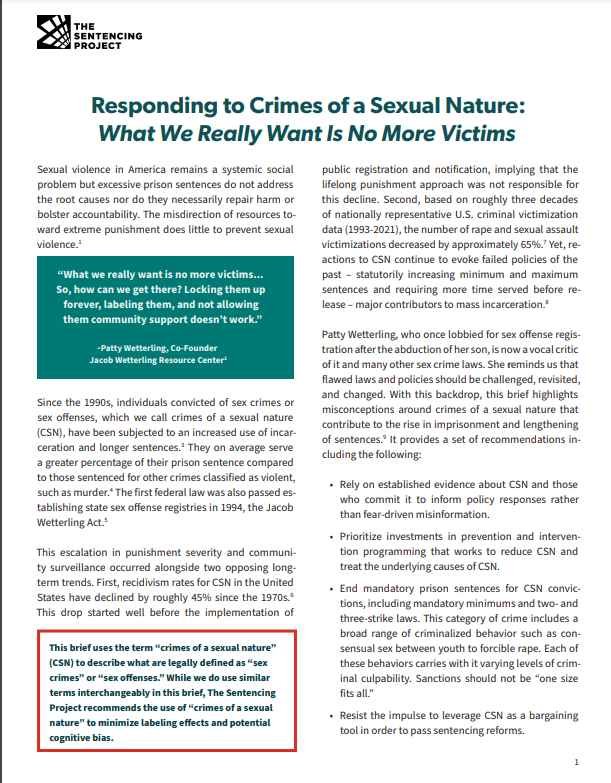
Responding to Crimes of a Sexual Nature: What We Really Want Is No More Victims

By Kristen Budd, Sabrina Pearce and Niki Monazzam

Sexual violence in America remains a systemic social problem but excessive prison sentences do not address the root causes nor do they necessarily repair harm or bolster accountability. The misdirection of resources toward extreme punishment does little to prevent sexual violence. Since the 1990s, individuals convicted of sex crimes or sex offenses, which we call crimes of a sexual nature (CSN), have been subjected to an increased use of incarceration and longer sentences. They on average serve a greater percentage of their prison sentence compared to those sentenced for other crimes classified as violent, such as murder. The first federal law was also passed establishing state sex offense registries in 1994, the Jacob Wetterling Act.

This escalation in punishment severity and community surveillance occurred alongside two opposing long-term trends. First, recidivism rates for CSN in the United States have declined by roughly 45% since the 1970s. This drop started well before the implementation of public registration and notification, implying that the lifelong punishment approach was not responsible for this decline. Second, based on roughly three decades of nationally representative U.S. criminal victimization data (1993-2021), the number of rape and sexual assault victimizations decreased by approximately 65%. Yet, reactions to CSN continue to evoke failed policies of the past – statutorily increasing minimum and maximum sentences and requiring more time served before release – major contributors to mass incarceration.

This brief uses the term “crimes of a sexual nature” (CSN) to describe what are legally defined as “sex crimes” or “sex offenses.” While we do use similar terms interchangeably in this brief, The Sentencing Project recommends the use of “crimes of a sexual nature” to minimize labeling effects and potential cognitive bias.

Washington DC: The Sentencing Project, 2024. 14p.

Download
“It's Like a Drive by Misogyny”: Sexual Violence at UK Music Festivals

By Hannah Bows, Aviah Day and Alishya Dhir

Despite increasing scholarly and media attention on sexual violence in public spaces, including those associated with the night-time economy and licensed venues, music festivals have been largely absent from research and policy. This paper presents the findings from the first UK study of sexual violence at music festivals, drawing on data from interviews with 13 women who have experienced some form of sexual harassment or assault at a festival. Analysis reveals that sexual violence at festivals occurs on a continuum and represents an extension of rape culture through which sexual violence is culturally condoned and normalized, enabled through a number of environmental and culture features that are unique to festivals.

It is widely recognized that sexual violence occurs in both public and private spaces; however, the majority of academic research and public/policy attention has tended to focus on sexual violence that occurs in private spaces, particularly the home (Vera-Gray & Fileborn, 2018). Despite the relative paucity of academic research on sexual harassment and violence in public spaces, anecdotal evidence, grassroots research, and industry surveys reveal that women routinely experience sexual harassment and sexual assault in public spaces, including public transport (London Assembly, 2016; SPA, 2014) university campuses (Brook, 2019) parks, and playgrounds (Budd et al., 2019). An international study of street sexual harassment in 22 countries reports that 50% of women have been fondled or groped and more than 81.5% of women have been harassed before the age of 17 (Hollaback, 2014). In the United Kingdom, 71% of women of all ages reported experiencing some form of sexual harassment in a public space, rising to 86% among 18- to 24-year-olds (UN Women UK, 2021).

Leisure spaces are frequently associated with sexual harassment and violence against women, particularly those linked to the night-time economy (NTE), situated within the “sexualized city” (Hubbard & Colosi, 2012). The existing work has illuminated the role that commercialized and heteronormative spaces play in contributing to developing “cultural atmospheres” (Kavanaugh, 2013, p. 242) where unwanted sexual attention becomes accepted as a normal part of being in these spaces (see Brooks, 2011; Fileborn, 2016; Gunby et al., 2020; Quigg et al., 2020; Sheard, 2011). In the United Kingdom, a Drinkaware study in 2015 reported 54% of women and 15% of men aged 18–24 experienced sexual harassment on a night out. Mellgren et al. (2018) found that sexual harassment of Swedish women occurred frequently at clubs and restaurants. More recently, Miranda and van Nes (2020) report that nearly all sexual violence cases occurring in public spaces at night are close to, or offer, nightlife activities. Moreover, emerging research in the context of live music venues has documented the routine everyday occurrence of harassment and sexual violence experienced by women in these environments (Hill et al., 2020). Thus, as Pain (1991) pointed out, while research may indicate the majority of (interpersonal) violence takes place in the private sphere (usually the victim's home), this does not mean the public sphere is a safe place for women.

Culturally and economically, music festivals are important British leisure events, at the “heart” of the British summer time (McKay & Webster, 2016). The turn of the century saw a massive expansion of the outdoor music festival scene into a large-scale commercial and corporate sector (Morey et al., 2014). Mintel (2018) estimates that there were 918 UK festivals in 2018, more than double that of a decade earlier, while CGA (2019) estimates more than 7.1 million people attended a festival in 2018. Many contemporary music festivals promote themselves by promising freedom, excitement, and hedonistic pleasure, thus encouraging consumers to purchase the experience of 1960’s hippie counterculture. “Freedom” is commodified as central to the marketing of many music festivals, which now form a highly commercialized sector of the UK leisure industry, subject to various regulatory restrictions (Griffin et al., 2018, p. 1). However, as festivals vary significantly in terms of size and audience make up, such as by age and the music genres or cultures being sought, it is important not to homogenize “the music festival.”

Demographically, the festival landscape has also shifted in recent years. Although music festivals were traditionally dominated by men, 60% of UK festival visitors in 2016 were female, an increase from 37% in 2015 (Statista, 2016). Elsewhere, women make up almost half of festival audiences. In Australia, 44.3% of festival attendees in 2018 were female (Hughes et al., 2019) and across European festivals in 2016 just over 45% of attendees were female (Statista.com, 2021).

Despite women occupying increasing space at festivals, the emerging research indicates they are not free to experience these events in the same ways as men (Aborisade, 2021; Baillie et al., 2021; Fileborn et al., 2020; Wadds et al., 2022). The two studies outside of the UK examining sexual violence at festivals through interviews with survivors (Aborisade, 2021 in Nigeria and Fileborn et al., 2020 in Australia) report on the normalcy of sexual violence in festival spaces, low reporting to festival staff or other formal agencies, and a range of negative consequences as a result of their experiences. These findings are supported by data in the United Kingdom and the United States. In the United Kingdom, a YouGov survey in 2018 reported that sexual harassment is prevalent at UK music festivals, revealing 43% of female festival goers under the age of 40 experienced unwanted sexual behavior at a music festival but only 2% reported to the police (although 7% did report it to festival staff). Our research has revealed similar findings, with 34% of women and 6% of men respondents experiencing sexual harassment at a festival in the previous five years, and 9% of women and 1% of men experiencing sexual assault (Bows et al., 2022). Interestingly, these reported levels are significantly lower than the figures reported in a survey of festival attendees in the USA, which revealed more than 90% of female respondents said they had been sexually harassed at a music festival or music gig/venue (OMMB, 2017).

Although there has been very little academic research on sexual violence at festivals, the issue has received high-profile media coverage over the last few years (Davies, 2017; Owen, 2021), leading to grassroots campaigns and activism (e.g., Girls Against and Safe Gigs for Women), in some cases, extraordinary responses from festivals. For example, in 2016 and 2017, a spate of rapes and sexual assaults of women at Bravalla, a Swedish festival, were reported, which led to the cancelation of the event in 2018 until men could “learn to behave themselves” (O’Connor, 2017). Similarly, Clear Lines Festival was set up in 2015—founded and crowd funded by volunteers—with the specific goal of addressing sexual assault and harassment through the arts and discussions. In the UK, the Association of Independent Festival led a campaign where music festival websites went dark for 24 h to raise awareness of sexual violence and call for positive action across the industry (Moore, 2017).

While the survey findings and media reports give some indication of the extent of sexual harassment and assault at festivals, there are major gaps in knowledge about the prevalence, nature, experiences, and responses to sexual violence. This article presents data from the first UK study to explore women's experiences of sexual violence at UK music festivals, contributing to the small but growing body of literature in this area (Aborisade, 2021; Baillie et al., 2021; Bows et al., 2020, 2022; Fileborn et al., 2020) and to the broader literature on gendered experiences of leisure spaces (Aitchison, 1999; Green & Singleton, 2006; Gunby et al., 2020; Hill et al., 2020; Stevenson, 2017).

Violence Against Women Volume 30, Issue 2 Feb 2024 Pages 347-688

Download