

The King in Yellow
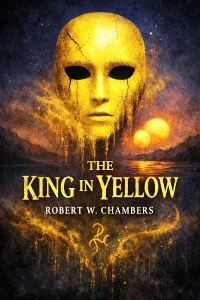
By ROBERT W. CHAMBERS. Introduction by Colin Heston
When The King in Yellow appeared in 1895, it slipped quietly into a literary world already saturated with decadence, occult enthusiasms, and the fin-de-siècle’s peculiar blend of anxiety and intoxication. Yet Robert W. Chambers’s strange mosaic of tales—united by a fictional forbidden play that unhinges those who read it—swiftly distinguished itself from its contemporaries. In the decades since, this slim volume has grown into one of the foundational works of the American weird tradition, prefiguring H. P. Lovecraft, influencing generations of modern horror writers, and unexpectedly resurfacing in the twenty-first century as a cultural touchstone.
What makes Chambers’s book so unusual is its deliberate blurring of boundaries: between reality and hallucination, sanity and delusion, art and contagion. The collection opens with “The Repairer of Reputations,” a tale set in an imagined New York of 1920—an unsettling mixture of futurism, authoritarian regulation, and manic delusion. It is here that the mysterious “King in Yellow” first exerts his influence. The narrator, a deeply unreliable figure, is convinced of his noble birthright and guided by an enigmatic “repairer” who traffics in scandal and blackmail. The narrative unfolds as a case study in self-deception, political paranoia, and the fragility of identity—yet nothing in the story is easily dismissed as mere fantasy. Reality itself buckles under the weight of the narrator’s convictions.
The Mask, perhaps the most haunting of the early tales, shifts the setting to the Latin Quarter of Paris, where art, science, and obsession converge. The grotesque beauty of Boris Yvain’s alchemical solution—capable of transforming living beings into flawless marble—creates a collision of aesthetics and mortality that typifies Chambers’s most powerful work. The story’s dreamlike quality reflects the decadent movement’s fascination with artificiality, transformation, and the erotic pull of the inanimate. Throughout, the shadow of the forbidden play hovers, never fully seen but always felt.
Other sections—“In the Court of the Dragon,” “The Yellow Sign,” and additional sketches—extend the book’s architecture of dread. Chambers never provides the text of the play itself, only its aftershocks, its “second act” whispered about as a psychic abyss from which there is no return. This structural absence is one of the book’s great innovations: The horror lies not in spectacle but in suggestion, in the void where meaning should be. The King in Yellow, the Pallid Mask, and the Lost City of Carcosa are not fully explained but instead exist as fragments of a mythology the reader assembles intuitively, as though the stories themselves are encoded with an infectious idea.
The power of The King in Yellow endures because it is not simply a collection of supernatural tales—it is a meditation on contagion: of ideas, of aesthetics, of inner instability. Chambers’s fictional play does not merely frighten; it corrodes. It reveals hidden fractures in those who encounter it and amplifies their darkest impulses. In this sense, the book mirrors its age. The 1890s were marked by the collapse of old certainties, the rise of new sciences of the mind, and an artistic fascination with decadence, degeneration, and the beautiful ruin of the self. Chambers captured that atmosphere with uncanny acuity.
Today, amidst digital conspiracies, fractured identities, and a renewed cultural fascination with alternate realities, The King in Yellow feels more relevant than ever. It invites the reader to step into a world where truth is unstable, where art is dangerous, and where the boundaries of perception are mercilessly thin. The book’s whispered mythology has become larger than the text itself, seeding later works, reappearing in unexpected media, and reminding us that the most enduring horrors are those we cannot fully see.
To open these stories is to risk a glimpse of the Yellow Sign—a symbol of beauty, madness, and forbidden knowledge. Chambers offers no assurances. He only extends an invitation to enter Carcosa, where twin suns sink over black waters and where, once the play begins, the mask cannot be removed.
Read-Me.Org Inc. New York-Philadelphia-Australia. 2026 p.209