by H.G. Wells. Edited with an Introduction by Colin Heston.
What happens when science makes life bigger—but the world refuses to grow with it?
In The Food of the Gods and How It Came to Earth, H. G. Wells transforms a seemingly absurd scientific experiment into a sweeping and surprisingly modern story about progress, fear, power, and humanity’s resistance to change.
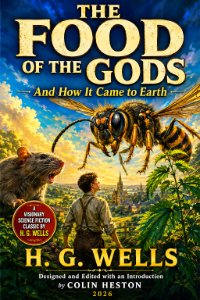
Two scientists, Mr. Bensington and Professor Redwood, develop an extraordinary substance—Herakleophorbia, soon known simply as “the Food”—capable of producing astonishing growth. Intended as little more than an improved food supply, their invention quickly escapes the laboratory. The consequences are spectacular: gigantic plants, monstrous wasps, enormous rats, and eventually human children who grow to dimensions that make ordinary society seem absurdly small.
At first, the giants are treated as curiosities and inconveniences. But as the children mature, their extraordinary strength and intelligence threaten a civilization constructed—physically, politically, and socially—for smaller people. The new generation can lift enormous weights, cross great distances, and contemplate achievements beyond the abilities of ordinary humanity.
Fear soon becomes political. Caterham, the self-proclaimed “Jack the Giant-killer,” rises to power as hostility toward the giants intensifies. Laws restrict their movement, society demands their submission, and the conflict between the old world and the new moves inexorably toward confrontation.
First published in book form in 1904, The Food of the Gods is one of Wells’s most imaginative works of speculative fiction—a novel he described as a “fantasia on the change of scale in human affairs.”Beneath its giant insects, colossal children, scientific mishaps, and dark comedy lies a serious question: When something new outgrows the society that created it, should humanity suppress it—or make room for the future?
This Read-Me.Org Classic Reprint preserves the novel’s original three-book structure and presents Wells’s remarkable vision for a new generation of readers. It includes a new Introduction by Colin Heston.
A classic of early science fiction filled with giant creatures, scientific catastrophe, political satire, social conflict—and H. G. Wells’s unmistakable fascination with the terrifying possibilities of the future.
.Read-Me.Org Inc. New York-Philadelphia-Australia. 2026. 176p.