Open Access Publisher and Free Library
Fiction+Mediajpg.jpg

FICTION and MEDIA

CRIME AND MEDIA — TWO PEAS IN A POD

Posts in rule of law
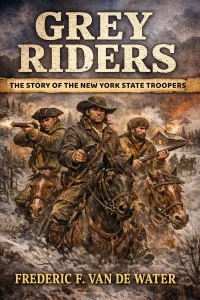
Grey Riders: The Story of The New York State Troopers

By Frederic F. Van de Water. Introduction by Graeme R. Newman

When Grey Riders appeared in 1922, Frederic F. Van de Water was already emerging as one of the most capable interpreters of American frontier mythology. A journalist, historian, and novelist, he had spent years documenting the enduring tensions between law, order, memory, and violence in the development of the Atlantic seaboard. Grey Riders stands as one of his most vivid contributions to that project: a narrative history and interpretive reconstruction of the Border Riders—Vermont and New York militiamen, irregulars, and informal vigilante bands who policed, contested, and sometimes exploited the wilderness regions between the American colonies and British Canada during the late eighteenth and early nineteenth centuries

Van de Water had a journalist’s fascination with complexity, and Grey Riders is at its strongest when it illuminates the contradictions inherent in a frontier culture that simultaneously demanded firmness of justice and tolerated the improvisational violence of irregular policing. In his account, the riders are men shaped by hardship—farmers, Loyalists, deserters, Yankee patriots, trappers, smugglers, and opportunists—who alternately defended and defied the emerging legal structures of the early United States. Their world was one where the line between protector and predator was always negotiable.

The book’s historical frame—stretching most visibly from the late Revolutionary era through the War of 1812—allows Van de Water to explore how unresolved grievances, economic scarcity, and geopolitical rivalry produced a frontier culture that did not neatly conform to the nation-state boundaries we take for granted today. The riders themselves were products of this ambiguity. While some acted as scouts and auxiliaries for the Continental Army or state militias, others drifted into banditry, smuggling, or private vengeance. Van de Water refuses to simplify this ambiguity; instead, he constructs a narrative that emphasizes how the frontier’s conditions forged men who were, by necessity, adaptable to both moral clarity and moral shade.

For the modern reader, Grey Riders also holds value as part of the broader early-twentieth-century reconsideration of American origins. The 1920s were a period of heightened nostalgia, cultural nationalism, and renewed interest in the country’s formative conflicts. Van de Water, however, avoids sentimentalism. His frontier is not a place of heroic inevitability but a zone of tension where identity, loyalty, and legitimacy are constantly renegotiated. In this respect, the book anticipates the more critical frontier historiography that would emerge later in the century.

Contemporary scholars may also find in Grey Riders an instructive account of how local communities develop security practices when state institutions are weak, distant, or contested—an issue that remains resonant in discussions of borderlands worldwide. The riders, as Van de Water portrays them, are precursors to many modern forms of irregular security actors: militias, local auxiliaries, self-appointed protectors, and armed community defense groups. Their actions demonstrate both the necessity and danger of such formations, especially when scarcity and political friction define daily life.

This new edition returns readers to a moment when questions of national boundaries, informal justice, and community resilience are central to global debate. Van de Water’s riders, moving through a grey zone of legality and identity, offer a powerful reminder that the frontier has never been a simple place—and that the forces shaping it never truly disappeared.

Read-Me.Org Inc. New York-Philadelphia-Australia. 2025. p.188.

download
kindle $2.99 -- Paperback $9.99
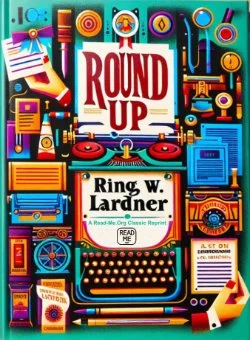
Round Up: The Stories Of Ring W. Lardner

By Ring W. Gardner (Author), Colin Heston (Preface) Format: Kindle Edition

Round Up gathers together the taut, muscular stories of Ring W. Lardner, a writer whose work bridges the divide between the mythologized West and its harsher, less forgiving realities. In these pages, Lardner is neither sentimental nor nostalgic. He strips the Western narrative to its barest elements, presenting us with a landscape that is both expansive and claustrophobic, and characters who are caught between the lure of freedom and the inevitability of fate.
Lardner’s contribution to the American short story lies in his ability to invest the familiar tropes of frontier life with psychological depth and moral ambiguity. His cowboys and ranchers are not mere archetypes; they are restless souls negotiating loyalty, isolation, and survival in a world where law and justice are provisional at best. The violence in these stories is never gratuitous—it is sudden, often senseless, and always carries a human cost. Lardner understands that the West was not only a place but also an idea, one that promised reinvention yet often delivered ruin.
What sets Lardner apart from many of his contemporaries is his prose: terse, unsentimental, yet charged with a quiet lyricism. His narratives move with the inevitability of a gathering storm, his dialogue as spare as the plains he describes. The result is a body of work that feels astonishingly modern in its refusal of easy resolutions.
In an era when the Western genre risks being dismissed as an artifact of popular culture, Round Up demands reconsideration. These are not mere adventure tales or moral fables. They are stories of a liminal world, where the boundaries between civilization and wilderness, justice and vengeance, myth and memory, blur and collapse. Lardner’s West is not simply the West that was; it is also the West as it continues to haunt the American imagination.

download
kindle $1.99 -- paperback $11.99
5 Grams: Crack Cocaine, Rap Music, and the War on Drugs

By Dimitri A. Bogazianos

In 2010, President Barack Obama signed a law repealing one of the most controversial policies in American criminal justice history: the one hundred to one sentencing disparity between crack cocaine and powder whereby someone convicted of “simply” possessing five grams of crack—the equivalent of a few sugar packets—had been required by law to serve no less than five years in prison. In this highly original work, Dimitri A. Bogazianos draws on various sources to examine the profound symbolic consequences of America’s reliance on this punishment structure, tracing the rich cultural linkages between America’s War on Drugs, and the creative contributions of those directly affected by its destructive effects.

Focusing primarily on lyrics that emerged in 1990s New York rap, which critiqued the music industry for being corrupt, unjust, and criminal, Bogazianos shows how many rappers began drawing parallels between the “rap game” and the “crack game." He argues that the symbolism of crack in rap’s stance towards its own commercialization represents a moral debate that is far bigger than hip hop culture, highlighting the degree to which crack cocaine—although a drug long in decline—has come to represent the entire paradoxical predicament of punishment in the U.S. today.

UA Open. New York; London: NYU Press, 2011. 216p.

download
Murdering Masculinities: Fantasies of Gender and Violence in the American Crime Novel

by Gregory Forter

Though American crime novels are often derided for containing misogynistic attitudes and limiting ideas of masculinity, Greg Forter maintains that they are instead psychologically complex and sophisticated works that demand closer attention. Eschewing the synthetic methodologies of earlier work on crime fiction, Murdering Masculinities argues that the crime novel does not provide a consolidated and stable notion of masculinity. Rather, it demands that male readers take responsibility for the desires they project on to these novels.
Forter examines the narrative strategies of five novels--Hammett's The Glass Key, Cain's Serenade, Faulkner's Sanctuary, Thompson's Pop. 1280, and Himes's Blind Man with a Pistol--in conjunction with their treatment of bodily metaphors of smell, vision, and voice. In the process, Forter unearths a "generic unconscious" that reveals things Freud both discovered and sought to repress.

UA. Open. New York; London: NYU Press, 2000. 278p.

download
Making #BlackLivesMatter in the Shadow of Selma: Collective Memory and Racial Justice Activism in U.S. News

Sarah J. Jackson

“It is clear in news coverage of recent uprisings for Black life that journalists and media organizations struggle to reconcile the fact of ongoing racism with narratives of U.S. progress. Bound up in this struggle is how collective memory—or rather whose collective memory—shapes the practices of news-making. Here I interrogate how television news shapes collective memory of Black activism through analysis of a unique moment when protests over police abuse of Black people became newsworthy simultaneous with widespread commemorations of the civil rights movement. I detail the complex terrain of nostalgia and misremembering that provides cover for moderate and conservative delegitimization of contemporary Black activism. At the same time, counter-memories, introduced most often by members of the Black public sphere, o ff er alternative, actionable, and comprehensive interpretations of Black protest.”

Communication, Culture and Critique 00 (2021) 1–20.

download
Taking Offense: Religion, Art, and Visual Culture in Plural Configurations

Editors: Christiane Kruse, Birgit Meyer, and Anne-Marie Korte

What makes an image offensive? — This question is addressed in this volume. It explores tensions and debates about offensive images and performative practices in various settings in and beyond Europe. Its basic premise is that a deeper understanding of what is at stake in these tensions and debates calls for a multidisciplinary conversation. The authors focus on images that appear to trigger strongly negative reactions; images that are perceived as insulting or offensive; those subject to taboos and restrictions; or those that are condemned as blasphemous. In light of recurrent acts of violence leveled against images and symbols in the contemporary, globally entangled world, addressing instances of “icono-clash” (Bruno Latour) from a new post-secular, global perspective has become a matter of urgency.

UA. Open. Leiden: Brill - Schöningh and Fink Social Sciences, 2018. 383p.

Download
Writing Pirates: Vernacular Fiction and Oceans in Late Ming China

By Yuanfei Wang

In Writing Pirates, Yuanfei Wang connects Chinese literary production to emerging discourses of pirates and the sea. In the late Ming dynasty, so-called “Japanese pirates” raided southeast coastal China. Hideyoshi invaded Korea. Europeans sailed for overseas territories, and Chinese maritime merchants and emigrants founded diaspora communities in Southeast Asia. Travel writings, histories, and fiction of the period jointly narrate pirates and China’s Orient in maritime Asia. Wang shows that the late Ming discourses of pirates and the sea were fluid, ambivalent, and dialogical; they simultaneously entailed imperialistic and personal narratives of the “other”: foreigners, renegades, migrants, and marginalized authors. At the center of the discourses, early modern concepts of empire, race, and authenticity were intensively negotiated. Connecting late Ming literature to the global maritime world, Writing Pirates expands current discussions of Chinese diaspora and debates on Sinophone language and identity.

Ann Arbor: University of Michigan Press, 2021. 227p.

download