Open Access Publisher and Free Library
CRIMINAL JUSTICE.jpeg

CRIMINAL JUSTICE

CRIMINAL JUSTICE-CRIMINAL LAW-PROCDEDURE-SENTENCING-COURTS

Posts in Constitution
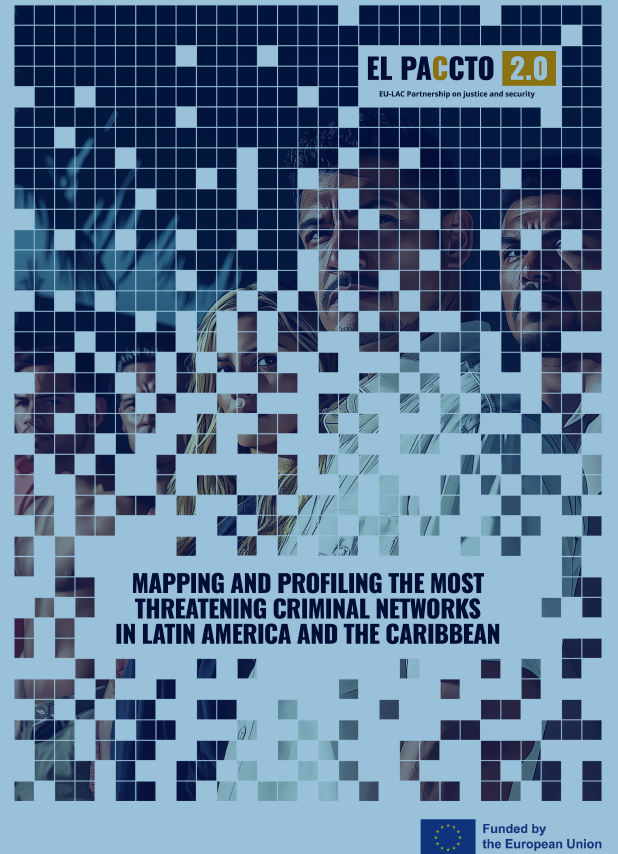
Mapping and Profiling the Most Threatening Criminal Networks in Latin America and the Caribbean- EL PAcCTO

By Jeremy McDermott,  Steven Dudley


“Connections between European and Latin American criminal networks have surged in recent years, with drugs, gold, and human trafficking proving particularly lucrative in the European market.

The number of European citizens linked to criminal networks arrested in Latin America has increased significantly, especially in Colombia, Peru, Brazil, the Dominican Republic, and Argentina. The strengthening alliance between Latin American and European crime groups now poses a global threat.

Today’s Latin America’s major criminal networks, unlike the cartels of the 1980s, operate in a world of subcontracting. Groups, or nodes in the network, often specialize in specific roles or stages of the supply chain. If a node is targeted by law enforcement, the network can quickly adjust and reconfigure itself, ensuring efficiency and the uninterrupted flow of criminal commodities.

These networks pose a serious threat to the rule of law, subverting it by establishing social norms through violence to exercise control with different forms of criminal governance. In Latin America and the Caribbean, they pose the single biggest threat to democracy in the region, using corruption to penetrate the state, and violence where bribery fails. This means it is the primary motor for human rights abuses and homicides. Corruption, like cancer, is spreading through state institutions in many nations of the region. Additionally, these networks harm economic stability development, distorting local economies, deterring foreign investment and affecting international financing.

Studying these networks is crucial to understanding the flow of illicit goods from Latin America to Europe, and essential to crafting effective strategies to combat these structures. After an analysis of different variables such as their criminal economies, geographical distribution or state response, EL PACCTO 2.0 and InSight Crime, with the support of the European Multidisciplinary Platform Against Criminal Threats (EMPACT), particularly within the Operational Action 8.3, of the High Risk Criminal Networks EMPACT, have ranked the 28 most active or relevant high-risk criminal networks in Latin America and the Caribbean, identifying key factors about their operations that reveal potential opportunities for combating organized crime in the region. This work has direct implications for both Latin America and Europe.

The list ranges from criminal networks with thousands of members to small brokers or gangs operating in Latin American countries, Caribbean islands or in Central America. In addition, the current report has sought to identify the connections or influence that high-risk criminal networks may have in different countries. This has led to the creation of a specific file for each criminal network with a specific individual map. Likewise, an aggregate map of all the information on the 28 criminal networks has been designed to provide a global overview.”

Washington, DC: Insight Crime, 2025. 114p
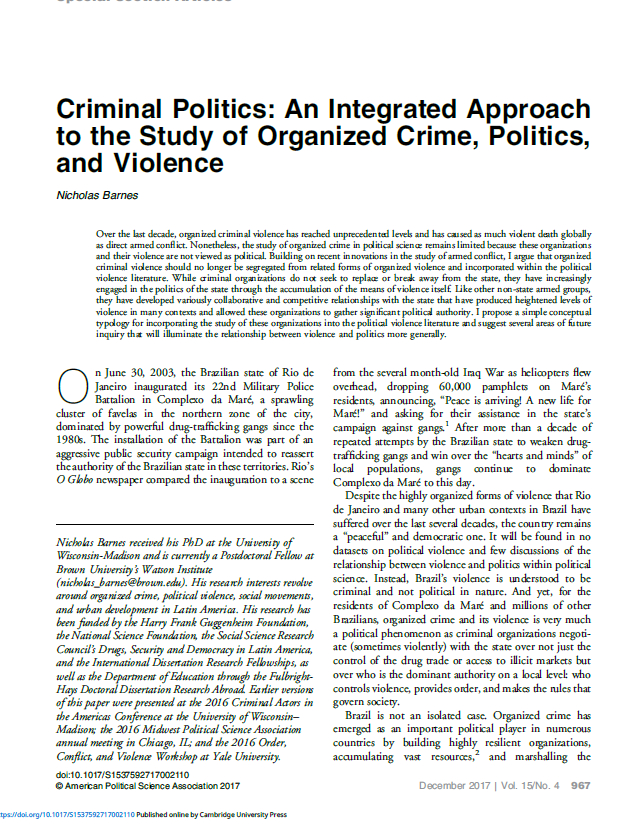
Criminal Politics: An Integrated Approach to the Study of Organized Crime, Politics, and Violence

By Nicholas Barnes

Over the last decade, organized criminal violence has reached unprecedented levels and has caused as much violent death globally as direct armed conflict. Nonetheless, the study of organized crime in political science remains limited because these organizations and their violence are not viewed as political. Building on recent innovations in the study of armed conflict, I argue that organized criminal violence should no longer be segregated from related forms of organized violence and incorporated within the political violence literature. While criminal organizations do not seek to replace or break away from the state, they have increasingly engaged in the politics of the state through the accumulation of the means of violence itself. Like other non-state armed groups, they have developed variously collaborative and competitive relationships with the state that have produced heightened levels of violence in many contexts and allowed these organizations to gather significant political authority. I propose a simple conceptual typology for incorporating the study of these organizations into the political violence literature and suggest several areas of future inquiry that will illuminate the relationship between violence and politics more generally.

Perspectives on Politics. 2017;15(4):967-987.

Research review of the overarching guideline for sentencing offenders with mental disorders, developmental disorders, or neurological impairments

By 

The Sentencing Council (UK)

The Sentencing Council for England and Wales was established in April 2010 (under s118, of the Coroners and Justice Act 2009) in order to promote greater transparency and consistency in sentencing, while maintaining the independence of the judiciary. The Sentencing Council is an independent, non-departmental public body which is part of the Ministry of Justice’s (MoJ’s) family of arm’s-length bodies. The Sentencing Council has statutory duties to: • develop and issue sentencing guidelines and monitor their use • assess the effect of guidelines on sentencing practice • promote awareness among the public regarding the realities of sentencing, and publish information about sentencing practice in magistrates’ courts and the Crown Court The majority of sentencing guidelines issued by the Sentencing Council are ‘offence specific’, providing a step-by-step framework for sentencing a particular offence or group of offences. This begins with an initial assessment of seriousness where the sentencer will arrive at a sentence starting point outlined within the relevant guideline. The guideline then outlines possible aggravating and mitigating factors in relation to the offence or offender that a sentencer should consider, consideration of which may move the sentence starting point up or down. The guideline then provides guidance on a reduction for a guilty plea. The guideline may then include any other considerations that should be taken into account and finally the final sentence outcome. An example of an offence specific guideline can be seen for arson. Where there is no relevant offence specific guideline, the general guideline: overarching principles provides a sentencer with step-by-step guidance. The Sentencing Council also produces ‘overarching’ guidelines, which address specific issues that may arise across many different offences. These overarching guidelines do not typically follow the same format as offence guidelines. They instead contain guidance that can be applied across a range of offences and are expected to be used in conjunction withany relevant offence specific guidelines. The overarching guideline for sentencing offenders with mental disorder, developmental disorder, or neurological impairments, hereafter referred to as ‘the guideline’, was issued by the Sentencing Council in 2020 and is an example of an overarching guideline. It applies to all offenders aged 18 and over sentenced by courts in England and Wales. In accordance with the Sentencing Council’s statutory duties to assess the effect of guidelines on sentencing practice, the Sentencing Council has conducted a research review of this guideline. This explores sentencers’ understanding and application of the guideline. The following section outlines the details of the guideline. 

The Sentencing Council for England and Wales, 2026. 63p

Wrongful convictions in Spain: Systematic analysis of judgments from 1996 to 2022

By Nuria Sánchez , Guadalupe Blanco-Velasco , Linda M. Geven , Jaume Masip , Antonio L. Manzanero 

A comprehensive analysis of wrongful convictions in Spain was conducted. Out of 447 Supreme Court judgments made between 1996 and 2022, 243 cases involving a successful appeal made by a person claiming their innocence were examined in terms of the characteristics of wrongfully convicted individuals, the crime types, and the factors contributing to these judicial errors. An average rate of nine wrongful convictions per year was found, mostly for crimes against public safety and property, with a significant overrepresentation of foreign citizens. Legal professionals’ misconduct was identified as the main factor contributing to these wrongful convictions. The mean time between the judgment and the conviction being overturned was around 4.5 years. More than half of the cases were reopened due to evidence indicating that the alleged crime never occurred. While new evidence was the primary reason for reopening cases, only 3 % were reopened based on DNA evidence. The systematic methodology used in this research may serve as a model for future studies on wrongful convictions in other countries. To reduce wrongful convictions in Spain, several key measures must be implemented. Legal representation should be mandatory for all individuals accused of crimes, without exception. Legal professionals must receive enhanced training to minimize judicial errors. Furthermore, stricter forensic protocols should be established, and forensic experts must be properly accredited to prevent the misapplication of scientific evidence in legal proceedings. Additionally, reforms are needed to ensure that plea bargains are subject to more rigorous scrutiny, and that minor crimes are properly investigated.

Journal of Criminal Justice

Volume 103, March–April 2026,

Staying Too Long: Michigan’s Stalled Sentencing Reform

By Kate Bryan, Rachel Schmidt, and Ashley Neufeld, with support from Nikki Miguel and Maura McNamara.

Michigan’s sentencing structure remains among the most restrictive in the nation. While many states have adopted policies that allow earned-time credits and provide opportunities for early release or resentencing, Michigan requires individuals to serve 100 percent of their minimum sentence before parole eligibility. While recent reforms, such as record clearing, medical parole, and limits to pretrial detention, have advanced progress to the state’s system, they do not target the key challenge of long lengths of stay. Today, more than 65 percent of the state’s prison population is serving a sentence of ten years or more, with limited opportunity for review or reduction. As the prison population rises for the first time in a decade, coupled with the state’s mounting budget pressures, a comprehensive examination of the state’s length of stay challenges is necessary. The goal of this brief is to serve as a baseline to begin that deeper examination. The Crime and Justice Institute, supported by Arnold Ventures, analyzed Michigan’s publicly available prison population data to understand the key trends regarding length of stay. Key findings include: Population growth: The prison population is growing after decades of decline, up 3% since 2021, with more individuals receiving additional sentences while already incarcerated. Sentences are getting longer: Average minimum terms rose 30% in the past decade, from 9.3 years (2014) to 12 years (2023). Drug offenses saw sharpest increases: Average minimum terms for drug offenses grew 33% over  the past decade. Sentencing practices exceeding statutory maximums: Data show minimum terms beyond statutory maximums for top offenses indicating the impacts of habitual offender enhancements, consecutive sentences, and additional sentencing stacking. With the urgency of a now rising population, the reinstated Sentencing Commission provides a renewed opportunity for the state to review sentencing practices. As Michigan prepares for leadership changes in 2026, the state has an opportunity to tackle its most pressing criminal justice challenge. To advance reform, Michigan must: Leverage the Sentencing Commission to produce data-driven recommendations and introduce corresponding legislation. Use corrections data to identify policies contributing to long stays, especially those related to enhancements, habitual offenders, and additional sentences imposed on already incarcerated individuals. Analyze the fiscal impact of long sentences considering recent budget volatility and an aging prison population. Reintroduce policies to reduce length of stay early in the 2026 session, backed by fiscal and public safety data.

Boston: Crime and Justice Institute, 2026. 17p.

A WORLD OF DECEIT MAPPING:  THE LANDSCAPE OF THE GLOBAL SCAM CENTRE PHENOMENON

By Kristina Amerhauser | Alex Goodwin

Scams and fraud have undergone a profound evolution in recent decades, becoming one of the most sophisticated, pervasive and lucrative forms of organized crime globally. According to the Global Anti-Scam Alliance, 57% of adults worldwide reported experiencing a scam in the previous 12 months. Estimates suggest that more than US$1 trillion was generated from scams and fraud in 2024 alone


Rather than focusing on individual scam typologies – such as romance, investment or impersonation scams – this report examines the scam centre as a distinct organizational unit, mapping the various forms they take, the different economic models they use, and the broader ecosystem that allows them to operate and expand. 

Around the world, these hubs of scams appear in different shapes and sizes. Some are located in apartments, hotels or villas, which offer discretion and the ability to relocate quickly – and sometimes in-built security. Many rent office space, sometimes with legal call centres as neighbours, providing camouflage for criminal activities. At the largest scale, cyber scam compounds in South East Asia host extensive workforces and structured operations with management, financial services and technical infrastructure. In some contexts, they also operate from prisons or pre-trial detention centres, where a captive workforce and collusion with officials can facilitate criminal activity. 

This new research report finds that whatever form they take, size does not always correlate to impact. Small operations can also be highly effective, and may sometimes be linked to an overarching scam network, essentially making them nodes in a dispersed scam centre. 

Despite their varied physical footprints, scam centres are enabled by six common ‘glocal’ force multipliers that allow them to operate, scale and target victims worldwide: networked groups; technology and crime-as-a-service; money; political protection; people; and geopolitics. 

Technology is a critical driver of the scam economy. It enables scammers to reach victims around the world at minimal cost and provides tools to circumvent cyber defences. Some of the tools used include deepfakes, cloned applications, fake investment platforms and instant translation, as well as the use of data that enables precise social targeting of victims. 

Illicit financial flows generated through scams are handled through a combination of money mules, cryptocurrencies, fintech tools and physical assets. These mechanisms often operate simultaneously, making it difficult and time-sensitive for law enforcement to trace illicit proceeds. 

The report also highlights the central role of people in scam centre operations. Workers may be recruited locally with promises of lucrative salaries or trafficked from abroad and forced to work in exploitative conditions. In South East Asia alone, an estimated 300 000 people have been trafficked into scam compounds. 

Looking ahead, the research identifies three major risks: displacement, diffusion and de-globalization. These dynamics may lead scam centres to become more embedded in more places, especially in areas where governance is weak. Some countries may also become linked to the scam economy not by hosting scam centres themselves but by facilitating money laundering or enabling services. 

The report concludes that tackling scam centres requires addressing the interconnected nature of their operations. Single-strand approaches may disrupt individual operations, but they will not meaningfully affect the broader environment in which scam centres thrive. 

Geneva: Global Initiative Against Transnational Organized Crime., 

, 2026. 52p.

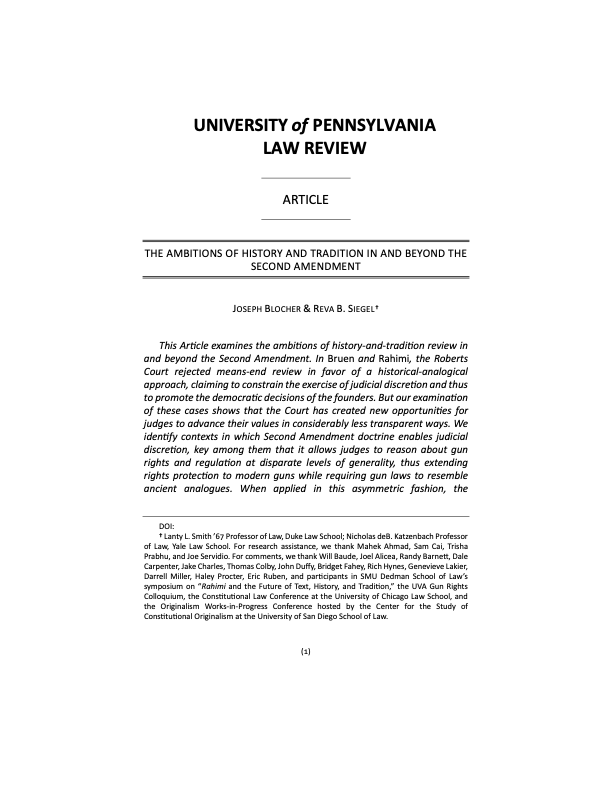
The Ambitions of History and Tradition in and Beyond the Second Amendment

By Joseph Blocher and Reva Siegel

This Article examines the ambitions of history-and-tradition review in and beyond the Second Amendment. In Bruen and Rahimi the Roberts Court rejected means-end review in favor of a historical-analogical approach, claiming to constrain the exercise of judicial discretion, and thus to promote the democratic decisions of the founders. But our examination of these cases shows that the Court has created new opportunities for judges to advance their values in considerably less transparent ways. We identify contexts in which Second Amendment doctrine enables judicial discretion, key among them that it allows judges to reason about gun rights and regulation at disparate levels of generality, extending rights protection to modern guns while requiring gun laws to resemble ancient analogues. When applied in this asymmetric fashion, the historical approach deregulates in ways that are neither acknowledged nor justified. An eight-member majority objected to this strategy in Rahimi and voted to uphold a federal gun law. Yet numerous Justices wrote separately to limit Rahimi’s reach—and, a year later, to suggest that the Court should take a case involving an assault-weapons ban to clarify the method set forth in its earlier cases.

Our close reading of the history-and-tradition (HAT) cases shows that there is a persistent gap between what the Court says and does—between the judicial constraint the Roberts Court promises and the actual decisions it delivers. Understanding this dynamic in the Second Amendment cases helps us recognize it in the First Amendment and Substantive Due Process cases as well.

We can better appreciate the Court’s reasoning in extending HAT review if we excavate the arguments advanced in the decade between Heller and Bruen for substituting the HAT approach for means-ends review. This retrospective shows us that HAT approaches exhibit the very problems imputed to means-ends review: HAT review is not grounded in original understanding and employs shifts in generality to provide judges discretion to enforce value-based understandings. We can see this dynamic unfolding inside and outside the Second Amendment context.

HAT decisions pose distinctive threats to democracy. First, Bruen has implemented HAT through judicial review with a strong presumption of unconstitutionality, a counter-majoritarian practice lacking precedent at the founding. Second, HAT review is not transparent, obscuring reasons for judicial decisions from the people and thus obstructing democratic dialogue. Third, the HAT framework encourages judges to decide the constitutionality of public safety laws on grounds that ignore the public’s most urgent reasons for enacting the laws.

This reading of the Court’s Second Amendment cases indicates that the push to adopt HAT approaches in First Amendment, Due Process, and other areas of constitutional law is likely to compound the problems it is supposed to solve, while insulating the Court’s control of the Constitution from the public governed by it.