
Open Access Publisher and Free Library
CRIMINAL JUSTICE.jpeg

CRIMINAL JUSTICE

CRIMINAL JUSTICE-CRIMINAL LAW-PROCDEDURE-SENTENCING-COURTS

Posts tagged Economic impact
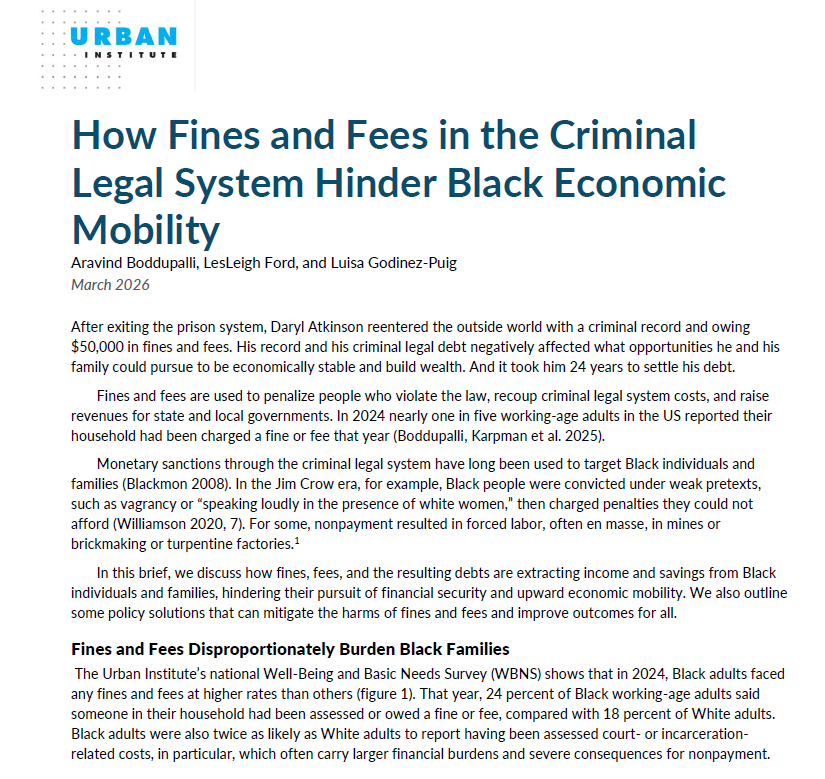
How Fines and Fees in the Criminal Legal System Hinder Black Economic Mobility

By Aravind Boddupalli, LesLeigh D. Ford, Luisa Godinez-Puig

Criminal legal system fines and fees disproportionately impact Black households, entrenching poverty and creating significant barriers to economic mobility and wealth-building. These financial burdens, often imposed without regard to ability to pay, frequently lead to driver's license suspensions, increased debt, and incarceration, disrupting employment and housing stability. 

Urban Institute +3

Key Impacts on Black Communities:

  • Disproportionate Burden: Black households face criminal legal fines and fees at the highest rates compared to other racial groups.

  • Economic Mobility Barriers: These costs, often totaling hundreds or thousands of dollars, hinder the ability of Black families to build assets and improve their financial well-being.

  • Cycle of Debt and Punishment: Inability to pay can lead to driver's license suspensions, preventing individuals from traveling to work, as well as additional fines, interest, and jail time.

  • Family Well-being: As highlighted in this analysis by the Fines and Fees Justice Center, 57 percent of people with court debt reported food insecurity, while nearly 20 percent of those surveyed reported that they or a household member served time in jail due to an inability to pay.

  • Housing and Employment: Debt-related penalties, such as suspended licenses or a criminal record for nonpayment, make securing stable housing and employment more difficult. 

    Urban Institute +4

Washington, DC:  Urban Institute, 2026. 7p.
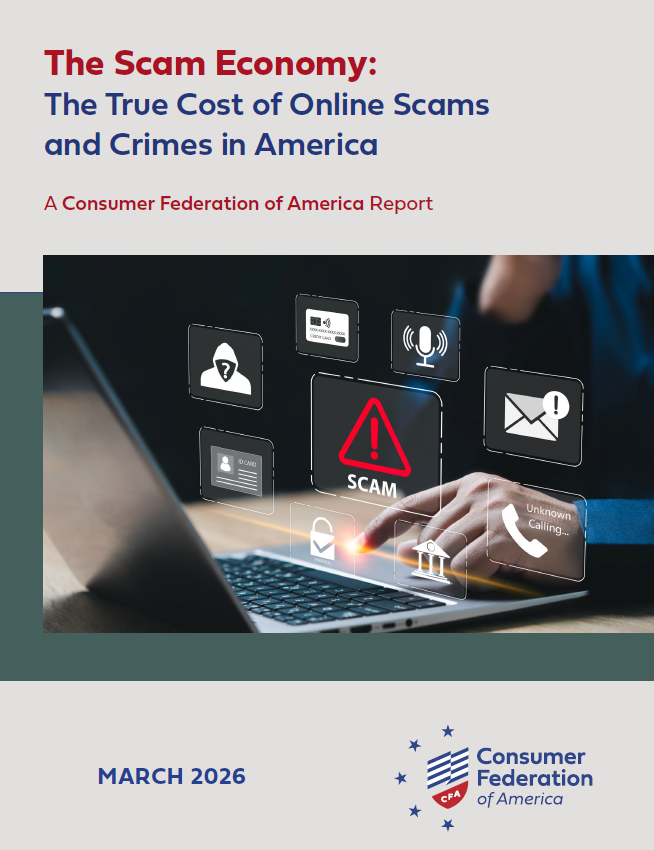
The Scam Economy: The True Cost of Online Scams and Crimes in America

By  Consumer Federation of America

Federal agencies, third parties, and other groups report on scam losses each year, but these numbers are only the tip of the iceberg in measuring the size and devastation experienced by those who are targeted. Behind these reports and big spreadsheets describing reported losses are shattered families, rent money lost, and grandmothers exploited. Newer technology is leading to a rise in these scams – in both severity and number: AI is supercharging these scams, social media platforms are enabling the spread, and data brokers facilitate targeting of victims, allowing criminals to reach consumers at massive scales while exploiting highly precise profiling to victimize vulnerable people. One of the biggest problems in fully understanding the scope of these scams is underreporting. Due to reporting fragmentation and communication, as well as the understandable devastation, embarrassment, and confusion that victims often feel, estimates on how many people report their losses to scams put it extremely low – often in the single digit percent of the actual number, according to conservative key government estimations. CFA is proud to publish this report that takes the most conservative estimate of underreporting and uses it to estimate The True Cost of Scams. While this issue is complicated to solve completely, there are significant unrealized opportunities for legislators, enforcement agencies, and industry to step up to address it.

Washington, DC: Consumer Federation of America, 2026, 31p.