Open Access Publisher and Free Library
CRIMINAL JUSTICE.jpeg

CRIMINAL JUSTICE

CRIMINAL JUSTICE-CRIMINAL LAW-PROCDEDURE-SENTENCING-COURTS

Posts in Economics
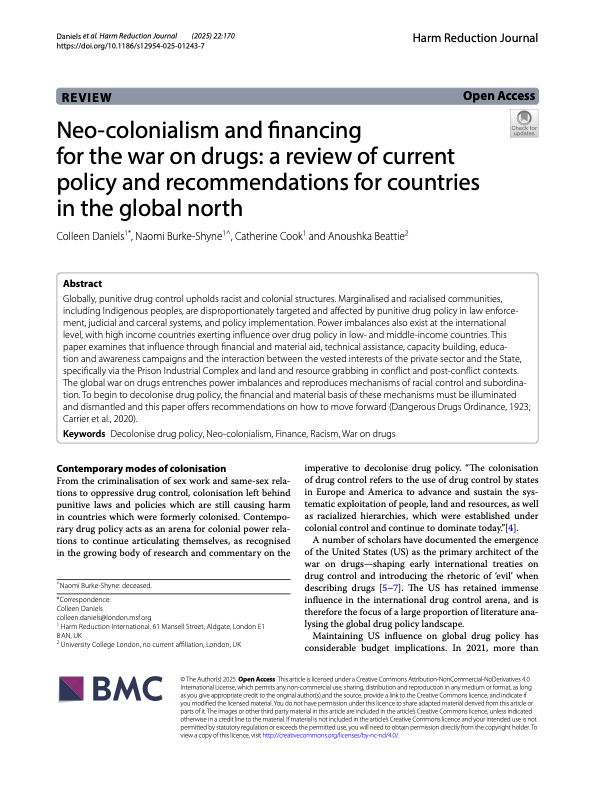
Neo‑colonialism and financing for the war on drugs: a review of current policy and recommendations for countries in the global north

By Colleen Daniels, Naomi Burke‑Shyne. Catherine Cook and Anoushka Beattie

Neo‑colonialism and financing for the war on drugs: a review of current policy and recommendations for countries in the global north Colleen Daniels1*, Naomi Burke‑Shyne1^, Catherine Cook1 and Anoushka Beattie2 Abstract Globally, punitive drug control upholds racist and colonial structures. Marginalised and racialised communities, including Indigenous peoples, are disproportionately targeted and affected by punitive drug policy in law enforcement, judicial and carceral systems, and policy implementation. Power imbalances also exist at the international level, with high income countries exerting influence over drug policy in low- and middle-income countries. This paper examines that influence through financial and material aid, technical assistance, capacity building, educa‑ tion and awareness campaigns and the interaction between the vested interests of the private sector and the State, specifically via the Prison Industrial Complex and land and resource grabbing in conflict and post-conflict contexts. The global war on drugs entrenches power imbalances and reproduces mechanisms of racial control and subordina‑ tion. To begin to decolonise drug policy, the financial and material basis of these mechanisms must be illuminated and dismantled and this paper offers recommendations on how to move forward (Dangerous Drugs Ordinance, 1923; Carrier et al., 2020).

Paying the Price: The Cost and Impact of Imprisonment on Families in Ireland

By The Irish Penal Reform Trust

For years now, IPRT has sought to shine a light on an overlooked group of families and children in Irish society – those with a family member in prison. Not only do very many families in this situation face ongoing stigma, but there is also a very real impact on their everyday lives. This report seeks to highlight the challenges these families and children face. What is clear from the research findings is that they regularly struggle to make ends meet and experience high levels of poverty and deprivation, often without access to dedicated or adequate support. We know that parental imprisonment can have an extremely detrimental and disruptive impact on a child or children as well as their partner and wider family. While previously IPRT estimated that more than 5,000 children had a parent in prison daily with over 10,000 children affected each year, with the current record prison overcrowding levels this number is likely to be much higher. In the absence of concrete and up-to-date data, it is much more difficult to identify the scale and type of issues that these families face. It also makes it harder to design and introduce policy solutions or interventions that could make a significant differenceRecent commitments in Young Ireland: The National Policy Framework for Children and Young People 2023-2028 to improve the reliability and accessibility of data on parental imprisonment, improve visiting conditions and put in place a policy as well as prison staff undertaking child-rights training, are all very welcome. The recruitment by the Irish Prison Service (IPS) of a dedicated Family Connections Officer is a step in the right direction. However, the IPS is not solely responsible for families and children impacted by imprisonment. This is a much wider issue that requires a whole-ofgovernment response and commitment. Very many of the children impacted will already be counted in the child poverty statistics as we already know that households headed by single parents experience the highest rates of poverty and deprivation. Yet, the connection is not always made that the reason for someone parenting alone is that their co-parent has been imprisoned and that these families have lost an essential income. At the same time, they are having to adjust to life withouttheir partner. The cost is not only financial; imprisonment takes an emotional toll on a person’s family and affects everyone’s mental health and wellbeing. Lives are turned upside down. This is very clearly seen in the responses from the people who were so generous with their time to share their experience for this report. Usually when a family suffers the loss of a parent, their extended family and community network rally around and support them, ask them how they are and see how they can help. However, the people who took part in this research tell us how they were treated differently – they were ignored, unfriended and no help was forthcoming. This is also evident at an official level – bereaved partners are able to avail of exemptions from some of the more stringent criteria to apply for social welfare support (and rightly so) but the same rules do not apply for families who lose a parent to prison even though they face the same drop in income, the same costs and a similar sense of loss.

Dublin: The Irish Penal Reform Trust (IPRT), 2025. 60p.

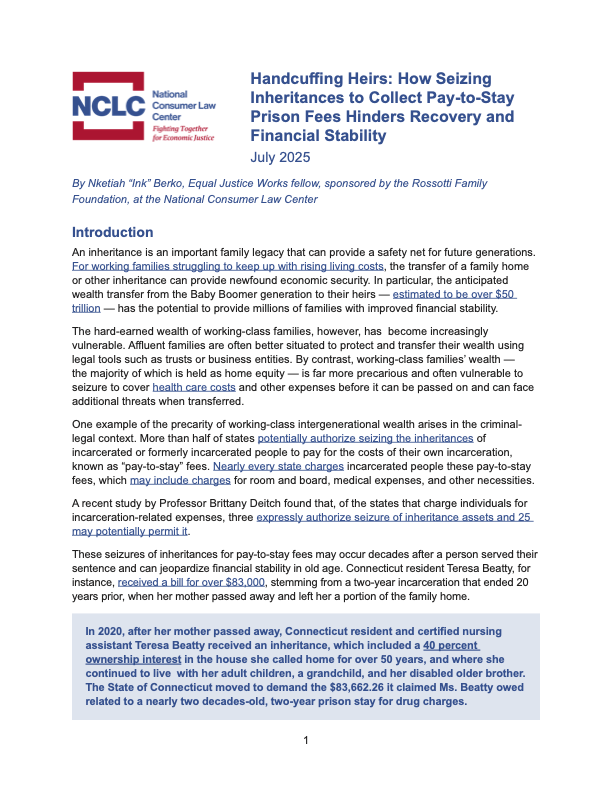
Handcuffing Heirs: How Seizing Inheritances to Collect Pay-to-Stay Prison Fees Hinders Recovery and Financial Stability

By Nketiah “Ink” Berko  

An inheritance is an important family legacy that can provide a safety net for future generations. For working families struggling to keep up with rising living costs, the transfer of a family home or other inheritance can provide newfound economic security. In particular, the anticipated wealth transfer from the Baby Boomer generation to their heirs — estimated to be over $50 trillion — has the potential to provide millions of families with improved financial stability.

The hard-earned wealth of working-class families, however, has become increasingly vulnerable. Affluent families are often better situated to protect and transfer their wealth using legal tools such as trusts or business entities. By contrast, working-class families’ wealth — the majority of which is held as home equity — is far more precarious and often vulnerable to seizure to cover health care costs and other expenses before it can be passed on and can face additional threats when transferred.

One example of the precarity of working-class intergenerational wealth arises in the criminal-legal context. More than half of states potentially authorize seizing the inheritances of incarcerated or formerly incarcerated people to pay for the costs of their own incarceration, known as “pay-to-stay” fees. Nearly every state charges incarcerated people these pay-to-stay fees, which may include charges for room and board, medical expenses, and other necessities.

A recent study by Professor Brittany Deitch found that, of the states that charge individuals for incarceration-related expenses, three expressly authorize seizure of inheritance assets and 25 may potentially permit it.

These seizures of inheritances for pay-to-stay fees may occur decades after a person served their sentence and can jeopardize financial stability in old age. Connecticut resident Teresa Beatty, for instance, received a bill for over $83,000, stemming from a two-year incarceration that ended 20 years prior, when her mother passed away and left her a portion of the family home.

Pay-to-stay laws and, in particular, the seizure of family inheritances to cover pay-to-stay fees, exacerbate an already wide chasm between the haves and have-nots, causing poor families to grow poorer as rich families continue to grow richer.

Seizing family inheritances to pay for incarceration causes particular harm to Black communities. Due to widespread inequities across the criminal justice system, as well as historic disinvestment in Black neighborhoods, Black families have less wealth available to pass to their heirs and are more likely to lose what little wealth they manage to build to the government to pay for the costs of operating prisons and jails. Moreover, seizure of resources to collect pay-to-stay fees can make it harder for returning citizens to achieve the financial stability necessary to reintegrate into society and avoid reincarceration.

Constitutional challenges to pay-to-stay fees have largely been unsuccessful, but reformers have made progress through several state legislatures. IllinoisNew Hampshire, and Missouri have repealed their pay-to-stay statutes in recent years. Additionally, in 2022, Connecticut partially reformed its pay-to-stay laws, exempting incarcerated individuals from paying the first $50,000 of their incarceration costs and collecting only from individuals convicted of “serious crimes.”

State policymakers have an important role to play in reforming the laws that sentence formerly incarcerated people and their families to generations of debt. In addition to an analysis of the disparate harm that pay-to-stay laws and inheritance seizures have on low-income and Black communities. This paper provides recommendations to state lawmakers on how to end or alleviate the punishing impact of incarceration fees.

State policymakers have an important role to play in reforming the laws that sentence formerly incarcerated people and their families to generations of debt. In addition to an analysis of the disparate harm that pay-to-stay laws and inheritance seizures have on low-income and Black communities. This paper provides recommendations to state lawmakers on how to end or alleviate the punishing impact of incarceration fees.

National Consumer Law Center, 2025. 7p.

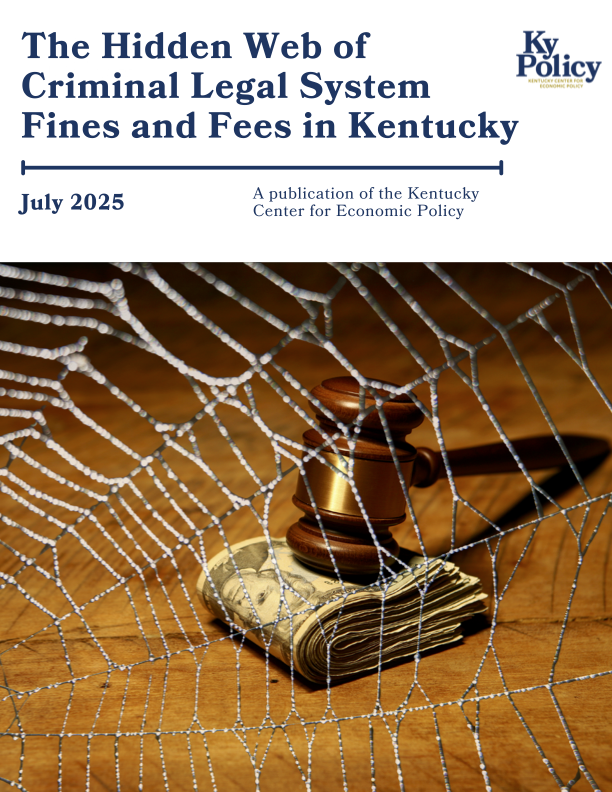
The Hidden Web of Criminal Legal System Fines and Fees in Kentucky

Ashley Spalding, Pam Thomas, Patience Martin, Scott West and Kaylee Raymer | July 8, 2025

Thousands of provisions in Kentucky state law, and untold local ordinances, make up a vast, hidden web of criminal legal system fines and fees that trap many people in a cycle of long-term debt and incarceration. In a poor state like Kentucky, owing a few hundred dollars in fines and fees for a minor offense can all too easily ensnare a person indefinitely in the criminal system and result in lost income and employment, homelessness, poor health, and family instability, among other consequences. As of 2019, Kentuckians owed at least $91 million in fines and fees debt.

2025. 27p.