Open Access Free Library
CRIMINAL JUSTICE.jpeg

CRIMINAL JUSTICE

CRIMINAL JUSTICE-CRIMINAL LAW-PROCDEDURE-SENTENCING-COURTS

The Islamic Punishment for Blasphemy

By Gordon Nickel

Death or bodily harm suffered by people accused of blasphemy in con- nection with Islam have made up some of the most sensational news stories in the West during the past several dec- ades. News reports, however, have sel- dom explored the background to these stories in sufficient depth to allow non- Muslims to understand the thinking behind the attacks and to formulate an appropriate response.

Read-Me.Org
The ‘Fortress Farm’: Articulating a new approach to redesigning ‘Defensible Space’ in a rural context.

Abstract This conceptual paper explores and develops a holistic, contemporary model of crime prevention namely the ‘Fortress Farm’ concept as proposed by the National Farmers Union in the United Kingdom. This novel idea is underpinned by the criminological theory of defensible space as posited by Oscar Newman, and by other theories of crime prevention. A holistic, practice-based model of crime prevention drawing on all aspects of the topic is developed and discussed in the context of preventing and deterring farm crime. This model can be adapted by individual farms or collectives to design out crime on farms. In the process, this paper advances our understanding of crime prevention both at a farm level and in a wider rural context. “Countryside criminals are becoming more brazen and farmers are now having to continually increase security and adopt new ways of protecting their equipment. In some parts of the country, farmers are having to turn their farmyards into fortresses to protect themselves from repeated thieves who are targeting quads, tractors and power tools. They are using tracking devices on tractors, video and infra-red surveillance in their farmyards and even DNA markers to protect sheep from rustlers”.

Tim Price, NFU Spokesman (2017).

Read-Me.Org
The Forgotten (Practical) Side of School Safety: What Do Clery Reports Say about CPTED and Crime on College Campuses? A

Auzeen Shariati & Rob T.

Following incidents of school violence, common discourse often neglects the role of practical approaches, such as CPTED, to safe- guard campuses. This study utilized a content analysis of U.S. Clery Act Safety Reports from a national, randomly drawn strati ed sam- ple of n=100 American universities to determine the extent CPTED techniques were implemented. Findings suggested that 1) CPTED use is limited; 2) two CPTED techniques, access control and activity support, were most common; 3) institutions with higher crime rates tended to have implemented more CPTED measures; and 4) CPTED use appears to be related to less severe campus crimes. Implications are discussed.

Auzeen Shariati & Rob T. Guerette (2020): The Forgotten (Practical) Side of School Safety: What Do Clery Reports Say about CPTED and Crime on College Campuses?, Planning Practice & Research,

Read-Me.Org
The Effects of ‘Alley-Gating’ in an English Town

John Haywood Greater Manchester Police, UK Paula Kautt Loughborough University, UK Andrew Whitaker Greater Manchester Police,

Terraced housing is particularly vulnerable to burglary where the offender gains access from the rear of the premises. ‘Alley-gating’ attempts to prevent this by fitting robust gates across alleyway access points and is currently used in Oldham, North West England. This study evaluates its effectiveness at preventing burglary via statistical and geographic information system (GIS) analysis of crime data from alley-gate treatment sites in Oldham. Focus group data also identify secondary effects beyond crime reduction not apparent from the quantitative analyses. We argue that clearer understanding of the contextual dynamics specific to the gated area, together with careful analytical work and use of computerized crime mapping programmes, can inform strategic decision-making and further reduce victimization.

Read-Me.Org
The effects of closed-circuit television on crime: meta-analysis of an English national quasi-experimental multi-site evaluation

David P. Farrington Martin Gill Sam J. Waples Javier Argomaniz

Abstract This article reports results obtained in an English national quasi- experimental multi-site evaluation of 14 closed-circuit television (CCTV) projects in residential areas, town and city centers, a city hospital, and car parks (parking lots). Both police and victimization data were collected before and after the installation of CCTV in target, control and buffer areas, and police Divisions. The results showed that CCTV was effective in reducing crimes in train station car parks but not in city centers or residential areas, seemed to be effective in reducing vehicle crimes (but not other types of crimes), and was most effective when the degree of coverage by CCTV was high and when CCTV was combined with other inter- ventions such as improved lighting. Implications for situational crime prevention theory are drawn. There was no evidence of displacement or diffusion of benefits. It is concluded that CCTV needs to be implemented more effectively, based on an analysis of the crime problem and its causes, and needs to be evaluated using a randomized experimental design.

Published online: 14 February 2007 #Springer Science + Business Media B.V. 2007

Read-Me.Org
The Crime Triangle of Kidnapping for ransom inCidenTs in Colombia, souTh ameriCa A ‘Litmus’ Test for Situational Crime Prevention

Christopher H. sSubbert

Crime science research over the last few decades has shown that crime tends to concentrate, most notably spatially and temporally. These and other concentrations oriented by the crime triangle (victims, offenders and places) offer important implications for the development of effective preven- tion initiatives. Yet, these indings have mostly been derived from analysis of conventional domestic crimes leaving questions as to whether similar patterning occurs among less studied crime types, such as kidnappings. This study examined 9,696 kidnapping incidents (2002–2011) in Colombia, South America, to see whether kidnappings for ransom exhibit similar concentrations according to the crime triangle framework. Results suggest that kidnappings indeed have spatio-temporal and other concentrations, which could be used to guide policy makers and policing organizations in the formulation of strategic preventive action, rather than relying on reactive efforts after kidnapping incidents have already occurred.

Read-Me.Org
The Centrality of Theory in Modern Day Crime Prevention: Developments, Challenges, and Opportunities

Brandon C. Welsh, Gregory M. Zimmerman & Steven N. Zane

Theory matters in crime prevention. Indeed, but this is hardly the full story. Crime prevention is oftentimes viewed as atheoretical not grounded in the etiology of crime and offending. Reasons abound for this view, and the recent interest in an evidence-based approach to policy-making has been at the forefront. This article reviews the role that theory plays in modern day crime prevention, with a special focus on the three main crime prevention strategies: developmental, community, and situational. The review identifies a number of key challenges and opportunities for making theory more central to crime prevention. It suggests that the classification system employed in situational crime prevention has allowed for a more

The Centrality of Theory in Modern Day Crime Prevention: Developments, Challenges, and Opportunities, Justice Quarterly, 35:1, 

Read-Me.Org
LAS DOS CARAS DE LA PREVENCIÓN SITUACIONAL: EL DESPLAZAMIENTO Y LA DIFUSIÓN DE BENEFICIOS Una investigación criminológica sobre el cierre de dos macro prostíbulos en una localidad catalana

CARLES SOTO

La tesis que les voy a presentar se ha convertido en una parte de mi familia. El largo periodo que he utilizado en el estudio y la redacción de la investigación hizo que fuera creciendo como uno más de la parentela. Ahora es el momento de presentar la tesis en sociedad y el agradecimiento se convierte en un repaso de estos años de trabajo compartido entre mi familia y la Criminologia.

URPINA Licenciado en Criminologia DEPARTAMENTO DE DERECHO PENAL Y CRIMINOLOGIA FACULTAD DE DERECHO

Read-Me.Org
Talking punishment: How victim perceptions of punishment change when they communicate with offenders

Diana Batchelor

Abstract The myth that restorative justice is the opposite of retributive justice persists, despite a long his- tory of rhetorical challenges. Only empirical evidence can advance the debate, so this article investigates the relationship between punishment and victim offender communication from the victim s perspective. Interviews with 40 victims of crime established that some victims saw victim offender communication and punishment as alternatives, and others saw them as independent. However, more than half the participants expected that communicating with the offender would increase their satisfaction with the offenders punishment or reported after- wards that this was in fact the case, suggesting that some victims ful l punishment objectives through communication with the offender. The changes occurred when victims received infor- mation about the offender s punishment, received feedback from the offender or used commu- nication with the offender to impose a mild punishment of their own. Victims were not excessively punitive, but this study demonstrates the existence of an association between pun- ishment and victim offender communication from at least some victims perspectives. This art- icle argues that we should not ignore or attempt to eliminate this relationship. Rather, acknowledging and examining the existence of punishment within victim offender communica- tion would improve practice and generate better outcomes for victims, offenders and society.

Centre for Criminology, University of Oxford, UK

Read-Me.Org
Young women and punishment within and beyond the penal system

Gilly Sharpe

Feminist research on troublesome girls has revealed a close relationship between welfare and punishment, extending to the de facto punishment of girls through welfare mechanisms (for example Chesney- Lind, 1989; Carrington, 1993; O’Neill, 2001). Despite these scholarly insights, limited attention has been paid to similarities and continuities in young women’s experiences of punishment and punitiveness across penal and welfare settings, and youth justice and penal practices have tended to be considered in isolation from other institutional arrangements. Such compartmentalisation serves to fragment experiences which are overlapping and interwoven, and which may have cumulative and enduring effects on individuals over time. This chapter, through a focus on the structural and cultural contexts which shape both lawbreaking and desistance (Weaver, 2019), examines the treatment and punishment of marginalised young women across three domains: education, criminal labelling and the benefits system. Following Carvalho et al (2020, pp 265– 6), I conceptualise young women’s experience of punitiveness as multi- faceted and ‘a central feature of a range of intersecting experiences and practices’. I argue that schools, formal and informal youthful criminal labels and the welfare benefits system constitute intersecting and sometimes mutually constitutive sites of punishment which, in combination, are likely to have a toxic impact on marginalised young women’s sense of self as well as on their economic and social prospects.

Read-Me.Org
Why Does Japan Retain Capital Punishment?

Leo Tolstoy’s Anna Karenina

Abstract Japan retains the death penalty for three main reasons: because it missed a major opportunity for abolition in the postwar Occupation, because of the long hegemony of the (conservative) Liberal Democratic Party, and because (like the United States and China) it has sufficient size, economic influence, and political clout to enable it to defy human rights norms. Capital punishment also persists in Japan because it performs welcome functions for politicians, prosecutors, media, and the public. Despite widespread belief to the contrary, capital punishment in Japan does not deter homicide better than long terms of imprisonment do.

Read-Me.Org
What Punishment Expresses

Craig Reeves

It is much easier to show that punishment has a symbolic significance than to say exactly what it is that punishment expresses...1. Expressivism – Philosophical and Psychosocial The philosophical view that punishment should be understood as an essentially expressive practice and evaluated as such has been influential in both the normative philosophy of punishment and in psychosocial penal theory,2 though about this view, as about many issues, there has been relatively little communication between those two traditions. Philosophical and psychosocial expressivist accounts of punishment have developed more or less independently, as if they had little to do with one another.

(Feinberg, 1965: 402)

Read-Me.Org
What Have Criminologists Done for Us Lately?

Ken Pease and Graham Farrell

‘Directly related to’ is a weaselly phrase which disguises the fact that nearly all the listed jobs require further professional training and that a criminology degree does not confer an advantage over other degree courses in recruit- ment into such careers. Only just over half of criminology graduates are in employment six months after graduation, and a third of those employed are in retail, catering and bar work. So your next Whopper and chips from Burger King may be served by a criminology graduate regretting their degree choice. So to paraphrase the old song, ‘Don’t let your daughter study criminology. Mrs Worthington’.

Ken Pease and Graham Farrell 87

Read-Me.Org
Vom Geist der Strafe. Andreas Gryphius’ Carolus Stuardus und die englischen Debatten über den Tod Karls I.

Maximilian Bergengruen

17.1 Einleitung

Meine Überlegungen setzen an den Debatten für und wider das Todesurteil gegen den englischen König Karl I. in Andreas Gryphius’ Carolus Stuardus an; einer Debatte, die ursprünglich in England geführt wurde, aber nicht zuletzt durch ver- schiedene Übersetzungen Auswirkungen auf und in ganz Europa hatte (3). Im Mittelpunkt steht die Austauschbarkeit der Argumente in Bezug auf die göttliche Legitimation von Herrschaft, die sowohl die royale wie auch die independente Position für sich beanspruchen.

Read-Me.Org
Violence (Crime and Punishment)

Rastko Vuković,

There is no valid evidence that the extension of legal penalties reduces the percentage of crime in society. It is known that saturation of society by laws reduces the chances of development, so the question arises as to why we are striving to more and more durable laws? Why are we extinguishing out the fire with the oil in the alleged fight for justice?

May 30, 2019

Read-Me.Org
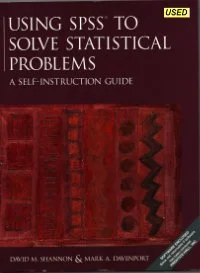
Using SPSS® to Solve Statistical Problems: A Self -Instruction Guide

David M. Shannon with Mark A. Davenport

The motivation for writing this text comes from ten years of experience with students en- rolled in beginning statistics classes. Students in these classes have had to deal with the chal- lenges of learning not only statistical concepts, but also how to use the computer software (SPSS) that will guide them through their statistical analyses. Whether you are a student learning about statistics for the first time or an experienced researcher who has used sta- tistics throughout your career, you are likely to have many encounters with software such as SPSS® for Windows.

Library of Congress Cataloging-in-Publication Data

Read-Me.Org
Undergraduate’s Perception toward Corporal Punishment

Nurhidayat , Danarti , Habib Al Fattah

Abstract. This study is conducted to find out the undergraduate’s perception toward the corporal punishment that may happens in the school. The subjects of the research are sixth semester students of English Department of Teacher Training and Education of Universitas Muhammadiyah Surakarta. The data were collected through close and open questionnaire and analysed using content analysis. Based on the analysis of the data, it is concluded that most undergraduates experienced corporal punishment in the previous education before studying in the university. The experience of suffering corporal punishment leads the undergraduate’s perception toward the corporal punishment.

1Universitas Muhammadiyah Surakarta, Surakarta, Indonesia 2SMP N 6 Surakarta, Surakarta, Indonesia 3MTs AL Kahfi, Surakarta, Indonesia

Read-Me.Org
Uma outra pena de morte: a violência letal do sistema penal brasileiro

Another capital punishment: the lethal violence of the Brazilian penal system

By Luiz Phelipe Dal Santo

Introdução Costuma-se compreender o monopólio sobre o uso legítimo da violência como uma das principais características dos Estados Modernos.1 Conforme denotado pela palavra “legítimo”, isso não significa que os Estados têm (ou deveriam ter) liberdade para dispor da violência contra seus cidadãos como bem entenderem. A despeito do desenv

Universidade de Oxford – Inglaterra, Reino Unido. 1.

Read-Me.Org
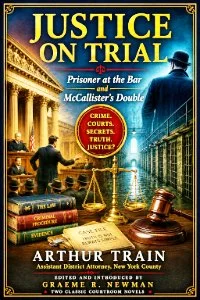
Justice on Trial

By Arthur Train (Author) and Graeme Newman (Editor and Introduction)

Arthur Train was not merely a novelist of crime and courtroom intrigue—he was an Assistant District Attorney in New York County who understood the hidden machinery of American justice from the inside. In Justice on Trial, two of his most compelling works—Prisoner at the Bar and McCallister’s Double—are brought together in a powerful new edition edited and introduced by Graeme R. Newman.

Part legal exposé, part philosophical inquiry, part classic crime fiction, this volume explores questions that remain disturbingly relevant today: How is guilt really determined? Do courts discover truth—or construct it? Why are prisons hidden from public view? Do criminals receive justice, or merely punishment? And what of the victims left behind by the machinery of law?

In Prisoner at the Bar, Train offers a rare insider’s account of the criminal justice system of early twentieth-century America. Drawing upon his own prosecutorial experience, he exposes the realities behind arrests, grand juries, trials, sentencing, police practices, courtroom performance, and the uneasy relationship between law and morality. The result is one of the earliest and most penetrating critiques of modern criminal justice ever written.

Complementing this work is McCallister’s Double, a brilliant collection of courtroom and criminal tales filled with deception, mistaken identity, legal maneuvering, and moral ambiguity. These stories reveal Train’s remarkable ability to combine suspense with sharp observations about the fictions upon which justice itself often depends.

Graeme R. Newman’s extensive new introduction places Train’s work within the larger history of crime, punishment, and legal power, comparing the courts and prisons of Train’s era with those of the twenty-first century. The introduction examines the secrecy of prisons, the hidden social functions of trials, the mythology of “justice,” and the enduring question of whether criminal justice systems truly deliver fairness—or merely preserve authority.

Blending classic legal writing, detective fiction, social criticism, and courtroom drama, Justice on Trial is both a fascinating historical document and a strikingly modern meditation on crime, punishment, truth, and power.

For readers of true crime, legal history, courtroom drama, criminology, and classic detective fiction, this volume offers a rare and unsettling look behind the curtain of justice itself.

Read-Me.Org Inc. New York-Philadelphia-Australia. 2026. p.362.

The Kid And The Camel: Stories Of The Court And Criminality

By Arthur Train (Author) and Graeme Newman (Editor and Introduction)

Before modern courtroom thrillers and television crime dramas, Arthur Train was bringing readers inside the strange, unpredictable, and deeply human world of criminal law. The Kid and the Camel: Stories of the Court and Criminality collects some of Train’s most memorable tales from the New York courts, blending legal realism, sharp humor, and penetrating social observation.

At the center of the volume is the celebrated story “The Kid and the Camel,” a bizarre and unforgettable courtroom case involving immigrants, conflicting testimony, cultural misunderstanding, and a camel hidden in a city attic. Around it unfolds a wider panorama of criminal justice in early twentieth-century America: ambitious lawyers, eccentric witnesses, cunning swindlers, ethical dilemmas, jury manipulation, and the uncertain search for truth inside crowded urban courtrooms.

This collection also features the famous Tutt & Tutt stories, introducing one of American fiction’s earliest and most sophisticated lawyer-heroes. Through the clever, theatrical, and psychologically astute attorney Ephraim Tutt, Train explores the law not merely as a system of rules, but as a human drama shaped by persuasion, ambiguity, and competing notions of justice.

Far more than period entertainment, these stories remain strikingly relevant today. Issues of immigration, courtroom spectacle, prosecutorial strategy, media influence, unequal justice, and the power of lawyers continue to dominate modern criminal justice systems. Train’s fiction reveals how little the essential tensions of law and society have changed.

Edited and introduced by Graeme Newman, this new Read-Me.Org edition restores an important classic of American legal literature for contemporary readers interested in true crime, courtroom drama, criminology, legal history, and the enduring complexities of justice itself.

Read-Me.Org Inc. New York-Philadelphia-Australia. 2026. p.367.