

By Cole Anderson and Caitlin McKennie
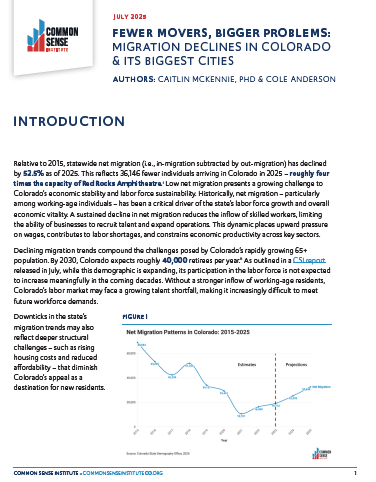
Relative to 2015, statewide net migration (i.e., in-migration subtracted by out-migration) has declined by 52.5% as of 2025. This reflects 36,146 fewer individuals arriving in Colorado in 2025 – roughly four times the capacity of Red Rocks Amphitheatre.i Low net migration presents a growing challenge to Colorado’s economic stability and labor force sustainability. Historically, net migration – particularly among working-age individuals – has been a critical driver of the state’s labor force growth and overall economic vitality. A sustained decline in net migration reduces the inflow of skilled workers, limiting the ability of businesses to recruit talent and expand operations. This dynamic places upward pressure on wages, contributes to labor shortages, and constrains economic productivity across key sectors. Declining migration trends compound the challenges posed by Colorado’s rapidly growing 65+ population. By 2030, Colorado expects roughly 40,000 retirees per year.ii As outlined in a CSI report released in July, while this demographic is expanding, its participation in the labor force is not expected to increase meaningfully in the coming decades. Without a stronger inflow of working-age residents, Colorado’s labor market may face a growing talent shortfall, making it increasingly difficult to meet future workforce demands. According to a recent study by the Bureau of Economic Analysis (BEA), Colorado ranks 14th (not including the District of Columbia) in terms of regional price parities relative to all other states (a measurement that evaluates the differences in price levels across states for a given year).iii If these issues remain unaddressed, they could have long-term consequences for the state’s economic competitiveness and growth prospects. Evidence suggests this scenario is already emerging: Colorado’s economic growth is slowing, with job growth projected to increase by only 1.2% in 2025. During the first quarter of 2025, Colorado’s job growth ranked 26th in the nation. This deceleration is suggested to be linked to decreased net migration and an aging population, both of which pose risks to the state’s labor force capacity and overall economic dynamism.
Greenwood Village, CO: Common Sense Institute, 2025. 10p.