Open Access Free Library
PUNISHMENT.jpeg

PUNISHMENT

PUNISHMENT-PRISON-HISTORY-CORPORAL-PUNISHMENT-PAROLE-ALTERNATIVES. MORE in the Toch Library Collection

Posts tagged hanging in chains
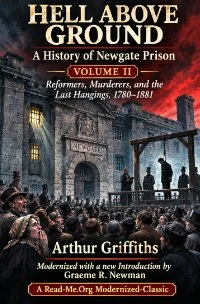
Hell above Ground -.A History of Newgate Prison. Volume II.

Volume II: Reformers, Murderers, and the Last Hangings, 1780–1881

By Arthur Griffiths

Modernized with a New Introduction by Graeme R. Newman

For centuries, Newgate Prison was synonymous with suffering, cruelty, and death. But as the eighteenth century gave way to the nineteenth, a new era of criminal justice began to emerge. Reformers challenged the barbarity of England's penal system, public executions came under increasing criticism, and the notorious prison itself became a battleground between entrenched traditions and the demands of humanity.

Hell Above Ground, Volume II continues Arthur Griffiths's gripping history of London's most infamous prison, tracing its turbulent final century from 1780 to 1881.

Drawing upon historical records, eyewitness accounts, and the extraordinary experiences of prisoners and reformers, Griffiths reveals a world of sensational murders, ingenious frauds, notorious criminals, and spectacular executions. Readers encounter poisoners, forgers, body snatchers, swindlers, and desperate men and women whose crimes brought them face to face with the gallows.

Among the most compelling figures is Elizabeth Fry, whose courageous efforts to improve conditions for women prisoners helped transform public attitudes toward imprisonment. Other reformers, including Thomas Fowell Buxton and the pioneering prison inspectors, exposed the corruption, overcrowding, disease, and institutional indifference that continued to plague Newgate despite repeated promises of improvement.

The book also recounts the grim spectacle of public hanging, when enormous crowds assembled outside Newgate to watch condemned prisoners die. The abolition of public executions in 1868 marked a turning point, but it did not end the controversies surrounding capital punishment.

Beyond its dramatic accounts of crime and punishment, Volume II examines the gradual dismantling of England's notorious Bloody Code, the emergence of professional prison administration, and the reforms that eventually brought Newgate's long history as a regular prison to an end.

This Read-Me.Org Modernized-Classic edition presents Griffiths's original Victorian narrative in accessible contemporary English. The text has been condensed, historical errors corrected where identified, and the original illustrations retained. A new Introduction by criminologist Graeme R. Newman places the history of Newgate within the broader development of modern criminal justice.

Special "Then and Now" discussions compare nineteenth-century practices with contemporary problems of imprisonment, including overcrowding, institutional corruption, prisoners' rights, and capital punishment. Review and discussion questions further enhance the book's value for students, teachers, and general readers.

Hell Above Ground is more than a history of a notorious prison. It is a disturbing examination of humanity's continuing struggle to reconcile punishment with justice, deterrence with compassion, and the authority of the state with the dignity of the individual.

Volume II completes a remarkable two-volume history of one of the most feared institutions in the English-speaking world.

Read-Me.Org Inc. New York-Philadelphia-Australia. 2026. p.204.
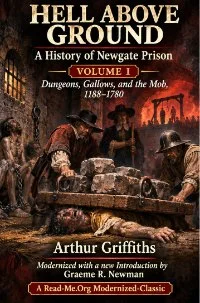
Hell above Ground -.A History of Newgate Prison. Volume I.

Volume I: Dungeons, Gallows, and the Mob, 1188–1780

Arthur Griffiths Modernized with a New Introduction by Graeme R. Newman

For nearly a thousand years, Newgate Prison stood at the heart of London as a monument to cruelty, corruption, and the terrifying power of the criminal law. Behind its forbidding walls, prisoners endured starvation, disease, extortion, chains, and torture. Outside, enormous crowds gathered to witness public executions, turning the suffering of condemned men and women into popular entertainment.

Hell Above Ground brings this extraordinary history vividly to life.

Originally published in 1884 as The Chronicles of Newgate, Arthur Griffiths's classic account draws upon court records, historical documents, and contemporary eyewitness testimony to reconstruct the brutal world of England's most notorious prison.

Volume I traces Newgate's history from its medieval origins in 1188 to the destruction of the newly constructed prison during the Gordon Riots of 1780. Along the way, readers encounter religious martyrs, highwaymen, murderers, political prisoners, corrupt jailers, and desperate debtors. They discover the horrifying practice of crushing prisoners beneath heavy weights, the deadly epidemics of jail fever, spectacular escapes, and the grotesque spectacle of mass hangings at Tyburn.

Yet Newgate was more than a prison. It was a mirror of English society, exposing the extraordinary inequalities of a justice system in which wealth purchased comfort and privilege while poverty could mean imprisonment, suffering, and death.

This Read-Me.Org Modernized-Classic edition transforms Griffiths's often dense Victorian prose into accessible contemporary English. The original text has been carefully condensed, historical errors corrected where identified, and the original illustrations retained. A new Introduction by criminologist Graeme R. Newman places Newgate within the broader history of crime and punishment. Throughout the volume, comparisons with contemporary criminal justice invite readers to consider how much has changed—and how much remains disturbingly familiar.

Review and discussion questions make this edition particularly valuable for students of criminology, criminal justice, history, and penology, as well as general readers fascinated by historical crime and punishment.

Hell Above Ground is both a gripping history of human suffering and a powerful reminder that the progress of civilization cannot be measured simply by the severity of its punishments.

Read-Me.Org Inc. New York-Philadelphia-Australia. 2026. p.224.

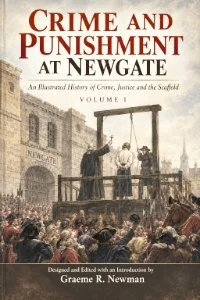
Crime And Punishment At Newgate.: An Illustrated History of Crime, Justice and the Scaffold. Volume II.

By Graeme R. Newman

Murderers and highwaymen, pirates and forgers, thieves and traitors, duelists and rebels—the men and women who passed through the British criminal justice system between 1700 and 1816 inhabited a world in which punishment was intended not merely to penalize the offender, but to be seen.

Crime and Punishment at Newgate brings that world vividly back to life through nearly 190 illustrated cases drawn from Camden Pelham’s celebrated nineteenth-century Chronicles of Crime; or, The New Newgate Calendar. Each case has been newly designed and presented as a compact illustrated narrative, combining the story of the crime with arrest, trial, conviction and, above all, punishment.

The punishments could be extraordinary. Men and women were hanged for offences that today might result in imprisonment. Others were whipped, branded, transported, imprisoned, mutilated or exposed to public humiliation. Bodies might be dissected after execution or displayed in chains. Yet the system was not uniformly merciless: pardons, reprieves, escapes, reduced verdicts and differences of wealth, gender and social rank produced striking variations in who was punished—and how.

Among these pages are murder, piracy, robbery, treason, duelling, forgery, riot, domestic killing and political crime. But this is more than a collection of sensational criminal stories. It is an illustrated history of the changing meaning of punishment itself.

In a substantial new Introduction, criminologist Graeme R. Newman asks questions that remain surprisingly modern: Did the punishment fit the crime? Who deserved punishment? Was justice applied equally to rich and poor? How fair were criminal trials? Why did governments make punishment a public spectacle? And how different are modern societies, which have moved punishment behind prison walls while turning crime and criminal trials into mass entertainment?

The scaffold, the prison, the courtroom and the crowd become parts of the same history. As Newman observes, the eighteenth-century spectator travelled to the punishment; today the spectacle travels to the spectator.

Richly illustrated throughout and supplemented by a Thematic Guide to Crime and Punishment and a Selected Bibliography, this first volume transforms the traditional Newgate Calendar into a modern visual history of crime, justice and society.

For readers interested in criminal justice, criminology, the history of punishment, capital punishment, Newgate Prison, British social history, true crime, and the darker side of eighteenth- and early nineteenth-century life.

Read-Me.Org Inc. New York-Philadelphia-Australia. 2026. p.204.
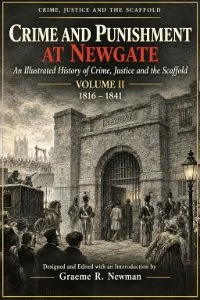
Crime And Punishment At Newgate.: An Illustrated History of Crime, Justice and the Scaffold. Volume I.

By Graeme R. Newman

Murderers and highwaymen, pirates and forgers, thieves and traitors, duelists and rebels—the men and women who passed through the British criminal justice system between 1700 and 1816 inhabited a world in which punishment was intended not merely to penalize the offender, but to be seen.

Crime and Punishment at Newgate brings that world vividly back to life through nearly 190 illustrated cases drawn from Camden Pelham’s celebrated nineteenth-century Chronicles of Crime; or, The New Newgate Calendar. Each case has been newly designed and presented as a compact illustrated narrative, combining the story of the crime with arrest, trial, conviction and, above all, punishment.

The punishments could be extraordinary. Men and women were hanged for offences that today might result in imprisonment. Others were whipped, branded, transported, imprisoned, mutilated or exposed to public humiliation. Bodies might be dissected after execution or displayed in chains. Yet the system was not uniformly merciless: pardons, reprieves, escapes, reduced verdicts and differences of wealth, gender and social rank produced striking variations in who was punished—and how.

Among these pages are murder, piracy, robbery, treason, duelling, forgery, riot, domestic killing and political crime. But this is more than a collection of sensational criminal stories. It is an illustrated history of the changing meaning of punishment itself.

In a substantial new Introduction, criminologist Graeme R. Newman asks questions that remain surprisingly modern: Did the punishment fit the crime? Who deserved punishment? Was justice applied equally to rich and poor? How fair were criminal trials? Why did governments make punishment a public spectacle? And how different are modern societies, which have moved punishment behind prison walls while turning crime and criminal trials into mass entertainment?

The scaffold, the prison, the courtroom and the crowd become parts of the same history. As Newman observes, the eighteenth-century spectator travelled to the punishment; today the spectacle travels to the spectator.

Richly illustrated throughout and supplemented by a Thematic Guide to Crime and Punishment and a Selected Bibliography, this first volume transforms the traditional Newgate Calendar into a modern visual history of crime, justice and society.

For readers interested in criminal justice, criminology, the history of punishment, capital punishment, Newgate Prison, British social history, true crime, and the darker side of eighteenth- and early nineteenth-century life.

Read-Me.Org Inc. New York-Philadelphia-Australia. 2026. p.206.

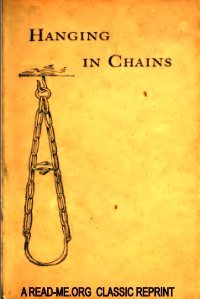
Hanging in Chains

By Albert Hartshorne.

‘And humanity would recoil to-day with abhorrence from the actual gibbet, sensation itself would be stunned at the punishment for High Treason, the drawing and quartering of patriots, whose names may shine in history " through their tears like wrinkled pebbles in a glassy stream." It will be borne in mind that the gallows and the gibbet are the most ancient instruments of capital punishment in the world.’ NY. Cassell Publishing (1893) 160p.