Open Access Free Library
PUNISHMENT.jpeg

PUNISHMENT

PUNISHMENT-PRISON-HISTORY-CORPORAL-PUNISHMENT-PAROLE-ALTERNATIVES. MORE in the Toch Library Collection

Posts in Torture
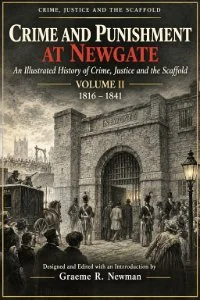
Crime And Punishment At Newgate.: An Illustrated History of Crime, Justice and the Scaffold. Volume II.

By Graeme R. Newman

Murderers and highwaymen, pirates and forgers, thieves and traitors, duelists and rebels—the men and women who passed through the British criminal justice system between 1700 and 1816 inhabited a world in which punishment was intended not merely to penalize the offender, but to be seen.

Crime and Punishment at Newgate brings that world vividly back to life through nearly 190 illustrated cases drawn from Camden Pelham’s celebrated nineteenth-century Chronicles of Crime; or, The New Newgate Calendar. Each case has been newly designed and presented as a compact illustrated narrative, combining the story of the crime with arrest, trial, conviction and, above all, punishment.

The punishments could be extraordinary. Men and women were hanged for offences that today might result in imprisonment. Others were whipped, branded, transported, imprisoned, mutilated or exposed to public humiliation. Bodies might be dissected after execution or displayed in chains. Yet the system was not uniformly merciless: pardons, reprieves, escapes, reduced verdicts and differences of wealth, gender and social rank produced striking variations in who was punished—and how.

Among these pages are murder, piracy, robbery, treason, duelling, forgery, riot, domestic killing and political crime. But this is more than a collection of sensational criminal stories. It is an illustrated history of the changing meaning of punishment itself.

In a substantial new Introduction, criminologist Graeme R. Newman asks questions that remain surprisingly modern: Did the punishment fit the crime? Who deserved punishment? Was justice applied equally to rich and poor? How fair were criminal trials? Why did governments make punishment a public spectacle? And how different are modern societies, which have moved punishment behind prison walls while turning crime and criminal trials into mass entertainment?

The scaffold, the prison, the courtroom and the crowd become parts of the same history. As Newman observes, the eighteenth-century spectator travelled to the punishment; today the spectacle travels to the spectator.

Richly illustrated throughout and supplemented by a Thematic Guide to Crime and Punishment and a Selected Bibliography, this first volume transforms the traditional Newgate Calendar into a modern visual history of crime, justice and society.

For readers interested in criminal justice, criminology, the history of punishment, capital punishment, Newgate Prison, British social history, true crime, and the darker side of eighteenth- and early nineteenth-century life.

Read-Me.Org Inc. New York-Philadelphia-Australia. 2026. p.204.
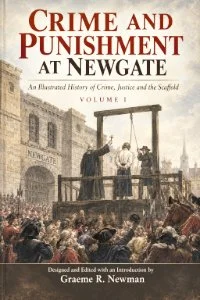
Crime And Punishment At Newgate.: An Illustrated History of Crime, Justice and the Scaffold. Volume I.

By Graeme R. Newman

Murderers and highwaymen, pirates and forgers, thieves and traitors, duelists and rebels—the men and women who passed through the British criminal justice system between 1700 and 1816 inhabited a world in which punishment was intended not merely to penalize the offender, but to be seen.

Crime and Punishment at Newgate brings that world vividly back to life through nearly 190 illustrated cases drawn from Camden Pelham’s celebrated nineteenth-century Chronicles of Crime; or, The New Newgate Calendar. Each case has been newly designed and presented as a compact illustrated narrative, combining the story of the crime with arrest, trial, conviction and, above all, punishment.

The punishments could be extraordinary. Men and women were hanged for offences that today might result in imprisonment. Others were whipped, branded, transported, imprisoned, mutilated or exposed to public humiliation. Bodies might be dissected after execution or displayed in chains. Yet the system was not uniformly merciless: pardons, reprieves, escapes, reduced verdicts and differences of wealth, gender and social rank produced striking variations in who was punished—and how.

Among these pages are murder, piracy, robbery, treason, duelling, forgery, riot, domestic killing and political crime. But this is more than a collection of sensational criminal stories. It is an illustrated history of the changing meaning of punishment itself.

In a substantial new Introduction, criminologist Graeme R. Newman asks questions that remain surprisingly modern: Did the punishment fit the crime? Who deserved punishment? Was justice applied equally to rich and poor? How fair were criminal trials? Why did governments make punishment a public spectacle? And how different are modern societies, which have moved punishment behind prison walls while turning crime and criminal trials into mass entertainment?

The scaffold, the prison, the courtroom and the crowd become parts of the same history. As Newman observes, the eighteenth-century spectator travelled to the punishment; today the spectacle travels to the spectator.

Richly illustrated throughout and supplemented by a Thematic Guide to Crime and Punishment and a Selected Bibliography, this first volume transforms the traditional Newgate Calendar into a modern visual history of crime, justice and society.

For readers interested in criminal justice, criminology, the history of punishment, capital punishment, Newgate Prison, British social history, true crime, and the darker side of eighteenth- and early nineteenth-century life.

Read-Me.Org Inc. New York-Philadelphia-Australia. 2026. p.206.

Siberia And The Exile System: Volume 2

by George Kennan (Author), George Frost (Illustrator), Graeme Newman (Introduction)

SIBERIA AND THE EXILE SYSTEM — VOLUME TWO
By George Kennan
Extensively Illustrated
Designed, Modernized and Edited with an Introduction by Graeme R. Newman

The journey becomes an indictment.

In Volume One, George Kennan crossed the immense Siberian frontier, increasingly questioning the Russian Empire's system of exile and punishment. In Volume Two, those doubts disappear forever.

Travelling thousands of miles farther into Eastern Siberia, Kennan reaches the most feared destinations of Imperial Russia—the remote prisons, penal settlements, and infamous katorga mines of the Trans-Baikal. Here he encounters political prisoners, hardened convicts, prison officials, and ordinary Siberians whose lives have been shaped by one of history's harshest systems of punishment.

What he witnesses is both shocking and meticulously documented. Kennan examines overcrowded prisons, disease, forced labour, administrative exile without trial, brutal punishments, and the daily struggle for survival endured by men and women banished to the edge of the known world. Drawing upon official government records, personal interviews, and his own observations, he constructs a devastating portrait of a penal system that profoundly altered Western understanding of Tsarist Russia.

Yet Volume Two is more than an exposé. Kennan remains a gifted travel writer whose vivid descriptions of Siberia's mountains, forests, rivers, settlements, and extraordinary people transform this work into one of the greatest travel narratives ever written. The breathtaking beauty of the landscape stands in haunting contrast to the suffering concealed within it.

This new 2026 edition has been carefully designed and extensively edited for the modern reader while preserving Kennan's original voice and historical integrity. OCR errors have been corrected, typography modernized, and the narrative presented in a clear, readable format, while retaining the rich illustrations that accompanied the original publication.

More than a century after its first appearance, Siberia and the Exile System remains one of the most important eyewitness investigations ever published—a work of journalism whose influence reached far beyond Russia and helped expose a penal regime that much of the world preferred not to see.

Together, Volumes One and Two form one of the greatest works of investigative travel writing and prison history ever written—an unforgettable journey into the frozen heart of the Russian Empire.

Read-Me.Org Inc. New York-Philadelphia-Australia. 2026. 284p.

Siberia And The Exile System: Volume 1

by George Kennan (Author), George Frost (Illustrator), Graeme Newman (Introduction)

SIBERIA AND THE EXILE SYSTEM — VOLUME ONE
By George Kennan. Extensively Illustrated. Designed, Modernized and Edited with an Introduction by Graeme R. Newman

In 1885, American journalist and explorer George Kennan journeyed deep into the Russian Empire intending to investigate—and, in many respects, defend—the notorious Siberian exile system. What he discovered changed his mind completely.

Siberia and the Exile System became one of the nineteenth century’s most influential works of investigative journalism: a firsthand account of prisons, convict transports, political exile, arbitrary banishment, and life on the immense Siberian frontier. Kennan entered Russia initially skeptical of reports of government brutality. Eighteen months later, after visiting prisons, traveling with convicts, examining official records, and speaking privately with political exiles, he emerged as one of the system’s most formidable critics.

Volume One follows Kennan and artist George A. Frost from St. Petersburg across the Urals and into Siberia. Their journey takes them through the Tiumen forwarding prison, aboard a Siberian convict barge, across the vast Kirghis steppe, into the Altai, and through settlements populated by men and women banished by administrative order—sometimes without trial or even a formal criminal charge. It concludes with Kennan’s investigations in Tomsk and his increasingly disturbing encounters with the machinery of exile.

Yet this is far more than a catalogue of suffering. Kennan was an accomplished travel writer with an extraordinary eye for landscape and character. Siberian villages, endless roads, river journeys, frontier inns, officials, peasants, prisoners and revolutionaries emerge vividly from his narrative. Humor and adventure repeatedly interrupt the darkness, making the eventual revelations about imprisonment and exile all the more powerful.

Of particular importance is Kennan’s changing perspective. He began his investigation believing that Russia and its penal system had been unfairly represented and that many revolutionaries were simply dangerous fanatics. His own observations progressively undermined those assumptions. The result is the unusual spectacle of an investigator changing his conclusions because the evidence before him demanded it.

This new 2026 edition has been designed and extensively edited for the contemporary reader while preserving Kennan’s narrative voice and historical testimony. It is extensively illustrated, drawing the reader visually into the extraordinary landscapes, journeys, prisons, settlements and people Kennan encountered.

At once travel narrative, prison exposé, political history and eyewitness investigation, Siberia and the Exile Systemremains a disturbing examination of what happens when punishment is removed from public view and political authority acquires the power to make inconvenient people disappear.

Volume One begins the journey. Volume Two carries Kennan deeper into Eastern Siberia and toward the dreaded katorga mines of the Trans-Baikal.

Read-Me.Org Inc. New York-Philadelphia-Australia. 2026. 284p.