
Open Access Free Library
SOCIAL SCIENCES.jpeg

SOCIAL SCIENCES

Social sciences examine human behavior, social structures, and interactions in various settings. Fields such as sociology, psychology, anthropology, and economics study social relationships, cultural norms, and institutions. By using different research methods, social scientists seek to understand community dynamics, the effects of policies, and factors driving social change. This field is important for tackling current issues, guiding public discussions, and developing strategies for social progress and innovation.

Posts in Gun Law
RULES: An Argument with a Machine- Volume One

by Graeme Newman and the Machine

Why do we need rules? Who makes them? Who benefits from them? And what happens when we begin to question them?

Rules: An Argument with The Machine is a unique collection of short stories exploring one of the most fundamental features of human society: rules.

From ancient villages to futuristic cities, from courts of law to battlefields, from schools and prisons to utopian experiments, these stories examine the rules that govern our lives and the consequences of obeying, bending, or breaking them.

But this is more than a collection of stories.

Each story began as a collaboration between author Graeme Newman and an artificial intelligence. The Machine produced a story. The author responded, sometimes agreeing, often challenging, and occasionally mocking the machine's tendency toward optimism, redemption, and tidy moral conclusions. The result became an ongoing conversation about law, justice, power, morality, freedom, authority, conformity, and human nature itself.

As the stories unfold, a second narrative emerges:

  • Can society exist without rules?

  • Can rules exist without injustice?

  • And can a machine ever understand the messy realities of human life?

Part philosophical inquiry, part social commentary, part literary experiment, Rules: An Argument with a Machine invites readers to join a lively debate between human skepticism and artificial optimism.

The stories may not provide definitive answers. But they ask questions worth arguing about.

In This Volume

  • In the beginning: The origins of rules and morality

  • The rise of rulers and authority

  • Law, punishment, and social control

  • Rule worshippers and rule breakers

  • Utopias, dystopias, and "Ruletopia"

  • The continuing dialogue between a human author and his machine co-author

For readers interested in social issues, criminal justice, political thought, philosophy, artificial intelligence, and the strange ways stories can illuminate the human condition.

Read-Me.Org Inc. New York-Philadelphia-Australia. 2026. p.192.
The Art and Science of Urban Gun Violence Reduction: Evidence from the Advance Peace Program in Sacramento, California

By Jason Corburn, Yael Nidam and Amanda Fukutome-Lopez

Urban gun violence is a critical human health and social justice issue. Strategies to reduce urban gun violence are increasingly being taken out of the domain of police and into community-based programs. One such community-driven gun violence reduction program analyzed here is called Advance Peace. Advance Peace (AP) uses street outreach workers as violence interrupters and adult mentors to support the decision making and life chances of those at the center of urban gun violence. We reported on the impact Advance Peace had on gun violence and program participants in the City of Sacramento, California, from 2018–2019. Using an interrupted time series model, we attributed a gun violence reduction of 18% city wide and up to 29% in one of the AP target neighborhoods from the intervention. We also found that of the 50 participants in the Advance Peace Sacramento program 98% were alive, 90% did not have a new gun charge or arrest, 84% reported an improved outlook on life, all received cognitive behavioral therapy, and 98% reported that their AP outreach worker was one of the most important adults in their life. Advance Peace is a viable community-driven, urban gun violence, and healing-focused program.

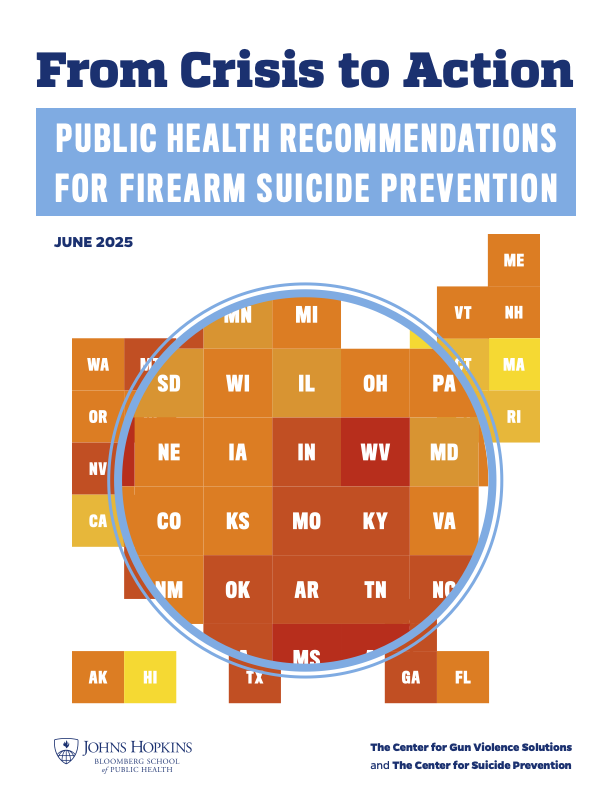
From Crisis to Action: Public Health Recommendations for Firearm Suicide Prevention

By Somayaji, N., Crifasi, C.K., Kim, R., Villarreal, S., Nestadt, P., Horwitz, J.

Suicide is a leading cause of death in the United States. In 2023, firearm suicide reached an all-time high in both the total number of deaths and overall rate. Approximately 27,300 individuals died by firearm suicide—averaging one death every 19 minutes.1 Over the last five years, over 50% of all deaths by suicide were due to a firearm.1 While firearms do not increase thoughts of suicide, prior research has shown that suicide attempts involving firearms are far more likely to result in death, with a fatality rate of 90% due to their high lethality.2 Furthermore, individuals who have access to guns have 3.2 times the risk of suicide.3,4 Although suicide is a complex issue, it is preventable.Temporarily removing firearms from individuals at increased risk of self-harm significantly reduces the risk of death. While people rarely substitute other suicide methods when firearms are not available, most alternative means are far less lethal, making survival more likely.2 Ninety percent of those who survive a suicide attempt do not die from suicide in the future.5 There are several frameworks that can be used to approach suicide prevention. A core framework in public health is the social ecological model. This framework was developed to illustrate the influence of individual and environmental factors on health and well-being. The evidence-based examples of firearm suicide prevention interventions that are proposed here involve action and intervention across multiple levels (individual, relationship, community, and society) to address the urgent issue of firearm suicide.