
Open Access Publisher and Free Library
TERRORISM.jpeg

TERRORISM

Terrorism-Domestic-International-Radicalization-War-Weapons-Trafficking-Crime-Mass Shootings

Posts in Social Sciences
U.S. Gun Violence in 2021: An Accounting of a Public Health Crisis

By Ari Davis, Rose Kim, Cassandra Crifasi

Gun violence is an ongoing public health crisis in the United States that impacts the health and wellbeing of all of us. In 2020, during the first year of the COVID-19 pandemic, the U.S. experienced an unprecedented spike in gun homicides. Many believed that this spike would be short-lived; levels of gun violence would subside as institutions effectively responded to the pandemic and people returned to their daily routines. This, unfortunately, was not the case. In 2021, for the second straight year, gun deaths reached the highest number ever recorded. Nearly 49,000 people died from gun violence in the U.S. in 2021. Each day, an average of 134 people died from gun violence—one death every 11 minutes. Gun homicides continued to rise in 2021, increasing 7.6% over the previous year. Gun suicides reached record levels, increasing 8.3%, the largest one-year increase recorded in over four decades. Guns, once again, were the leading cause of death among children and teens in 2021 accounting for more deaths than COVID-19, car crashes, or cancers. Coincident with the rise in gun-related deaths were record gun sales. Millions of first-time purchasers, including Black and Hispanic/Latino people, and women of all races and ethnicities, bought guns during the pandemic at unprecedented levels. Many of these purchasers were motivated by gun industry marketing claims that guns make you safer. Yet, this is far from the truth; gun ownership greatly increases the risk of dying by suicide and homicide. While it is too early to tell whether this surge in gun purchases contributed directly to the rise in gun violence the country is experiencing, we know that over the long run this influx of guns will only exacerbate the public health crisis of gun violence and worsen health disparities

Baltimore, MD: Johns Hopkins Center for Gun Violence Solutions. Johns Hopkins Bloomberg School of Public Health 2023. 45p.
download
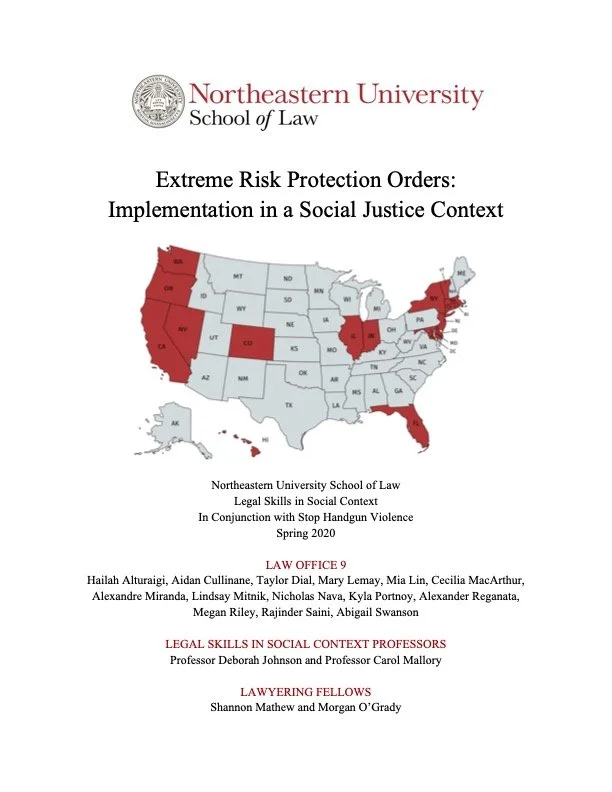
Extreme Risk Protection Orders: Implementation in a Social Justice Context

By Northeastern University, School of Law, Legal Skills in Social Context In Conjunction with Stop Handgun Violence

Extreme Risk Protection Orders (ERPOs) are civil orders that allow law enforcement to temporarily remove firearms and ammunition from persons who pose a danger to themselves or others. ERPOs address the critical problem posed when individuals are at risk of harming themselves or others with firearms but have not yet committed an action that warrants law enforcement’s involvement. ERPOs are a relatively new legislative tool, with only seventeen states and the District of Columbia having ERPO laws, the majority of which were adopted in 2018. Given that ERPO legislation is relatively new in the majority of jurisdictions, states are still in the process of implementing and developing law enforcement and court protocols to enforce ERPOs. Additionally, there is limited information available about ERPO effectiveness in implementation. This paper collects existing information about ERPO implementation across jurisdictions and uses comparative analysis with the broader gun control landscape to draw inferences about potential legal challenges to ERPOs and social justice implications of the laws. Other resources exist that provide information about ERPOs; however, this paper poses a novel approach in that it is grounded in a social justice lens with the principle that ERPO laws must not only be evaluated in terms of technical execution, but must also be examined closely for potential disparities in utilization and enforcement…

Boston: Northeastern University, 2020. 125p.

download
Gun violence restraining orders in California, 2016–2018: case details and respondent mortality

Veronica A Pear, Rocco Pallin, Julia P Schleimer, Elizabeth Tomsich, Nicole Kravitz-Wirtz, Aaron B Shev, Christopher E Knoepke, and Garen J Wintemute

Background Gun violence restraining orders (GVROs), implemented in California in 2016, temporarily prohibit individuals at high risk of violence from purchasing or possessing firearms and ammunition. We sought to describe the circumstances giving rise to GVROs issued 2016–2018, provide details about the GVRO process and quantify mortality outcomes for individuals subject to these orders (‘respondents’). Methods For this cross-sectional description of GVRO respondents, 2016–2018, we abstracted case details from court files and used LexisNexis to link respondents to mortality data through August 2020.

Results We abstracted information for 201 respondents with accessible court records. Respondents were mostly white (61.2%) and men (93.5%). Fifty-four per cent of cases involved potential harm to others alone, 15.3% involved potential harm to self alone and 25.2% involved both. Mass shooting threats occurred in 28.7% of cases. Ninety-six and one half percent of petitioners were law enforcement officers and one-in-three cases resulted in arrest on order service. One-year orders after a hearing (following 21-day emergency/temporary orders) were issued in 53.5% of cases. Most (84.2%) respondents owned at least one firearm, and firearms were removed in 55.9% of cases. Of the 379 respondents matched by LexisNexis, 7 (1.8%) died after the GVRO was issued: one from a self-inflicted firearm injury that was itself the reason for the GVRO and the others from causes unrelated to violence.

Injury Prevention, 2022.

download
Examining risky firearm behaviors among high-risk gun carriers in New York City

By Rod K. Brunson , Brian A. Wade , Brooklynn K. Hitchens

Precarious firearm conduct among inexperienced gun possessors has the potential to intensify firearm-related fatalities and injuries. The current study involves face-to-face interviews with 51 high-risk (and prohibited) residents of Brooklyn and the Bronx, NY, each of whom have either been shot or shot at. We analyze study participants’ lived experiences regarding urban gun violence (including as victims and perpetrators), firearm handling, sharing, and improper storage. Despite claiming to be knowledgeable about firearm fundamentals, the vast majority of respondents acknowledged never having received professional instruction, but rather “figured it out” by “playing around” with available guns. These informal methods were shaped by respondents’ desire to arm themselves despite inadequate access to firearm training. Study participants also described routinely stashing firearms in unsecure, easily accessible locations. Our study findings have important implications for informing community-based harm reduction and safety strategies among persons within high-risk networks.

Preventive Medicine, Volume 165, Part A, December 2022

download
Underground Gun Markets and the Flow of Illegal Guns into the Bronx and Brooklyn: A Mixed Methods Analysis

By Anthony A Braga , Rod K Brunson , Philip J Cook , Brandon Turchan , Brian Wade

New York City (NYC) has experienced large reductions in violent crime over the last two decades, but gun-related violence continues to pose a threat to public safety. Despite strong gun laws, high-risk individuals in NYC neighborhoods are unfortunately still able to access and misuse firearms. This research analyzes NYC's underground gun market by closely examining the flow of guns into the two boroughs where gun violence and crime gun recoveries are most prevalent: the Bronx and Brooklyn. A mixed methods approach is utilized that consists of an assessment of firearms trace data and in-depth interviews with individuals considered to be at high risk for involvement in gun violence. Findings suggest that guns recovered in the Bronx and Brooklyn were significantly more likely to originate in states with less restrictive gun laws and more likely to have changed ownership in unregulated transactions relative to guns recovered elsewhere in NYC. Interviews revealed three primary avenues for illegal guns reaching Bronx and Brooklyn neighborhoods: high-volume gun brokers, middlemen, and individuals who make episodic low-level acquisitions from straw purchasers in other states. No subjects identified theft as a meaningful source of crime guns.

J Urban Health (2021) 98:596–608

download
The Colombo-Venezuelan Guerrillas: How Colombia’s War Migrated to Venezuela

By Unidad de investigación de Venezuela

For twenty years, Venezuela was a refuge for Colombia’s Marxist guerrillas, a place where they could hide out from the military, run criminal economies, and carry out political work with impunity thanks to their friendly relationship with the government of President Hugo Chávez. But today, it is so much more. Guerrillas such as the ELN have spread deep into Venezuelan territory, they are filling their ranks with recruits, taking control of communities, and interfering in politics. Today, they are binational guerrilla groups. The product of five years of fieldwork along the Colombia-Venezuela border and beyond, this investigation reveals the Venezuelan operations of Colombia’s guerrillas and explores the far-reaching implications for both countries of their evolution into Colombo-Venezuelan groups.

Washington, DC: Insight Crime, 2022. 53p.

download
Guns, Incels, and Algorithms: Where We Are on Managing Terrorist and Violent Extremist Content Online

Armstrong-Scott, Gabrielle L.; Waldo, Jim

From the document: "Ten years ago, U.S. national security agencies grew concerned about a relatively new and powerful weapon used by terrorists: the World Wide Web. What had begun as an effort to connect end users from across the world to share information and to serve as a force of human liberation, instead began to be used as a tool for destruction of life. Terrorists were exploiting technology companies' lax content moderation policies to recruit new members, spread violent extremist ideology, and plan terrorist attacks. [...] Technology companies and governments have spent the past decade trying to better address the evolving threat of terrorist and violent extremist content online (TVEC). However, there are few studies examining just how effective these efforts have been, where we are today in managing the problem, and wherein lie gaps for improvement. This paper argues that companies' efforts to deal with TVEC have been hampered at the outset by a tendency to define TVEC extremely narrowly. [...] This paper also explores the idea of ethical obligations and norms as an alternative to a legally required definition. On the technical side, this paper finds that even if there was consensus on the legal and ethical questions surrounding TVEC, the technical tools currently available are no panacea. Trade-offs across efficiency, scalability, accuracy, and resilience are persistent. Current technical tools tend to disadvantage minority groups and non-English languages. They are also less robustly implemented across small and non-U.S./European firms, generally either because they are left out of inter-firm initiatives or because they lack resources and capability. This paper does not claim to cover every issue relevant to TVEC; however, it highlights several important gaps that could be addressed by policymakers and tech companies and identifies avenues for future research."

Belfer Center For Science And International Affairs. 2023.

download
Learning from Foes: How Racially and Ethnically Motivated Violent Extremists Embrace and Mimic Islamic State's Use of Emerging Technologies

By Yannick Veilleux-Lepage, Chelsea Daymon and Emil Archambault

  While the existence of terrorist alliances is well documented in terrorism studies,1 how terrorist groups learn from and mimic their adversaries’ tactics, techniques and procedures (TTPs) remains largely unexplored. Building on existing terrorist innovation literature, this report introduces a framework to understand what factors can propel or hinder a terrorist group’s adoption of new TTPs. Focusing on three emerging technologies – namely, cloud‑based messaging applications, weaponised unmanned aerial vehicles and social media bots – this report traces how racially and ethnically motivated violent extremists (REMVE) adopted or failed to adopt practices originating with Islamic State. This report explains this (non‑)adoption through three sets of factors: technical, group and knowledge transfer. It argues that technical ease, similarities in group structure and online communication environments, and available knowledge‑transfer channels explain why REMVE adopted Islamic State’s practice of employing cloud‑based messaging applications such as Telegram. Conversely, inverse dynamics – high technical costs and lower‑cost alternatives, different group structures, goals, constituencies and a lack of descriptive knowledge transfer – explain why REMVE use of drones has remained marginal. Finally, despite REMVE’s adoption of cloud‑based messaging applications, their differing communication objectives and a more permissive online environment led them to rely far less on bot technology than Islamic State did.  

London:  The Global Network on Extremism and Technology (GNET) 2022. 35p.

download
The Role of Violent Conspiratorial Narratives in Violent and Non-Violent Extreme Right Manifestos Online, 2015-2020

By William Allchorn, Andreas Dafnos and Francesca Gentile

  Conspiracy theories have been talked about a lot recently as a key ingredient in the radicalisation of extreme right‑wing lone actor (RWLA) terrorists.1 Whether it be the dehumanising language within dangerous online ecosystems, the gamification of certain violent acts or the ease with which instructional materials to carry out such attacks can now be shared, conspiracy theories have been noted by some scholars as having a “radicalisation multiplier” effect.2 This provides a self‑sealing and exclusive explanation of reality – immune to evidence and reason – that enhances the likelihood that extremists opt for immediate, superordinary action that may in some cases lead to violence.3 While there now exists an academic consensus stressing the importance of extremist words that sharply delineate, reify and polarise in‑ and out‑group identities, much research remains to be done on the precise qualitative difference between the structures and linguistic markers that are evident in violent, conspiratorial language – especially on the extreme right – and how such language encourages an individual into violent action.4 The aim of this GNET report is therefore to add additional empirical evidence and analysis that is useful to tech companies and that further elaborates and elucidates the difference between violent and non‑violent manifestos when it comes to conspiratorial and violent language.

London: The Global Network on Extremism and Technology (GNET), 2022 , 47p.

download
Mental disorder, psychological problems and terrorist behaviour: A systematic review and meta-analysis

Kiran M. Sarma Sarah L. Carthy Katie M. Cox

The link between mental health difficulties and terrorist behaviour has been the subject of debate for the last 50 years. Studies that report prevalence rates of mental health difficulties in terrorist samples or compare rates for those involved and not involved in terrorism, can inform this debate and the work of those responsible for countering violent extremism. To synthesise the prevalence rates of mental health difficulties in terrorist samples (Objective 1—Prevalence) and prevalence of mental health disorders pre-dating involvement in terrorism (Objective 2—Temporality). The review also synthesises the extent to which mental health difficulties are associated with terrorist involvement compared to non-terrorist samples (Objective 3—Risk Factor).

Campbell Systematic Reviews, 2022.

download
What Are the Effects of Different Elements of Media on Radicalization Outcomes? A Systematic Review

By Michael WolfowiczBadi HasisiDavid Weisburd

Most national counter-radicalization strategies identify the media, and particularly the Internet as key sources of risk for radicalization. However, the magnitude of the relationships between different types of media usage and radicalization remains unknown. Additionally, whether Internet-related risk factors do indeed have greater impacts than other forms of media remain another unknown. Overall, despite extensive research of media effects in criminology, the relationship between media and radicalization has not been systematically investigated. This systematic review and meta-analysis sought to (1) identify and synthesize the effects of different media-related risk factors at the individual level, (2) identify the relative magnitudes of the effect sizes for the different risk factors, and (3) compare the effects between outcomes of cognitive and behavioral radicalization. The review also sought to examine sources of heterogeneity between different radicalizing ideologies.

. ampbell Systematic Reviews, Volume18, Issue2. June 2022. e1244

download
Preferences for Firearms and Their Implications for Regulation

Sarah MosharyBradley Shapiro & Sara Drango

This paper estimates consumer demand for firearms with the aim of predicting the likely impacts of firearm regulations on the number and types of guns in circulation. We first conduct a stated-choice-based conjoint analysis and estimate an individual-level demand model for firearms. We validate our estimates using aggregate moments from observational data. Next, we use our estimates to simulate changes in the number and types of guns in circulation under alternative regulations. Importantly, we find that bans or restrictions that specifically target “assault weapons” increase demand for handguns, which are associated with the vast majority of firearm-related violence. We provide distributions of consumer surplus under counterfactuals and discuss how those distributions could be useful for crafting policy.

Cambridge, MA: National Bureau of Economic Research (NBER), 2023. 

download
Using National Instant Criminal Background Check Data for Gun Policy Analysis A Discussion of Available Data and Their Limitations

by Sierra SmuckerMax GriswoldAmanda CharbonneauRose KerberTerry L. SchellAndrew R. Morral

Among researchers, policymakers, and advocates, momentum is growing to better understand the impact of firearm laws on a variety of outcomes (e.g., suicide, crime, defensive gun use, homicide). There is also a growing interest in data that can shed light on these relationships. One source of these data is the National Instant Criminal Background Check System (NICS). This system includes information used in background checks, the number and type of background checks processed, and details on the number of and reason for denials when NICS finds that an individual is prohibited from purchasing a firearm. In this tool, researchers provide detailed information about data associated with NICS and discuss the data's strengths and weaknesses for various gun policy evaluation objectives. The researchers also outline the substantial limitations to interpreting these data to assist researchers in this field. Finally, they provide these data to researchers to encourage further exploration and evaluation of how NICS data might be used for policy analysis.

Santa Monica, CA: RAND, 2022. 65p.

download
Impulse Purchases, Gun Ownership and Homicides: Evidence from a Firearm Demand Shock

By Christoph Koenig and David Schindler 

  Do firearm purchase delay laws reduce aggregate homicide levels? Using variation from a 6-month countrywide gun demand shock in 2012/2013, we show that U.S. states with legislation preventing immediate handgun purchases experienced smaller increases in handgun sales. Our findings indicate that this is likely driven by comparatively lower purchases among impulsive consumers. We then demonstrate that states with purchase delays also witnessed comparatively 2% lower homicide rates during the same period. Further evidence shows that lower handgun sales coincided primarily with fewer impulsive assaults and points towards reduced acts of domestic violence.   

Discussion Paper 20 / 730  

Bristol, UK: Bristol University, School of Economics, 2020. 70p.

download
ccess to Guns in the Heat of the Moment: More Restrictive Gun Laws Mitigate the Effect of Temperature on Violence

By Jonathan Colmer, Jennifer Doleac:

Gun violence is a major problem in the United States, and extensive prior work has shown that higher temperatures increase violent behavior. In this paper, we consider whether restricting the concealed carry of firearms mitigates or exacerbates the effect of temperature on violence. We use two identification strategies that exploit daily variation in temperature and variation in gun control policies between and within states. Our findings suggest that more prohibitive concealed carry laws attenuate the temperature–homicide relationship. Additional results suggest that restrictions primarily decrease the lethality of temperature–driven violent crimes, rather than their overall occurrence, but may be less effective at reducing access to guns in more urban areas.

 Bonn: IZA – Institute of Labor Economics, 2023. 67p,  

download
Regulating Guns as Products

Benjamin L. Cavataro

This article argues that the status quo is unacceptable, and proposes a clear, workable solution. Congress should empower the Commission to regulate the safety of guns as products, without granting the Commission authority over "gun control" as traditionally understood. This approach resolves the inadequacies of industry self-regulation, tort, and state consumer law; appropriately leverages the existing Consumer Product Safety Act framework; and is consistent with the Commission’s longstanding oversight of holsters, gun locks, and gun safes. Under this approach, the firearms industry would be obligated to report safety defects, recall dangerously defective firearms, and offer remedies to consumers. The Commission could also consider adopting common-sense product safety standards (such as regulations to ensure that new firearms have functional safety devices, and do not discharge without a trigger pull), just as the Commission adopts safety standards for many other consumer products. But the Commission would be precluded from regulating guns to curtail gun violence or suicide, or to reduce guns’ prevalence.

This approach is fully compatible with the Second Amendment in light of New York State Rifle and Pistol Association v. Bruen (2022). And lifting the firearms industry’s immunity from product safety law—thereby regulating guns as products—has helpful implications for broader debates on gun law and policy. By establishing that Commission regulation could simultaneously protect the public from harm and facilitate the right to lawful self-defense, this Article’s proposal demonstrates that some gun regulations can concurrently respect gun rights, uphold consumers’ rights, and protect lives—and, in doing so, reveals fissures between the interests of the gun industry and gun owners.

 Forthcoming in George Washington Law Review, Vol. 92 (2024),

download
Status of ISWAP and ISGS in West Africa and Sahel

By Pieter Van Ostaeyen | Kwesi Aning  

Since the initial rise in violent extremist and terrorist groups in the Sahel in the mid-2000s, the number of such groups in the region has continued to grow. This is reflected in the nature of the opportunistic alliances that have developed among different groups, with varying interests and memberships. Furthermore, these groups have changed their operational tactics over time and, since 2019, began a gradual expansion of their activities towards the littoral states of West Africa. This paper focuses on two of the most important extremist groups in the Sahel: Islamic State in West Africa Province (ISWAP) and Islamic State in Greater Sahel (ISGS). In discussing the origins of both groups, this paper argues that their establishment was not borne out of religious rationales alone. Rather, ISWAP’s and ISGS’s formation and expansion were based on their fractured relationships with the organizations from which they split and to a certain extent transformed, as well as their pursuit for new allegiances and competition for preeminence in the leadership as they battled to expand and establish Islamic states in northern Nigeria, Cameroon, Chad, Niger, and the Sahel. Ideologically, this paper identifies the adoption of Takfiri doctrines as the driving force resulting in more draconian interpretation and implementation of Islamic laws implemented by the hisba relating to zakat, hudud, ta’zir, and qisas. This paper argues that factionalism and splits from the original organizations represent fundamental splits from their original members and that the alliances formed by these originally distinct groups constitute a fundamental split and shift in operational tactics. ISWAP and ISGS operations are characterized by opportunism and exploitation of local grievances that enables them to build specific narratives for support….

Berlin: Konrad-Adenauer-Stiftung e.V.. Counter Extremism Program, 2023. 20p.  

download
Europol (2023), European Union Terrorism Situation and Trend Report

By Europol

  Terrorism remains a significant threat to the internal security of the European Union. Terrorists operate across borders, leveraging new technologies and modi operandi to target innocent people. EU law enforcement authorities, in particular the counter-terrorism community, remain vigilant and united in countering the threat. The EU Terrorism Situation and Trend Report (TE-SAT) 2023 contributes to this effort, by presenting prevalent terrorism trends in the EU. Terrorism constitutes an attack on our society intending to create fear and chaos among EU citizens. In 2022, 16 terrorist attacks took place in the EU and an additional 12 attacks failed or were foiled. While the attacks directly affected seven Member States, more Member States arrested suspects in terrorism-related cases. Tragically, four people were killed in terrorist attacks in the EU, two resulting from jihadist attacks and two from a right-wing terrorist attack. We honour the memory of all those lost to terrorism in 2022 and in previous years.

  • Member States continue to view jihadist terrorism as the most prominent terrorist threat to the EU despite the fact that the number of jihadist attacks has decreased compared to 2021 and 2020. The threat from right-wing terrorist lone actors, radicalised online, remains significant. Left-wing and anarchist terrorists and violent extremists continue to pose a threat to public safety and security in the EU. Additionally, the spread of propaganda online and its potential for radicalisation remains a key concern. Social isolation and the lack of a solid support system remain key vulnerabilities which terrorists take advantage of in order to propagate their messages and to recruit new followers. This is particularly worrying with the increasing number of young people, including minors, exposed to online terrorist propaganda. Furthermore, the terrorist and violent extremist environment is becoming more decentralised and volatile. Diffuse actors connect and inspire one another, uniting behind grievances beyond ideology or group affiliation. This context is ripe for self-radicalisation and for lone actors to begin engaging in attack planning, and poses significant challenges for preventing and combating terrorism and violent extremism in the EU.   

  Publications Office of the European Union, Luxembourg, 2023. 94p. 

download
Responding to the Threat of Violent Extremism: Failing to Prevent

By Paul Thomas

How should we understand home-grown terrorism like the 7/7 London bombings? This is a classic monograph focusing on recent British attempts to 'prevent violent extremism', their problems and limitations, and what lessons this can offer for more effective policy approaches in future. Paul Thomas's extensive research suggests that the Prevent policy approaches, and the wider CONTEST counter-terrorism strategy, have been misguided and ineffective, further alienating British Muslim communities instead of supporting longer-term integration. He argues that new, cohesion-based approaches encouraging greater trust and integration across all communities represent the best defence against terrorism.

London: Bloomsbury Academic, 2021. 190p.

download
Gaming the System: How Extremists Exploit Gaming Sites and What Can Be Done to Counter Them

By Olaizola Rosenblat, Mariana; Barrett, Paul (Paul M.)

From the document: "This report draws on existing literature; fresh interviews with gamers, gaming company executives, and experts; and findings from a multinational survey of gamers conducted in January 2023. [...] A growing body of evidence shows that bad actors exploit basic features of video games and adjacent platforms to channel hate-based rhetoric, network with potential sympathizers, and mobilize for action--sometimes with deadly consequences. The relative ease with which extremists have been able to manipulate gaming spaces points to the need for urgent action by industry actors to avoid further harm. Although some gaming companies have made recent investments in content moderation technologies and systems, most companies are still far behind in terms of adequately governing and mitigating abuse of their platforms. This call to address extremist exploitation became more urgent in April 2023 in the wake of media reports that the large gaming-adjacent platform, Discord, had been used by a young U.S. air national guardsman for the reckless and allegedly illegal sharing of top-secret military documents, which then were spread to other online sites. [...] Yet another reason to pay attention to the ways gaming spaces have been misused is that the technologies that help make video games so appealing are poised to become far more common. [...] Heeding the popularity of gaming, these companies are pouring billions of dollars into the creation of a fully immersive 3-D [three-dimensional] Internet. Addressing the extremist exploitation of gaming spaces today will better prepare the industry to usher in new technologies while preventing harm to individuals and societies."

New York University. Stern Center for Business and Human Rights. 2023. 40p.

download