Open Access Free Library
CRIME+CRIMINOLOGY.jpeg

CRIME

Violent-Non-Violent-Cyber-Global-Organized-Environmental-Policing-Crime Prevention-Victimization

Posts in Crime Policy
LEGAL TECHNOLOGIES OF PRIMITIVE ACCUMULATION: Judicial Robbery and Dispossession-by-Restitution in Warsaw

Joanna Kusiak

Among the ‘extra-economic means’ that facilitate primitive accumulation, or accumulation by dispossession, the law plays a prominent role. But works on neoliberal urban restructuring rarely engage with concrete legal technologies. Analysing judicial property restitution (‘reprivatization’) in Warsaw, this article grasps the machine of accumulation by dispossession at a moment of faltering and exposes the distinctive legal technologies behind its troubleshooting. It makes three contributions to critical urban studies. First, it demonstrates how judicial systems can steal political conflicts that obstruct the cycle of accumulation by dispossession. It thus introduces the notion of ‘judicial robbery’, a non-legislated expropriation of common property through judicial engineering that simultaneously deprives the public of political agency. Second, it shows that seemingly neutral legal technicalities, usually sheltered from political debate, can become a key locus of urban politics. Third, it examines the agency, scope and spatial patterns of ‘dispossession by restitution’, the term I use for a locally specific form of accumulation by dispossession in Warsaw. Lastly, I raise the question of political struggle against primitive accumulation. Is the judicial robbery reversible? If we can reclaim property, can we also reclaim political conflicts that have been stolen by the law?

INTERNATIONAL JOURNAL OF URBAN AND REGIONAL RESEARCH DOI:10.1111/1468-2427.12827

Comparing spatial patterns of robbery: Evidence from a Western and an Eastern European city

Vaˆnia Ceccato * and Dietrich Oberwittler

In this paper, we test hypotheses about the spatial variation in rates of robbery in West and East European cities (Cologne, Germany and Tallinn, Estonia). This comparison represents an interesting case study because Tallinn is an example of former socialist cities which have undergone a period of profound political and socio-economic change since the country’s independence in the early 1990s (including EU membership). These changes are expected to have implications for the level and composition of offences as well as their geographies. Using cross-sectional datasets, we examine whether or not levels and patterns of robbery in Tallinn follow similar processes to the ones found in Cologne applying GIS (Geographical Information System) and spatial statistical techniques. Findings show that although levels of robberies (rates) are higher in Tallinn than in Cologne, their geography (ratios) follows the same overlapping components of social contexts, as social disorganization and, particularly, routine activities.

Ó 2008 Elsevier Ltd. All rights reserved.

An Overview of the Impact of Special Anti-Robbery Squad (SARS) in Nigeria

Ogbette, Afamefuna Samuel

This study examined the impact of Special Anti-Robbery Squad (SARS) in Nigeria. It solely depended on the secondary source for information. SARS is one of the Nigeria Police Force units that is saddled with the responsibility of fighting crime in the society; specifically, robbery and kidnapping. The impact was examined in two ways: Positive and Negative impact. From the positive point of view, SARS has been able to reduce robbery and kidnapping to an extent but unfortunately, people now use them as bodyguards to intimidate, suppress, and harass other people. From our findings, SARS tortures people mercilessly, extort, beat, kill and jail people who are not forthcoming with their demands

International Journal of Human Resource Studies ISSN 2162-3058 2018, Vol. 8, No. 4

Alcohol and Drug Use Among Robbery-Related Homicide Victims in Trinidad and Tobago

Rachel K. Pierce and Joseph B. Kuhns

This study explores the link between alcohol and drugs and robbery-based homicide victimization within the context of routine activities theory. Using 2001-2005 homicide and toxicology data from Trinidad and Tobago, the study considers the general context of robbery-related homicides by identifying common place, victim, offender, and time characteristics. Next, the study examines whether victims of robbery-based homicides were more or less likely to be using alcohol and/or drugs at the time of death than victims of domestic and “street” homicides. The results indicate that robbery-related homicide victims were less likely to test positive for alcohol or be intoxicated and were significantly less likely to test positive for marijuana and cocaine than victims of street homicides. Nevertheless, when considered within a broader context, Trinidad and Tobago robbery-based homicide victims test positive at higher rates for marijuana (13.6%), compared with homicide victims in other locations (6%). The results of this study suggest a firm link between victim substance use and homicide victimization in Trinidad and Tobago, which could help explain escalating violence levels in the country.

Criminal Justice Policy Review XX(X) 1–20.

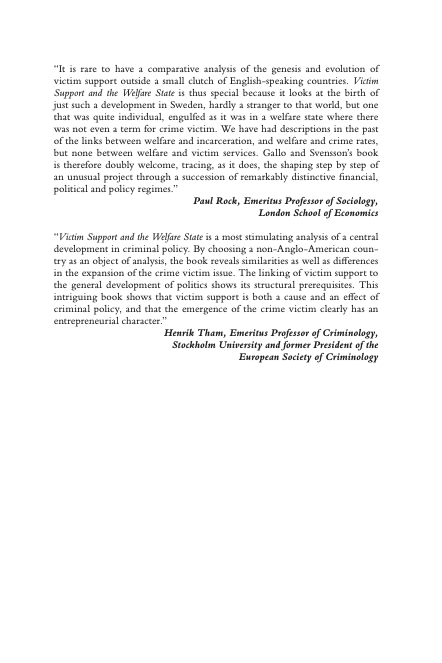
Victim Support and the Welfare State

By Carina Gallo, Kerstin Svensson

This book provides a rich analysis of the history of Swedish victim support. With the majority of research on victim support centering on the Anglosphere, this book offers a unique case study for considering the role of the victim in the criminal justice system. While Sweden has enacted many laws to support victims, and victim assistance programs have grown rapidly, welfare policy has become more restrictive and crime policy, to some degree, more punitive.