
Open Access Publisher and Free Library
CRIME+CRIMINOLOGY.jpeg

CRIME

Violent-Non-Violent-Cyber-Global-Organized-Environmental-Policing-Crime Prevention-Victimization

Posts tagged cybercrime and technology
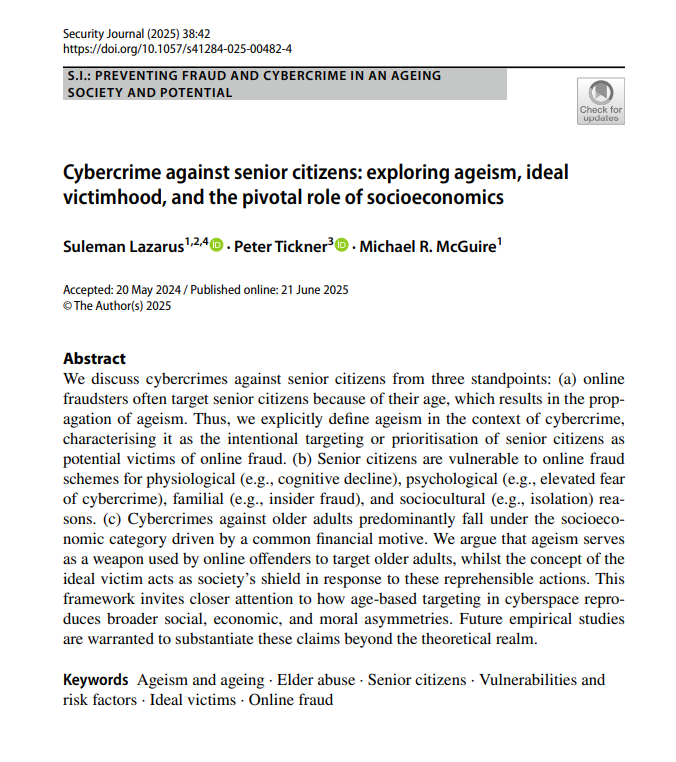
 Cybercrime against senior citizens: exploring ageism, ideal victimhood, and the pivotal role of socioeconomics

By Suleman Lazarus  · Peter Tickner  · Michael R. McGuire1

 We discuss cybercrimes against senior citizens from three standpoints: (a) online fraudsters often target senior citizens because of their age, which results in the propagation of ageism. Thus, we explicitly defne ageism in the context of cybercrime, characterising it as the intentional targeting or prioritisation of senior citizens as potential victims of online fraud. (b) Senior citizens are vulnerable to online fraud schemes for physiological (e.g., cognitive decline), psychological (e.g., elevated fear of cybercrime), familial (e.g., insider fraud), and sociocultural (e.g., isolation) reasons. (c) Cybercrimes against older adults predominantly fall under the socioeconomic category driven by a common fnancial motive. We argue that ageism serves as a weapon used by online offenders to target older adults, whilst the concept of the ideal victim acts as society’s shield in response to these reprehensible actions. This framework invites closer attention to how age-based targeting in cyberspace reproduces broader social, economic, and moral asymmetries.  Future empirical studies are warranted to substantiate these claims beyond the theoretical realm.

Security Journal (2025) 38:42 
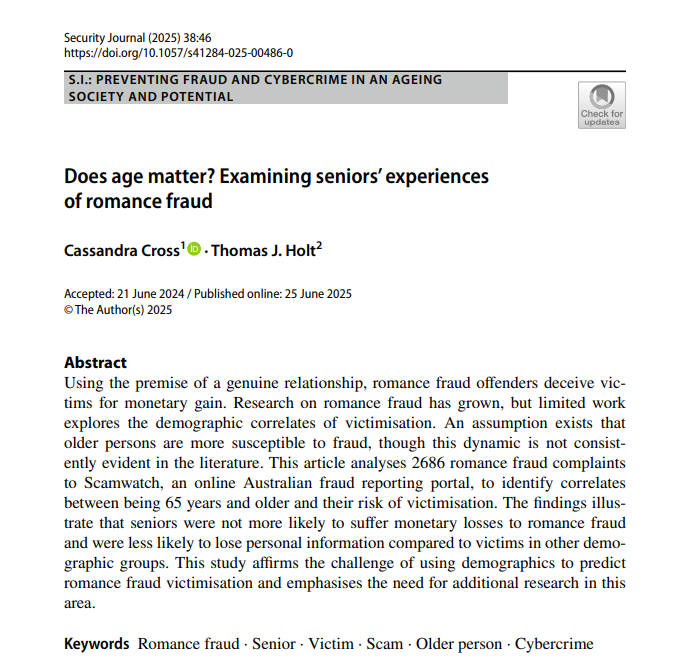

  Does age matter? Examining seniors’ experiences of romance fraud

By Cassandra Cross  · Thomas J. Holt 

Using the premise of a genuine relationship, romance fraud ofenders deceive victims for monetary gain. Research on romance fraud has grown, but limited work explores the demographic correlates of victimisation. An assumption exists that older persons are more susceptible to fraud, though this dynamic is not consistently evident in the literature. This article analyses 2686 romance fraud complaints to Scamwatch, an online Australian fraud reporting portal, to identify correlates between being 65 years and older and their risk of victimisation. The fndings illustrate that seniors were not more likely to sufer monetary losses to romance fraud and were less likely to lose personal information compared to victims in other demographic groups. This study afrms the challenge of using demographics to predict romance fraud victimisation and emphasises the need for additional research in this area 

  Security Journal (2025) 38:46

The Information Age: Transnational Organized Crime, Networks, and Illicit Markets

By John P. Sullivan

In his landmark trilogy, The Information Age: Economy, Society and Culture, sociologist Manuel Castells argued that networks, information technology, and global economic flows were altering the nature of politics, power, and states. This article examines the network dynamics Castells wrote about in relation to transnational crime and illicit economic markets. The article further explores Castells’s influence on the study of transnational organized crime, illicit networks, and the global illicit economy 

Journal of Strategic Security 16, no. 1 (2023) : 51-71