Open Access Publisher and Free Library
CRIME+CRIMINOLOGY.jpeg

CRIME

Violent-Non-Violent-Cyber-Global-Organized-Environmental-Policing-Crime Prevention-Victimization

Posts tagged elder abuse
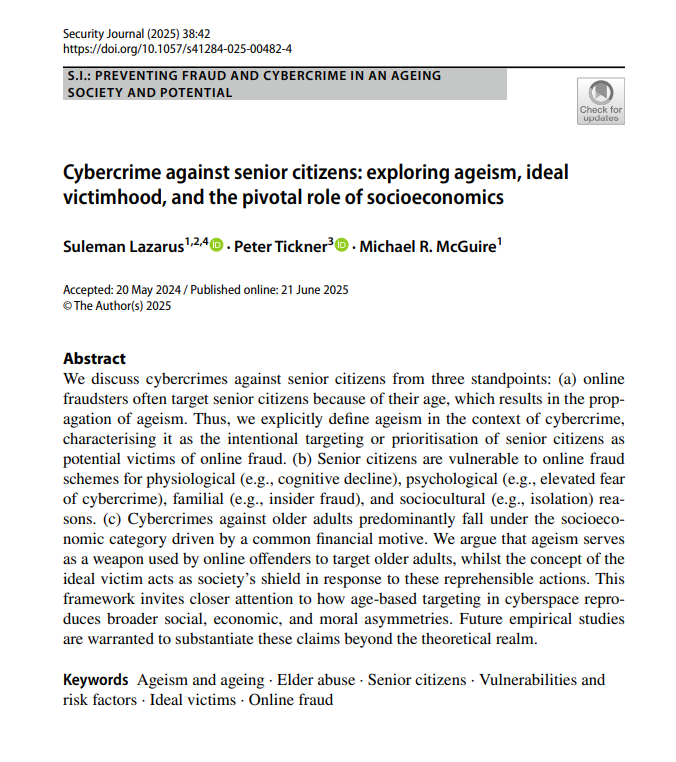
 Cybercrime against senior citizens: exploring ageism, ideal victimhood, and the pivotal role of socioeconomics

By Suleman Lazarus  · Peter Tickner  · Michael R. McGuire1

 We discuss cybercrimes against senior citizens from three standpoints: (a) online fraudsters often target senior citizens because of their age, which results in the propagation of ageism. Thus, we explicitly defne ageism in the context of cybercrime, characterising it as the intentional targeting or prioritisation of senior citizens as potential victims of online fraud. (b) Senior citizens are vulnerable to online fraud schemes for physiological (e.g., cognitive decline), psychological (e.g., elevated fear of cybercrime), familial (e.g., insider fraud), and sociocultural (e.g., isolation) reasons. (c) Cybercrimes against older adults predominantly fall under the socioeconomic category driven by a common fnancial motive. We argue that ageism serves as a weapon used by online offenders to target older adults, whilst the concept of the ideal victim acts as society’s shield in response to these reprehensible actions. This framework invites closer attention to how age-based targeting in cyberspace reproduces broader social, economic, and moral asymmetries.  Future empirical studies are warranted to substantiate these claims beyond the theoretical realm.

Security Journal (2025) 38:42 

Extended editorial: preventing fraud and cybercrime in an ageing society

By Mark Button  · Vasileios Karagiannopoulos  · Julak Lee  · Joon Bae Suh  · Jeyong Jung

Introduction The nature of crime has been changing globally with technological and other societal developments fuelling a growth in fraud and cybercrime (Button and Cross 2017). The diversity and rapid evolution of a broad range of scams has led to millions across the globe becoming victims of fraud (Federal Trade Commission 2019; ONS 2023a, 2023b). A common belief often promoted in policy circles and some research is that older adults are more vulnerable to fraud (James et al. 2014). This is not so clear cut, however, as in terms of victimisation, the middle aged have been most at risk (see Fig. 1 later). This is changing and there is evidence older adults (65+) are fast becoming the one of the most at risk categories and that they also tend to lose much more than other age groups (see Table 1 later). Indeed, there are a variety of trends fuelling a potential explosion in fraud and cybercrime among older adults unless serious action is taken to reduce the risks that we will shortly explore. It is for this reason we conceived this special edition and the research project that underpins it. To set the context for this edition, it is important to examine the factors fuelling the growth in fraud and cybercrime victimisation among older age groups. We will do this using data from the UK and South Korea. The reason for the selection of these countries is simple. The funding for the project stimulating this edition came from ESRC funding aimed at developing relationships with these two countries 

  Security Journal (2025) 38:40

Evaluability Assessment and Evaluation Options for an Elder Abuse Shelter Model

By Sierra Smucker, Jirka Taylor, Ivy Todd, Emily Hoch, Monique Martineau, Deven Clark, Meagan E. Cahill, Esther M. Friedman

s the number of older adults in the United States increases, there will be a corresponding increase in the need for services to prevent elder abuse and intervene in cases where it has already occurred. However, there are a limited number of evidence-based interventions to support victims of elder abuse. To encourage the rigorous evaluation of one intervention—Elder Abuse Shelters (EASs)—RAND researchers developed three research designs and assessed the preparedness of the well-established Weinberg Center's EAS in New York to undertake them. Researchers found that the Weinberg Center's EAS is well established, and the program model was organizationally and programmatically ready to be evaluated, though data collection practices should be strengthened before implementing the suggested evaluation designs. These evaluation designs could be generalized and implemented at EASs across the country as the number of shelters continues to grow.

Key Findings

The Weinberg Center's client numbers have fluctuated over time but are typically between 16 and 34 per year. Clients mostly identify as women, are ethnically and racially diverse, and are from the New York City area. Many clients have cognitive impairment and limited financial resources.

The COVID-19 pandemic corresponded with a decrease in the number of clients by decreasing potential clients' desire to stay in long-term care facilities and increasing turnover in referring agencies.

The Weinberg Center has a clear program logic model that connects inputs and outputs with measurable short- and long-term outcomes.

Organizationally and programmatically, the Center is ready to embark on an evaluation, with scores of 77 and 84 percent, respectively, in those areas of the evaluability assessment.

However, a low score for evaluation readiness of 43 percent, driven largely by currently insufficient data collection processes, indicates that the Center would need to strengthen its data collection capacity to complete a rigorous evaluation.

Three evaluation designs could help the Weinberg Center's EAS and other EAS models rigorously evaluate its impact: (1) a quasi-experimental design using non-random self-selection into the program, (2) a propensity score matching design that pairs clients with Adult Protective Services, and (3) a robust pre- and post-evaluation design.

When conducting an evaluation of an EAS, researchers must consider equity, data safety, and consent. The experience of elder abuse and the tools needed to help someone heal will differ across individuals depending on their background and cultural expectations.

Recommendation

Because the Weinberg Center is largely ready to embark on an evaluation, its leadership should review the proposed designs and consult with partners and potential evaluation teams as needed to decide how to proceed. Federal and state partners interested in protecting victims of elder abuse should consider funding one of these evaluation designs to determine whether EASs should be supported and encouraged to proliferate as the population ages.

Santa Monica, CA: RAND, 2023, 77p.

Pathways to Safety: An Examination of Federal and State-Level Barriers and Facilitators to Elder Abuse Reporting and Response

By Kristin Lees Haggerty; Olanike Ojelabi; Randi Campetti; Kathy Greelee

The authors of this paper report on a research project aimed at addressing unreported cases of elder abuse, and specifically exploring what guidance policy and decision-makers need in order to address barriers to reporting. Specifically, the authors’ research sought to improve understanding of elder abuse reporting pathways, facilitators, barriers, and outcomes. Over the course of their research, the authors report achieving three main objectives: conducting an environmental scan of policies and practices across states; conducting an in-depth case study of policy changes made in the state of Massachusetts; and developing recommendations for improving communication between Adult Protective Services (APS) and reporters based on findings from the first two objectives. The project was guided by two main research questions: what the legal, ethical, and practical barriers and facilitators are to establishing feedback loops about reported cases of potential elder abuse; and how regulations are interpreted and put into practice at the state and local levels in Massachusetts. The authors discuss their research design, methods, and analytical data analysis techniques, expected applicability of the research, limitations, outcomes, and recommendations.

Waltham, MA: Education Development Center, 2023. 67p.

Perspectives on Elder Abuse in the Netherlands

By Yuliya Mysyuk

This thesis explores perceptions and views of different groups involved in elder abuse. First chapter provides a general introduction to the topic and current study. In the second chapter of this thesis, definitions of elder abuse and their developments are reviewed. Chapter three explores different perspectives on the etiology of violence in later life. Chapter four discusses older persons’ definitions of and explanations for elder abuse. Chapter five explores older victims’ ideas about the causes and effects of abuse, the ways of coping with abuse and how they currently feel about it. In the sixth chapter, the framing of elder abuse as a social and a health problem is addressed, with attention to the factors that influence societal context and the health care system. Chapter seven raises the debate about the distinction of system abuse as a separate form of elder abuse. Finally, key findings of this thesis on perspectives on elder abuse are summarized in chapter eight of this thesis.

Leiden, Netherlands: Leiden University, 2015. 169p.