
Open Access Publisher and Free Library
CRIME+CRIMINOLOGY.jpeg

CRIME

Violent-Non-Violent-Cyber-Global-Organized-Environmental-Policing-Crime Prevention-Victimization

Posts tagged legal interpretation
Understanding variation in juvenile life without parole legislation following Miller

By Leah Ouellet, Daphne M. Brydon, Laura S. Abrams, Jeffrey T. Ward, Dylan B. Jackson, Rebecca Turner, J. Z. Bennett, Reese Howard, Ashley Xu
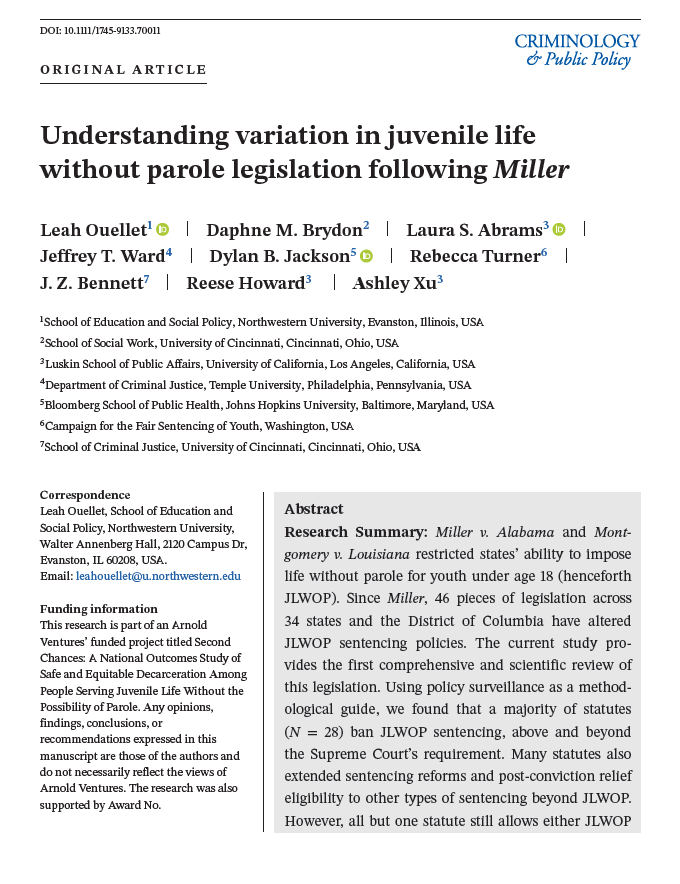


Miller v. Alabama and Montgomery v. Louisiana restricted states’ ability to impose life without parole for youth under age 18 (henceforth JLWOP). Since Miller, 46 pieces of legislation across 34 states and the District of Columbia have altered JLWOP sentencing policies. The current study provides the first comprehensive and scientific review of this legislation. Using policy surveillance as a methodological guide, we found that a majority of statutes (N = 28) ban JLWOP sentencing, above and beyond the Supreme Court's requirement. Many statutes also extended sentencing reforms and post-conviction relief eligibility to other types of sentencing beyond JLWOP. However, all but one statute still allows either JLWOP or life with parole as a sentencing option for minors convicted of homicide crimes and requires between 15 and 40 years, at minimum, to be served before being eligible for release. Grounding our analysis in institutional theory, we argue that the relative punitivity of the JLWOP reforms enacted was associated with measures of JLWOP institutionalization across states (i.e., pre-Miller JLWOP population and pre-Miller sentencing schema), suggesting that states where JLWOP was more routinely used were more resistant to policy reform.

Policy Implications

The current study provides implications for future decarceration efforts. Findings suggest that state legislatures are willing to enact post-conviction relief measures (e.g., judicial review or “second look” measures) for individuals convicted of violent crimes to address over-incarceration, deviating from previous decarceration efforts focused on non-violent, low-level offenses. In spite of the promising window for juvenile justice reform that Miller provided, however, these reforms have taken a relatively modest, incremental approach toward altering extreme youth sentencing practices in the United States. Policy makers and advocates seeking to promote sentencing reform efforts should factor in how highly institutionalized a sentencing practice is in each state, as this might inform effective strategies for policy change.

Divergent Interpretations of Child Abuse in Legal Judgments: Perspectives from Clinicians and Forensic Experts

By Ching-Min Tang, Chen-Fang Lou, Shao-Hsuan Hsia, Kuang-Tsung Liang, Wen Chang, Jainn-Jim Lin, Oi-Wa Chan, Kuang-Lin Lin & En-Pei Lee

Background: Child abuse in Taiwan is a major societal concern that severely affects the well-being of children. Despite the complexity in detecting abuse, reports of child abuse are increasing, evidenced by a rise in cases and heightened awareness. This study utilizes judicial judgments as a lens to understand the varied interpretations of child abuse by clinical and forensic experts and explores the broader epidemiological trends of such abuse within the declining youth population of Taiwan.

Methods: We conducted a retrospective study by analyzing official court judgments on child abuse allegations judged from 2008 to 2022 from the online database of Judicial Yuan. Furthermore, the study analyzed demographic factors, injury patterns, and opinions from various experts.

Results: The results reveal that severe criminal cases of child abuse predominantly involve biological fathers as the primary offenders and physical abuse as the most common form of maltreatment. Victims are typically aged less than 5 years, which frequently leads to an unfavorable prognosis. Analysis also highlights the TEN-4-FACESp acronym as a highly predictive indicator of child abuse and underscores the prevalence of abusive head trauma (AHT). Moreover, the findings emphasize ongoing disparities in opinions between forensic medical examiners and clinical physicians, especially in AHT cases, which potentially influences judicial decisions.

Conclusion: In summary, the study reveals ongoing disagreements between forensic medical examiners and clinical physicians, especially in cases of AHT, which may impact judicial decisions. Promoting consensus through interdisciplinary collaboration and improved communication can aid in revealing the truth in child abuse cases.

Archives of Public Health volume 82, Article number: 191, 2024, 8p.