Open Access Publisher and Free Library
CRIME+CRIMINOLOGY.jpeg

CRIME

Violent-Non-Violent-Cyber-Global-Organized-Environmental-Policing-Crime Prevention-Victimization

Posts in Justice Reform
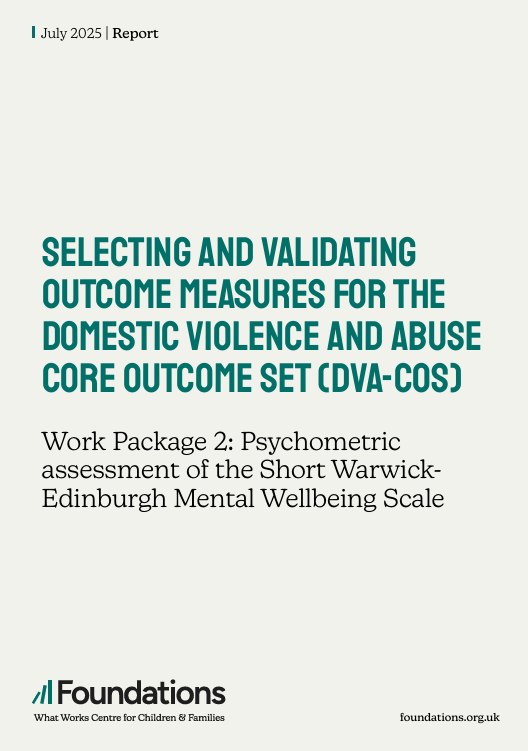
SELECTING AND VALIDATING OUTCOME MEASURES FOR THE DOMESTIC VIOLENCE AND ABUSE CORE OUTCOME SET (DVA-COS) 

By Jenna Harewell, Elizabeth Dunk Shivi Bains, Emma Howarth, Claire Powell, Lazaros Gonidis

  Background - The domestic abuse core outcome set (DVA-COS) is an agreed set of five outcomes intended for use in evaluations of interventions or services for children and families with experience of domestic violence and abuse (DVA, hereafter referred to as domestic abuse). A COS is a minimum standard for measurement in intervention studies, the purpose of which is to overcome heterogeneity in outcome selection and measurement. The aim of a COS is to maximise the value of a body of evidence by facilitating comparison between and synthesis across studies, thus reducing research wastage. Since the development of the DVA-COS, work has been undertaken to identify, select, and validate outcome measurement instruments (OMIs) to measure the core outcomes. The Warwick– Edinburgh Mental Wellbeing Scale (WEMWBS) was previously identified as acceptable by stakeholders to capture two outcomes: child and caregiver emotional health and wellbeing. This work seeks to extend those findings by validating the measure for use with domestic abuse experienced populations. Aims Foundations, the national What Works Centre for Children & Families, commissioned two work packages to develop and integrate previous work to outline and validate OMIs for use to assess outcomes comprising the DVA-COS. Work package 1 seeks to identify three OMIs, and this report focuses on work package 2, which aimed to validate the Short WEMWBS (SWEMWBS) for use with children and young people (aged 11 to 18) who have experienced domestic abuse. The studies that make up this work package used mixed methods to examine the acceptability, content validity, structural validity, internal consistency, and measurement invariance for the scale in children and young people experiencing domestic abuse. We also report a validation study of the WEMWBS for adults with experience of domestic abuse. Methods The above aims were addressed across four individual studies: two planned and two supplementary. First, a qualitative ‘think aloud’ study assessed the acceptability of the SWEMWBS with children and young people who had experienced domestic abuse. The remaining three studies were quantitative analyses of secondary data on using the SWEMWBS and WEMWBS with children and young people and adult samples. • Study A: a qualitative think aloud study that involved interviews and a focus group to gather feedback from children and young people with domestic abuse experience on use of the SWEMWBS. • Study B: examined cross-sectional data collected by the OxWell Student Survey to validate the SWEMWBS with children and young people affected by domestic abuse. • Study C: examined anonymised longitudinal service data to validate the SWEMWBS with children and young people affected by domestic abuse. • Study D: validated the WEMWBS with adults who have experienced domestic abuse using cross-sectional data from the Adult Psychiatric Morbidity Survey (APMS). Key findings Our findings demonstrate the validity and acceptability of the SWEMWBS and WEMWBS in domestic abuse-experienced child and adult populations respectively. Study A indicated that the SWEMWBS is broadly acceptable for use with children and young people, while raising important considerations regarding respondents’ interpretation of the measure’s items as well as the emotional impact of the measure on this population. Studies B and C demonstrated robust psychometric validity2 of the SWEMWBS with children and young people affected by domestic abuse, and Study D showed robust psychometric validity of the WEMWBS with adult victims of domestic abuse. These are significant findings given the limited number of measures that have been evaluated for use with this population across practice and research contexts. Moreover, this represents an important step forward in the implementation of the DVA-COS, which we hope will help to unify outcome measurement in domestic abuse research and evaluation, as well as service monitoring. Recommendations We recommend that the SWEMWBS and WEMWBS be used to measure wellbeing in the context of evaluation studies (of any quantitative design) seeking to assess the impact of child-focused domestic abuse interventions. To enhance the acceptability of the measure to children and adults we suggest minor adaptations for use in the domestic abuse context. Finally, we recommend the development of guidelines for practitioners and researchers about how to use the tools in a ‘carefirst’ way and how to guard against the tools being used for screening or triaging, or rationing care, as well as guidance for commissioners on how to interpret and use evidence, generated by the completion of the SWEMWBS and WEMWBS, for the basis of decision making. This guidance needs to reflect the balance between the benefits of data-driven decision making and the risk of unduly narrowing the breadth of services or thwarting innovation in the sector. The OMI’s implementation (including the use of guidance) should be closely monitored and evaluated, to inform any associated refinements and to develop an in-depth understanding of the process and outcomes associated with embedding routine measurement in practice. Further work is also required to identify an alternative OMI or adapt the SWEMWBS for appropriate use with children under the age of.   11.

Foundations UK: 2025. 106p.

Bridging the Immigration Detention Justice Gap

By Jaclyn Kelley-Widmer and  Alisa Whitfield

Immigrants held in United States detention centers experience a de facto denial of their right to access to counsel. The 38,000 immigrants detained each day are largely held in remote facilities, where they experience extremely poor—often abusive—conditions; the inability to contact counsel or prepare their cases; and a legal framework that is stacked against them. Many scholars have studied the overlapping challenges detained immigrants face in a hostile regime and have proposed solutions ranging from ending immigration prison to providing universal representation for all those detained to revising legal rationales for detention. These ideas are good ones. However, as we work towards such goals, tens of thousands remain detained with little recourse. As a partial way to bridge that gap, we argue for a transformative, collaborative model of access to justice that focuses on community empowerment and combines the work of organizers, attorneys, and law students in clinics.

 This article uniquely blends both theory and practical perspectives to advance a theory of abolition-minded provision of legal services in detention. First, we explore the legal right of access to counsel for detained immigrants, with an overview of Constitutional and international human rights models. We then examine the severe barriers to this counsel that immigration detention creates. We then use theories of abolition and legal pedagogy to explore an innovative and critical model for expanding justice in immigration detention. We propose primary goals of increasing access to counsel, empowering communities, and supporting organizing to work towards the end of immigration detention.

 This article was inspired by our experiences representing detained immigrants in a clinical setting, with law students, and in coalition with agencies and organizers working on the ground. Through examples, stories, and even photographs, we weave in insights from this ongoing collaborative project to advance a framework for bridging the immigration detention justice gap.

Cornell Legal Studies Research Paper 25-18, 2024


Urgent and long overdue: legal reform and drug decriminalisation in Canada

By Matthew Bonn, Chelsea Cox, Marilou Gagnon. et al.

The International Guidelines on Human Rights and Drug Policy recommend that States commit to adopting a balanced, integrated, and human rights-based approach to drug policy through a set of foundational human rights principles, obligations arising from human rights standards, and obligations arising from the human rights of particular groups. Following two years of consultation with stakeholders, including people who use drugs, NGOs, legal and human rights experts, UN technical agencies and Member States, the Guidelines “do not invent new rights. Rather, they apply existing human rights law to the legal and policy context of drug control to maximise human rights protections, including in the interpretation and implementation of the drug control conventions.” In respect of the Guidelines and its obligations under UN human rights treaties, Canada must adopt stronger and more specific commitments for a human rights-based, people centered and public health approach.3 This approach must commit to the removal of criminal penalties for simple possession and a comprehensive health-based approach to drug regulation.

Ottawa, ONT: Royal Society of Canada, 2024. 52p.

The End of Intuition-Based High-Crime Areas

By Ben Grunwald and Jeffrey Fagan

In 2000, the Supreme Court held in Illinois v. Wardlow that a suspect’s presence in a “high-crime area” is relevant in determining whether an officer has reasonable suspicion to conduct an investigative stop. Despite the importance of the decision, the Court provided no guidance about what that standard means, and over fifteen years later, we still have no idea how police officers understand and apply it in practice. This Article conducts the first empirical analysis of Wardlow by examining data on over two million investigative stops conducted by the New York Police Department from 2007 to 2012. Our results suggest that Wardlow may have been wrongly decided. Specifically, we find evidence that officers often assess whether areas are high crime using a very broad geographic lens; that they call almost every block in the city high crime; that their assessments of whether an area is high crime are nearly uncorrelated with actual crime rates; that the suspect’s race predicts whether an officer calls an area high crime as well as the actual crime rate; that the racial composition of the area and the identity of the officer are stronger predictors of whether an officer calls an area high crime than the crime rate itself; and that stops are less or as likely to result in the detection of contraband when an officer invokes high-crime area as a basis of a stop. We conclude with several policy proposals for courts, police departments, and scholars to help address these problems in the doctrine.

California Law Review 345-404 (2019

Risk-Need-Responsivity: Response Recommendations for Community Courts

by Lindsey Price Jackson

This guide on Risk-Need-Responsivity: Response Recommendations for Community Courts provides best practices for court practitioners in alignment with evidence-based RNR findings, including advice on incentives and sanctions and a response matrix template.

Also included with this publication is the Center for Justice Innovation's free, non-proprietary RNR tool, the Criminal Court Assessment Tool (CCAT), available in both English and Spanish. Use of an RNR tool is often legislated for community justice programs or required by grant funding. The CCAT is available as an option for use in court-based programs in alignment with local requirements. Please contact the Center for a short, free training before using the CCAT. We also strongly recommend locally validating the tool on your jurisdiction’s population before implementing.

New York: Center for Justice Innovation. 2024, 16pg