
Open Access Publisher and Free Library
CRIME+CRIMINOLOGY.jpeg

CRIME

Violent-Non-Violent-Cyber-Global-Organized-Environmental-Policing-Crime Prevention-Victimization

Posts tagged crime response
Understanding variation in juvenile life without parole legislation following Miller

By Leah Ouellet, Daphne M. Brydon, Laura S. Abrams, Jeffrey T. Ward, Dylan B. Jackson, Rebecca Turner, J. Z. Bennett, Reese Howard, Ashley Xu
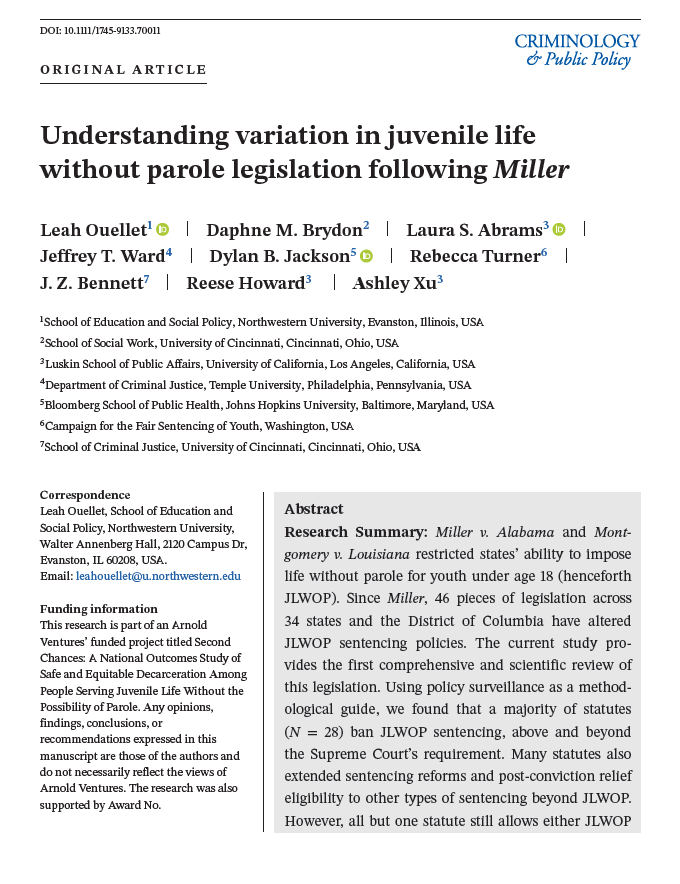


Miller v. Alabama and Montgomery v. Louisiana restricted states’ ability to impose life without parole for youth under age 18 (henceforth JLWOP). Since Miller, 46 pieces of legislation across 34 states and the District of Columbia have altered JLWOP sentencing policies. The current study provides the first comprehensive and scientific review of this legislation. Using policy surveillance as a methodological guide, we found that a majority of statutes (N = 28) ban JLWOP sentencing, above and beyond the Supreme Court's requirement. Many statutes also extended sentencing reforms and post-conviction relief eligibility to other types of sentencing beyond JLWOP. However, all but one statute still allows either JLWOP or life with parole as a sentencing option for minors convicted of homicide crimes and requires between 15 and 40 years, at minimum, to be served before being eligible for release. Grounding our analysis in institutional theory, we argue that the relative punitivity of the JLWOP reforms enacted was associated with measures of JLWOP institutionalization across states (i.e., pre-Miller JLWOP population and pre-Miller sentencing schema), suggesting that states where JLWOP was more routinely used were more resistant to policy reform.

Policy Implications

The current study provides implications for future decarceration efforts. Findings suggest that state legislatures are willing to enact post-conviction relief measures (e.g., judicial review or “second look” measures) for individuals convicted of violent crimes to address over-incarceration, deviating from previous decarceration efforts focused on non-violent, low-level offenses. In spite of the promising window for juvenile justice reform that Miller provided, however, these reforms have taken a relatively modest, incremental approach toward altering extreme youth sentencing practices in the United States. Policy makers and advocates seeking to promote sentencing reform efforts should factor in how highly institutionalized a sentencing practice is in each state, as this might inform effective strategies for policy change.
Thinking Through the ShotSpotter Debate

Robert VerBruggen Fellow

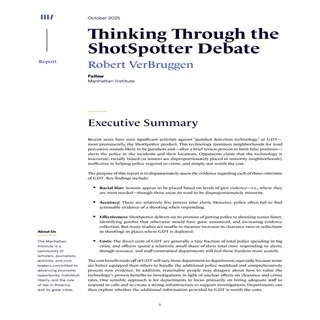
Recent years have seen significant activism against “gunshot detection technology,” or GDT— most prominently, the ShotSpotter product. This technology monitors neighborhoods for loud percussive sounds likely to be gunshots and—after a brief review process to limit false positives— alerts the police to the incidents and their locations. Opponents claim that the technology is inaccurate, racially biased (as sensors are disproportionately placed in minority neighborhoods), ineffective in helping police respond to crime, and simply not worth the cost. The purpose of this report is to dispassionately assess the evidence regarding each of these criticisms of GDT. Key findings include: • Racial bias: Sensors appear to be placed based on levels of gun violence—i.e., where they are most needed—though these areas do tend to be disproportionately minority. • Accuracy: There are relatively few proven false alerts. However, police often fail to find actionable evidence of a shooting when responding. • Effectiveness: ShotSpotter delivers on its promise of getting police to shooting scenes faster, identifying gunfire that otherwise would have gone unnoticed, and increasing evidence collection. But many studies are unable to measure increases in clearance rates or reductions in shootings in places where GDT is deployed. • Costs: The direct costs of GDT are generally a tiny fraction of total police spending in big cities, and officers spend a relatively small share of their total time responding to alerts, though resource- and staff-constrained departments will feel these burdens most acutely. The cost-benefit trade-off of GDT will vary from department to department, especially because some are better equipped than others to handle the additional police workload and comprehensively process new evidence. In addition, reasonable people may disagree about how to value the technology’s proven benefits to investigations in light of unclear effects on clearance and crime rates. One sensible approach is for departments to focus primarily on hiring adequate staff to respond to calls and to create a strong infrastructure to support investigations. Departments can then explore whether the additional information provided by GDT is worth the costs.

New York: Manhattan Institute 2025. 21p.